
Social Media Management Platforms vs a Managed Service: Which Fits Your Team

Choosing between social media management platforms and an outside agency is usually framed as a software question, but it is really a question about your team's hours. Social media management platforms give you the tools to plan, publish and report yourself, while a managed service gives you people who do it for you. With DataReportal's Digital 2025 India report counting 491 million social media user identities in India in January 2025, few businesses can afford to post inconsistently, so the real choice is how the work gets done. This guide compares a platform, a service and a hybrid of the two by team size and posting volume. If you want a second opinion on your current setup, talk to the Leadmetrics team.
Key Takeaways
- There are three models, not two: do it yourself on a platform, hand it to a managed service, or run a hybrid where AI drafts and a person reviews.
- Work out the hours per week at your real posting volume before you compare prices. Posting volume, not follower count, drives cost.
- Whichever model you pick, insist on an approval step and reporting that links social activity to enquiries, not only likes.
Platform, service or hybrid: what are the three models?
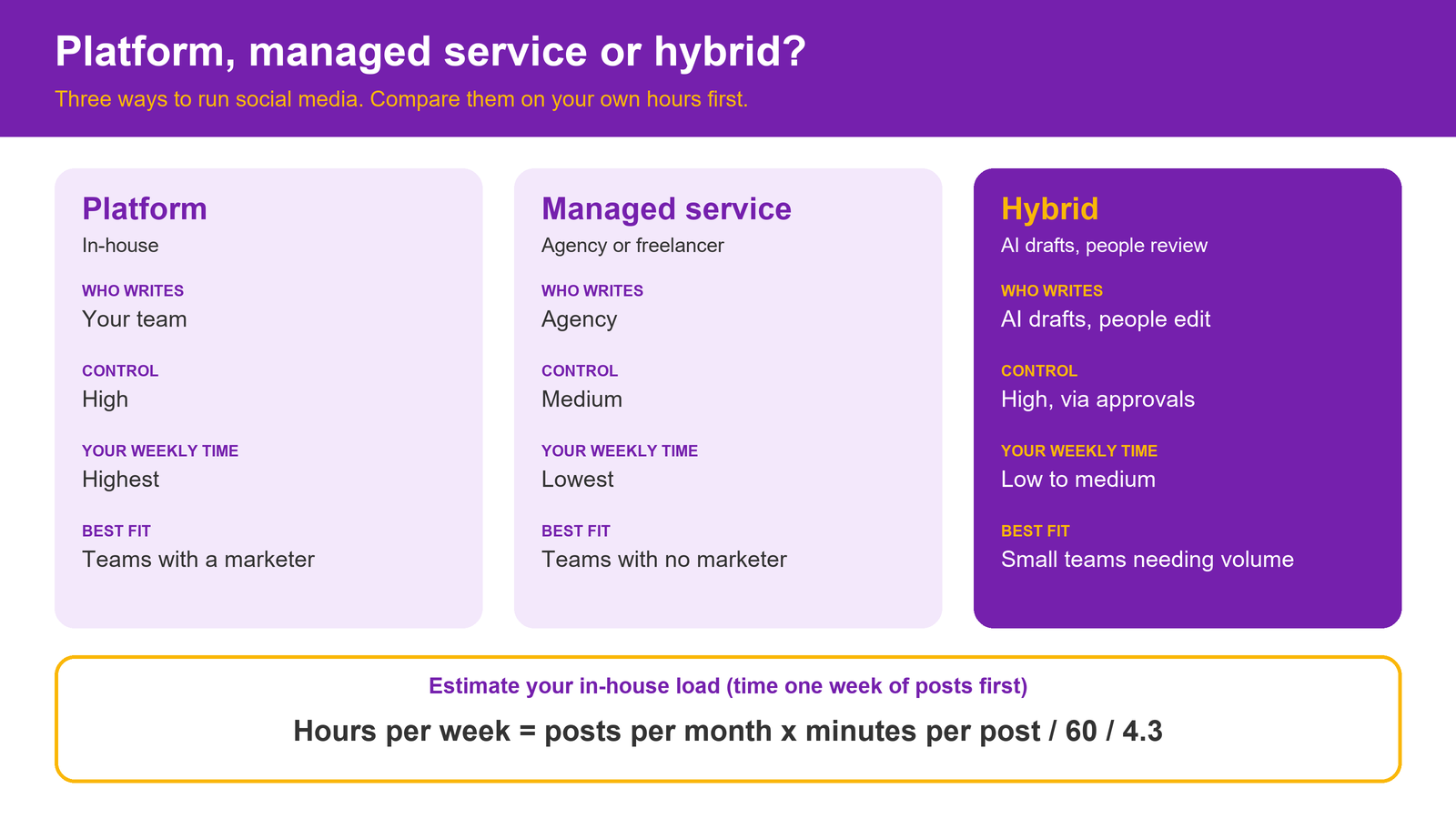
Model 1: Platform (in-house). You subscribe to a scheduling and management tool, and someone on your team writes, designs, schedules and replies. You keep full control and pay mainly in staff time. This suits businesses with a marketer who already knows the brand and has a few spare hours each week.
Model 2: Managed service. An agency or freelancer runs your accounts end to end, usually on a monthly retainer for a fixed number of posts. You trade control and speed of reaction for time saved. It works well when nobody in-house has the skills, but quality depends heavily on how well the agency understands your business.
Model 3: Hybrid. An AI platform produces the plan, drafts and creatives, and a person (your marketer, an agency or the platform's own experts) reviews before anything is published. This is the model behind AI social media management at Leadmetrics: the feature page describes AI that plans, creates, schedules and optimises posts across LinkedIn, Instagram, Facebook, X and Google Business Profile, with experts reviewing every campaign and the business approving before publishing.
| Platform | Managed service | Hybrid | |
|---|---|---|---|
| Who writes posts | Your team | Agency | AI drafts, people edit |
| Control over voice | High | Medium | High, via approvals |
| Your weekly time | Highest | Lowest | Low to medium |
| Speed on trending topics | Depends on staff | Depends on agency | Fast drafts, quick review |
| Best fit | Teams with a marketer | Teams with no marketer | Small teams that need volume |
How many hours a week do 12, 20 and 40 posts a month take?
Published benchmarks for small businesses in India and the UAE are thin, so the honest way to compare models is to time your own process. For reference, a Sprout Social survey of 500 social media marketers in the US and UK, reported by MarketingProfs, found that respondents spend on average 5 hours a week on content creation and approvals, 3.8 hours on data analysis and reporting and 3.6 hours on strategic planning. That is for full-time social marketers, before any community replies.
To estimate your own load, time one week of posts from idea to publish (idea, copy, creative, approval, scheduling), take the average minutes per post and use this formula:
Hours per week = posts per month x minutes per post / 60 / 4.3
The table below runs that formula for three scenarios. The minutes per post are assumptions to show how the maths scales, not benchmarks; replace them with your own timing.
| Posts per month | At 30 min per post | At 60 min per post | At 90 min per post |
|---|---|---|---|
| 12 | about 1.4 hrs/week | about 2.8 hrs/week | about 4.2 hrs/week |
| 20 | about 2.3 hrs/week | about 4.7 hrs/week | about 7 hrs/week |
| 40 | about 4.7 hrs/week | about 9.3 hrs/week | about 14 hrs/week |
Then add time for replies, DMs, reporting and planning, which the Sprout figures suggest can be as large as the posting work itself. Multiply the total by the hourly cost of whoever does it, and you have the real monthly cost of the in-house model to set against an agency retainer or a hybrid plan, in INR or AED.
What can social media automation tools automate, and what can they not?
Social media automation tools are good at repeatable, rules-based work. They are weaker at judgement, relationships and anything that depends on context only a person has.
| Usually safe to automate | Keep a human on it |
|---|---|
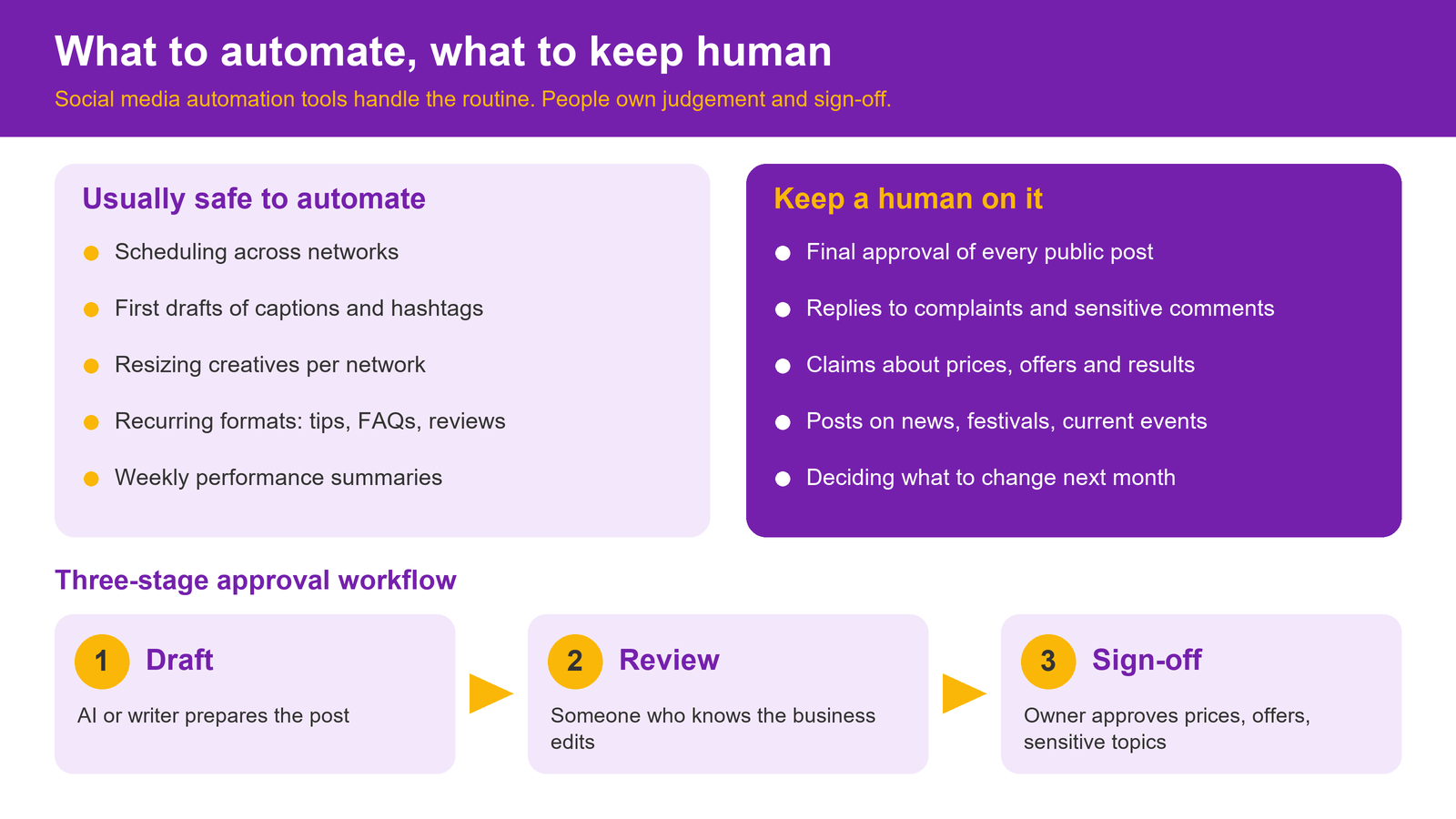
| Scheduling at set times across networks | Final approval of every public post |
| First drafts of captions and hashtag sets | Replies to complaints and sensitive comments |
| Resizing creatives for each network | Claims about prices, offers and results |
| Recurring post formats (tips, FAQs, reviews) | Posts on news, festivals and current events |
| Weekly performance summaries | Deciding what to change next month |
Drafting is where AI saves the most time, provided the input is good. Structured, prompt-led post ideas give the model a goal, audience, context and output format, so the first draft needs less rewriting. For copy you can adapt by network, our 25 marketing prompt templates include social and Google Business Profile examples.
Volume is the other gain. Generating captions and creatives at scale for several networks from one brief is now routine. For a deeper look at the campaign side, see our guide to automating social campaigns, which covers targeting and optimisation beyond the posting calendar.
How do approval workflows protect your brand?
Whichever model you choose, the most important control is a clear approval step before anything goes live. A good workflow has three stages: draft, review by someone who knows the business, and final sign-off by the owner or a named approver for sensitive topics. Posts that mention prices, offers, health claims or legal matters should always go to that final sign-off.
Disclosure rules matter too, especially if you work with creators. In India, the ASCI influencer advertising guidelines require disclosure whenever there is a material connection between an advertiser and an influencer, including free products, not just payment. The label must be upfront and prominent, using terms such as "Ad", "Sponsored" or "Collaboration", and should not be buried among hashtags.
In the UAE, the Media Council announced an Advertiser Permit in July 2025 for individuals who promote products or services on social media, whether the content is paid or not. The National's report on the UAE advertiser permit notes that people promoting their own business through a personal account are exempt, so check whether any creator or staff member posting for you needs one.
Finally, keep a short brand rulebook in your platform or agency brief: tone, banned words, competitor mentions, reply time targets and an escalation contact for negative comments. It is the cheapest brand safety measure available.
What reporting links social media to leads?
Likes and reach are useful signals, but they rarely persuade an owner to keep investing. Reporting should answer three questions: which posts drove website visits or messages, how many of those became enquiries, and what those enquiries cost compared with other channels.
To get there, tag every link with UTM parameters, count WhatsApp and DM enquiries as leads, and connect social data to the same place as your ad and CRM numbers. Our guide to connecting marketing data for small businesses walks through the order in which to join these sources.
When an organic post clearly outperforms the rest, it is often worth putting budget behind it. Boosting top posts as paid campaigns on Meta or LinkedIn lets you test a proven message with a wider audience. If Meta is your main paid channel, our piece on lowering Meta cost per lead explains how AI optimisation helps there.
Which model fits your team size? A decision table
Use this as a starting point, then adjust for your own hours and budget. In the UAE, where DataReportal's Digital 2025 UAE report counts 11.3 million social media user identities in January 2025, many businesses run several languages and networks, which pushes them toward higher volumes sooner.
| Team situation | Posts per month | Suggested model |
|---|---|---|
| Owner only, no marketer | 8 to 12 | Hybrid, or a managed service if budget allows |
| One marketer covering many channels | 12 to 20 | Hybrid: AI drafts, marketer reviews |
| Small marketing team (2 to 4) | 20 to 40 | Platform, with AI drafting for volume |
| Multi-location or multi-language brand | 40 or more | Hybrid with central approvals, or a service with clear SLAs |
| Regulated sector (health, finance, legal) | Any | Any model, but with mandatory expert sign-off |
Revisit the choice every six months, because the right model changes as you grow. A few signs that it is time to switch:
- Move from in-house to hybrid when posts are regularly skipped because the marketer is pulled into other work, or when drafting takes longer than reviewing.
- Move from a service to hybrid when you spend more time correcting the agency's drafts than you would spend writing them, or when replies to customers are slow because every answer has to go through the agency.
- Move from hybrid to a full service when you add networks or languages faster than your reviewer can keep up, and the approval queue becomes the bottleneck.
Whatever you switch to, keep your content calendar, brand rulebook and past performance data in a place you own, so the next team does not start from zero.
Conclusion
The platform versus service decision comes down to hours, skills and control. Time your real process, decide who must approve what, and make sure your reporting reaches all the way to enquiries. For most small teams in India and the UAE, a hybrid model gives the volume of automation with the judgement of a human reviewer.
To see how planning, drafting, expert review and approval work in one place, explore Leadmetrics social media marketing, or book a call with our team to map out the right model for your posting volume.
Share on Social Media
Frequently Asked Questions
What is a social media management platform?

What does a social media management service include?
Is a hybrid model cheaper than an agency?
What can social media automation tools not do well?
How many posts a month does a small business need?
Do businesses in India need to label sponsored social posts?
Do UAE businesses need an advertiser permit to post on social media?