
Meta Ads AI Optimization: Reducing Cost Per Lead

Meta Ads AI Optimization: Reducing Cost Per Lead
Cost per lead on Facebook and Instagram has climbed steadily as more advertisers compete for the same audiences. Manual campaign management struggles to keep pace, since Meta's auction reacts to thousands of signals every second. AI driven Meta Ads optimization adjusts targeting, creative, and budget continuously, catching efficiency gains a human team would never spot in time. This guide explains how AI optimized Meta campaigns actually lower cost per lead, how to structure campaigns so the algorithm learns quickly, and what to track once AI is managing the day to day decisions.
Key Takeaways
AI continuously tests audience segments, creative variants, and placements, shifting spend toward whichever combination is producing the lowest cost per qualified lead.
Campaigns with clear, accurate conversion signals let AI learn faster, often showing meaningful cost per lead improvements within the first 30 to 60 days.
Pairing Meta optimization with Google Ads optimization captures both paid social and paid search intent from the same buyer journey.
Why Meta Ads Cost Per Lead Keeps Rising Without AI
Meta's ad auction has grown more competitive every year, with more advertisers bidding for the same limited attention across Feed, Stories, and Reels. Manual campaigns that worked well two years ago often underperform today simply because the competitive landscape shifted while the targeting and creative strategy stayed static.
AI driven optimization responds to this shifting landscape automatically, reallocating budget the moment a segment or placement starts underperforming rather than waiting for a scheduled weekly review to catch the decline. Businesses that review client results consistently see lower cost per lead after switching to AI managed campaigns, largely because the algorithm catches inefficiencies within hours rather than the days or weeks a manual process typically takes.
Ad fatigue compounds the problem for manually managed campaigns. The same creative shown repeatedly to the same audience loses effectiveness over time, and a human team refreshing creative on a fixed monthly schedule often misses the exact point where performance starts declining. By the time a manual review catches the drop, the campaign has typically been overpaying for leads for days, a cost that compounds quickly across accounts spending significant budget every week. AI tracks engagement decay continuously, rotating in fresh variants before fatigue meaningfully impacts cost per lead.
Cross-platform competition adds another pressure manual campaigns struggle to account for. As advertisers shift budget between search, social, and other channels in response to performance, auction dynamics on Meta shift too, sometimes within the same day. A static bidding strategy set at the start of the month has no way to react to this kind of fluid, cross-channel competition the way an AI system monitoring auction conditions continuously can. AI driven visibility tracking across search and social together gives a fuller picture of where competitive pressure is actually building before it shows up as a sudden spike in cost per lead.
How AI Optimizes Meta Ad Targeting and Creative
Targeting starts broad and narrows based on actual conversion behaviour rather than assumptions made at campaign launch. AI tests audience segments in parallel, learning which combinations of interests, behaviours, and lookalike sources are producing leads at the lowest cost, then shifting budget toward those segments automatically as the data accumulates.
Creative optimization works similarly. Multiple image, video, and copy combinations run simultaneously, with the system serving winning variants more often as performance data builds. Tailored creative strategies built around specific audience segments give this testing process more useful variation to learn from than a single generic ad applied across every placement.
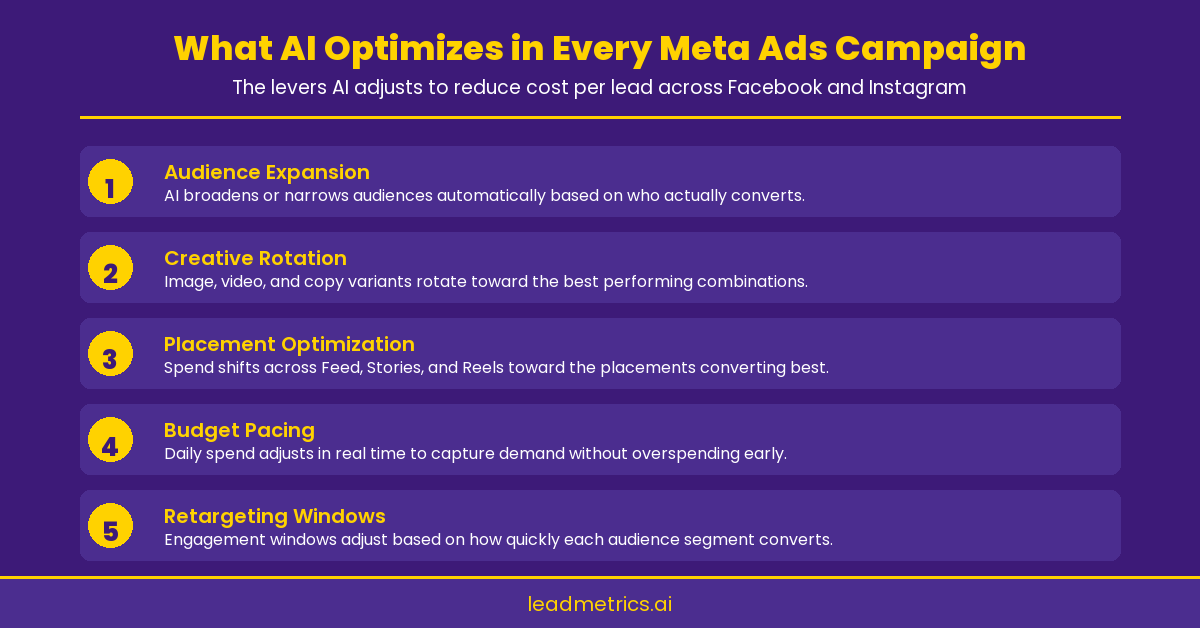
Placement optimization adds a further layer. Feed, Stories, and Reels each behave differently depending on the audience and offer, and AI shifts spend toward whichever placement is converting best for a given segment rather than splitting budget evenly across all placements by default.
Lookalike and interest based audiences continue to play a role even with AI managing optimization, but their function shifts from a fixed targeting decision to a starting input the algorithm refines continuously. A tailored audience strategy built around your actual customer data gives AI a stronger seed to expand from than a generic interest list copied from a competitor's campaign.
Structuring Meta Campaigns for AI to Learn Fast
AI needs a reasonable volume of conversion events to learn effectively. Campaigns split across too many ad sets, each receiving only a handful of conversions per week, give the algorithm too little signal to optimize confidently. Consolidating budget into fewer, well structured ad sets generally produces faster, more reliable optimization than spreading spend thin across dozens of micro-segments.
Conversion tracking accuracy matters just as much here as it does for any other paid channel. If the pixel is misconfigured or tracking the wrong event, AI will optimize toward that flawed signal with complete confidence, actively working against your actual business goals. Reviewing how comparable accounts structure their tracking before scaling spend helps avoid this costly mistake.
Creative volume also supports faster learning. Providing several genuinely different concepts, not just minor copy variations of the same image, gives AI more meaningful signal about what resonates with a given audience. A centralized platform that connects creative performance data with broader campaign reporting makes it easier to spot which concepts are actually driving the cost per lead improvements.
Landing page experience deserves the same attention here as it does on any other paid channel. Meta can deliver highly relevant traffic at a low cost, but if the destination page loads slowly or fails to match the promise made in the ad, conversion rate suffers regardless of how well the algorithm has optimized delivery. Reviewing client results often reveals that landing page improvements, not just campaign optimization, are responsible for a meaningful share of cost per lead gains.
Measuring Cost Per Lead Improvements Over Time
Daily fluctuations in cost per lead are normal and rarely worth reacting to once AI is managing optimization. A more useful approach tracks the metric on a rolling weekly or monthly basis, smoothing out short-term noise while still catching genuine trends in either direction.
Channel attribution remains essential. Meta Ads rarely operate in isolation from paid search and organic visibility, and understanding how these channels interact gives a more accurate picture of total efficiency than evaluating Meta performance in a vacuum. Compare Leadmetrics plans to see how a connected dashboard handles this kind of cross-channel reporting automatically.
Review cadence shifts from daily creative swaps to weekly or fortnightly strategic check-ins focused on whether conversion tracking still reflects genuine business value, whether new creative concepts are needed, and whether budget constraints are limiting how much efficient demand the algorithm can capture.
Benchmarking against comparable accounts provides useful context during this review. Reviewing how similar businesses have seen cost per lead trend after moving to AI managed Meta campaigns helps set realistic expectations, since results vary by industry, average order value, and how competitive a given audience segment has become.
Conclusion
AI optimized Meta Ads campaigns adapt to a competitive, fast-moving auction far better than static manual management. By consolidating campaigns into well structured ad sets with clean conversion signals and varied creative, businesses give AI what it needs to consistently lower cost per lead, whether that audience first discovers your brand through organic content or a paid placement. Explore Leadmetrics pricing plans to see how AI driven Meta Ads optimization fits your current budget, or get in touch to review your account structure.
Share on Social Media
Frequently Asked Questions
How does AI optimization reduce cost per lead on Meta Ads?

AI continuously tests audience segments, creative variants, and placements, shifting budget toward whichever combination produces the lowest cost per qualified lead, reacting far faster than manual review.
Why does Meta Ads cost per lead increase over time without AI?
Increased advertiser competition and creative fatigue both push cost per lead upward. Manual campaigns reviewed weekly often miss these shifts until they have already affected performance for days.
How long does it take to see cost per lead improvements with AI optimization?
Most accounts see meaningful improvement within 30 to 60 days, as the algorithm accumulates enough conversion data to optimize targeting and creative delivery with confidence.
Should I use fewer ad sets when AI is managing my Meta campaigns?
Yes. Consolidating budget into fewer, well structured ad sets gives AI more conversion volume per segment to learn from, generally producing faster and more reliable optimization than spreading spend thin.
Can AI fix a Meta Ads campaign with a weak landing page?
No. AI can deliver highly relevant traffic at a low cost, but a slow or mismatched landing page will still suppress conversion rate regardless of how well the campaign itself is optimized.
How many creative variations does AI need to optimize a Meta campaign effectively?
Several genuinely different creative concepts give AI more useful signal than minor variations of the same image or video. A handful of distinct concepts typically outperforms a single ad repeated with small tweaks.
How does AI handle Meta Ads placement optimization?
AI shifts spend across Feed, Stories, and Reels based on which placement is converting best for a specific audience segment, rather than splitting budget evenly across all placements by default.
How much does AI driven Meta Ads management cost?
Cost depends on ad spend and platform. Compare Leadmetrics pricing plans to see how a connected platform compares with managing Meta campaigns manually or through separate point solutions.
Does AI optimization work well alongside Google Ads campaigns?
Yes. Pairing Meta Ads optimization with Google Ads optimization captures both paid social and paid search intent from the same buyer journey, giving a fuller picture of total marketing efficiency.
How do I get started with AI optimized Meta Ads?
Review your current campaign structure and conversion tracking accuracy, then get in touch with the Leadmetrics team to discuss activating AI driven optimization for your account.