
Keyword Rank Checker or AI Visibility Tracker? What to Measure in 2027

A keyword rank checker tells you where your pages sit in Google for the terms you care about, and for twenty years that number has anchored most SEO reports. Going into 2027, it no longer tells the whole story: Ahrefs' February 2026 update found that the presence of an AI Overview correlated with a 58% lower average clickthrough rate for the top-ranking page, based on 300,000 keywords. You can hold position one and still lose most of the clicks it used to bring. This guide is written from the buyer's side: what to keep measuring, what only an AI visibility tracker can show, and a monthly report that combines both. If you want a second opinion on your current reporting, talk to the Leadmetrics team.
Key Takeaways
- Position data still matters for diagnosis, but it no longer predicts traffic on queries where an AI answer appears.
- An AI visibility tracker should record mentions, cited URLs, tone and share of answer per prompt, per platform and per market.
- The most useful monthly report puts rankings, AI visibility, local results and leads on one page, so nobody reads one number in isolation.
What does a classic rank checker measure, and what does it miss?
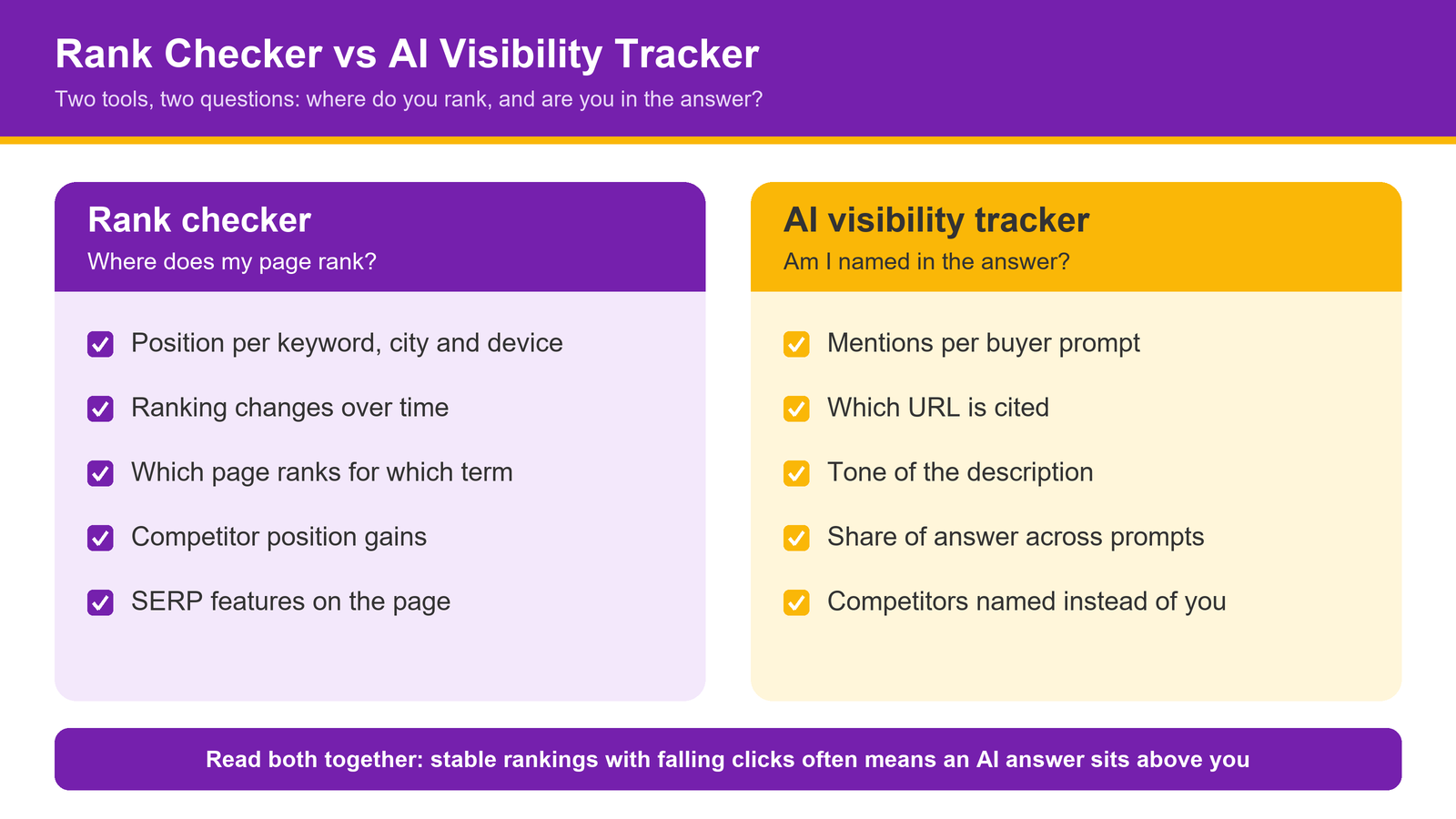
A classic seo ranking checker sends a query to a search engine, from a chosen location and device, and records which position your URL holds. Run that daily or weekly across a keyword list and you get trends: what moved up, what dropped, which page ranks for which term, and where competitors overtook you. That is still useful. A sudden drop across a page group is often the first sign of a technical problem or a lost backlink.
Google's own numbers follow the same logic. In the Search Console Performance report, average position is the topmost position your site held for a query, averaged across queries. Google's explanation of the report metrics adds a detail that matters now: an AI Overview occupies a single position in the results, and all links in it are assigned that same position. So a page cited inside an AI Overview can report a strong position while the user never scrolls to the blue links at all.
Here is what a position-only report misses:
- Whether an AI answer sits above you. Position 1 under an AI Overview behaves very differently from position 1 on a plain results page.
- Whether you are cited in that answer, and which URL was used.
- Answers outside Google. ChatGPT, Gemini and Copilot do not have positions at all.
- How you are described. A rank tells you nothing about whether an assistant calls you a specialist or a reseller.
None of this makes rank data obsolete. It makes it incomplete. The Leadmetrics AI-led rank and visibility tracking feature is built around exactly this split: it tracks keyword positions, ranking changes, SERP visibility and competitors, and adds AI Overview and AI citation monitoring in the same view.
Why do AI answers break position-based reporting?
Position-based reporting assumed one thing: a higher rank earns more clicks. AI answers weaken that link. When the question is answered on the results page, fewer people need to click anything, whatever your position.
Pew Research Center's analysis of browsing data from 900 US adults showed the scale. AI summaries appeared on 18% of the Google searches studied. Users clicked a traditional result in 8% of visits with a summary, against 15% without one, and clicked a link inside the summary itself in only about 1% of visits. These are US figures, but AI Overviews are shown to searchers in India too, so the direction is relevant here as well.
This produces a pattern you may already see in your own Search Console data: impressions hold steady or rise, rankings look stable, but clicks fall. Reporting rank alone in that situation makes the SEO work look healthy while enquiries drop. Reporting traffic alone makes it look broken while visibility may actually be growing in places the traffic data cannot see.
The fix is not to stop tracking positions. It is to add a second layer that measures presence inside the answer, and to read the two together. Google confirms that clicks and impressions from AI Overviews and AI Mode are counted in the Search Console Performance report under the Web search type, according to its page on AI features and your website. They are not broken out separately, which is another reason to track AI presence directly.
What signals should an AI visibility tracker capture?
An ai visibility tracker works from prompts, not keywords. You give it the questions your buyers actually ask, and it runs them on a schedule across the AI platforms you care about, then records what each answer says. When you compare tools, check whether they capture these signals:
| Signal | What it tells you | Why it matters |
|---|---|---|
| Mention | Did the answer name your brand? | The basic presence check |
| Citation | Which URL did the answer link or draw from? | Shows which pages are doing the work |
| Tone | Positive, neutral or negative description | A mention can still hurt you |
| Share of answer | How often you appear across all tracked prompts | The closest thing to a "rank" in AI search |
| Competitors named | Who appears when you do not | Shows where the next gain is |
| Market | Which country the prompt was run for | India and UAE answers often differ |
Two less obvious checks separate useful trackers from basic ones. First, does the tool separate answers built from a live web search from answers given from the model's training memory? Leadmetrics' AEO portal records this as grounded versus ungrounded, because only grounded answers move when your pages change. Second, does it keep a history of how the assistant describes you, so you can see the description shift as you update content?
Prompt design matters as much as the tool. Mix category prompts ("best physiotherapy clinic in Kochi"), problem prompts ("how to fix a leaking terrace before monsoon"), and comparison prompts ("in-house accountant or outsourced bookkeeping for a small firm"). Twenty to forty well-chosen prompts per market is a practical start for most service businesses. Once you can see which prompts leave you out, you can improve how AI engines describe you with targeted fixes, and our guide to getting your service pages cited in AI answers covers the page-level work.
How do map pack, organic and AI results differ for local rankings?
Local businesses face three separate result types for the same search. The map pack shows Business Profiles. The organic results show websites. AI answers increasingly summarise both. A single rank number cannot describe all three, so track them separately.
| Result type | What decides it | What to track |
|---|---|---|
| Map pack | Business Profile relevance, distance and prominence | Position by grid point or area, plus calls and direction requests |
| Organic | Website relevance, quality and links | Position by keyword and city |
| AI answer | Sources the assistant retrieves, including profiles and reviews | Mention, citation and tone per local prompt |
Google's help page on how local results are ranked names relevance, distance and prominence as the main factors, with prominence supported by signals such as links and review count. Distance is why a map pack rank from one pin location means little for a business serving a whole city. Track from several points across your service area, or by neighbourhood.
For multi-branch businesses, report per location rather than as one blended number. Leadmetrics offers map pack tracking for local listings with local rank tracking and competitor analysis, alongside the profile metrics that matter more than rank: calls, direction requests and profile views. If you run many branches, our note on managing many GBP locations covers the operational side.
What should a combined monthly report template include?
The best monthly report fits on one page and answers three questions: are we visible, are we being chosen, and is it producing leads? Here is a template that works for most service businesses and agencies in India and the UAE.
Section 1: Search positions. Top 20 keywords with current position, change since last month, and a flag for whether an AI Overview appears on that results page. Group by service line rather than listing hundreds of terms.
Section 2: AI visibility. Share of answer across your prompt set, per platform and per market. List the prompts where a competitor appears and you do not. Note any change in how assistants describe you.
Section 3: Local results. Map pack position by area for your top five local terms, plus calls, direction requests and profile views per location.
Section 4: Outcomes. Organic sessions, enquiries and leads by source, compared with last month. This is the section that keeps the other three honest.
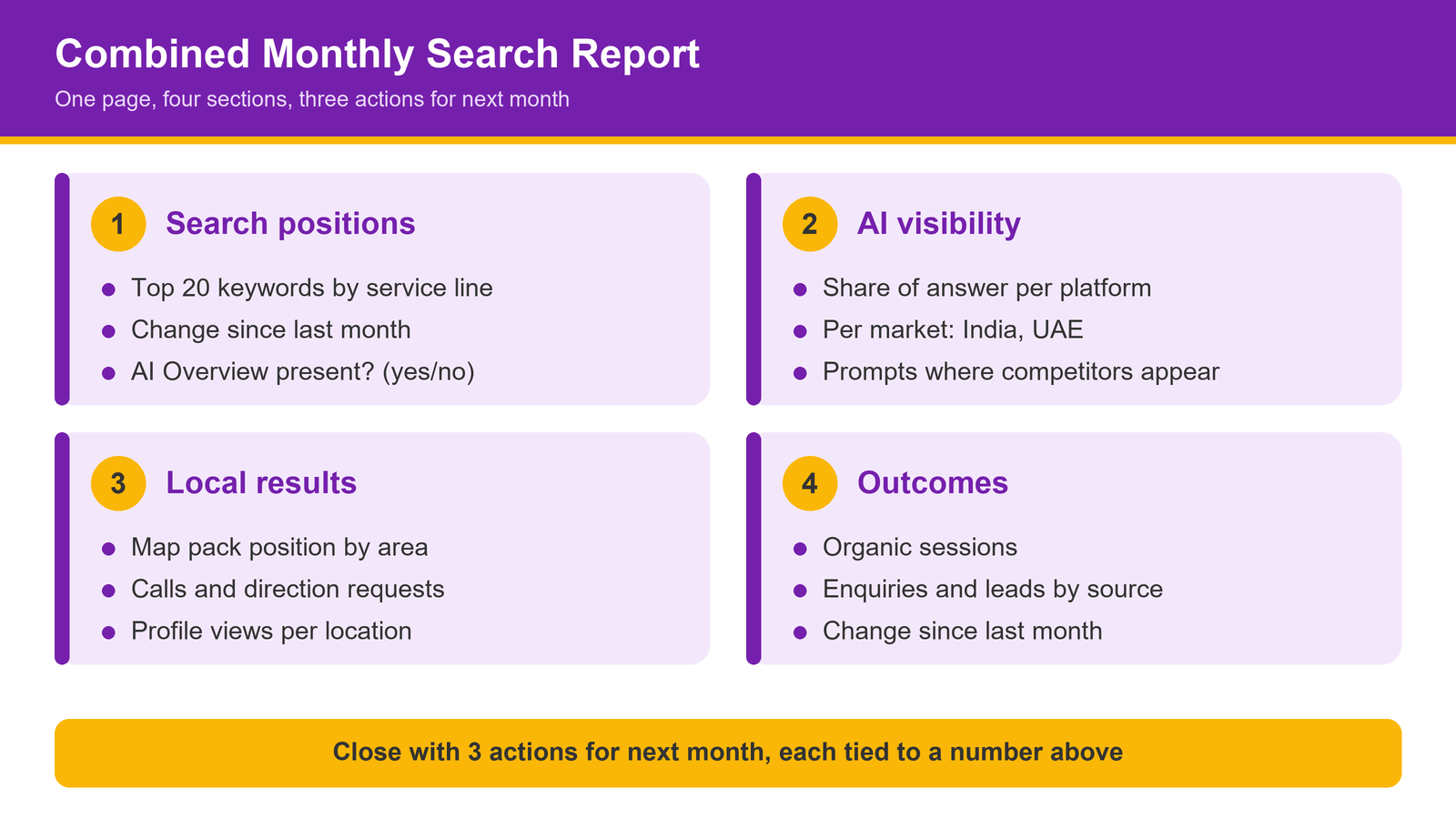
Close the report with three actions for next month, each tied to a number above. If the report cannot produce three actions, it is measuring the wrong things. Much of the data collection can be automated: an automated SEO workflow that monitors rankings, technical issues and AI search together saves hours of spreadsheet work each month.
What should you ask before you buy a tracker?
Most trackers look similar in a demo. The differences show up after three months of use. Before you commit, ask these questions and get the answers in writing:
- Which AI platforms does it track, and in which markets? A tool that only checks US results will not reflect what buyers in Chennai or Abu Dhabi see.
- Does it track both Google positions and AI answers in one place, or will you be merging two exports every month?
- How are prompts chosen and how many are included? Ask whether you can add your own.
- Does it record citations and tone, or just mentions?
- How often does it check? Daily rank checks and monthly AI checks serve different purposes.
- Can it report per location for multi-branch businesses?
- Who acts on the data? A tracker alone shows problems. Check whether recommendations come with it and who reviews them.
That last question matters most if you are deciding between a tool and a broader seo automation tool or managed service. Our guide on evaluating an SEO management platform covers that wider decision, including how to compare platforms with traditional seo services.
Conclusion
Rankings still matter, but in 2027 they describe only part of your search visibility. Keep tracking positions for diagnosis, add an AI visibility layer for presence inside answers, track local results separately, and tie all of it to leads in one monthly report. That combination tells you what is working, which no single number can.
To see positions, AI Overviews and AI citations side by side, explore Leadmetrics keyword and AI visibility tracking, or book a short walkthrough with our team to review your current report.
Share on Social Media
Frequently Asked Questions
Is a keyword rank checker still worth paying for in 2027?

What is the difference between a rank tracker and an AI visibility tracker?
Does Google Search Console show AI Overview performance?
How often should I check AI visibility?
Why do my rankings look stable while clicks are falling?
Do I need separate tracking for the map pack?
How many prompts should an AI visibility tracker monitor?