
Google Business Profile Software for Multiple Locations

Managing one Google Business Profile is a task. Managing thirty is a system problem, and that is where Google Business Profile management software earns its place. Bulk editing, permission control, review routing and consolidated reporting become necessary rather than convenient. This article covers what changes at scale, which capabilities matter for multi location businesses, and how to evaluate the options sensibly.
Key Takeaways
- Single profile habits break somewhere around ten locations, usually through inconsistent information rather than neglect.
- Bulk operations, permission granularity and review routing are the three capabilities that matter most at scale.
- Judge on consistency and response time across locations, not on the total number of posts published.
What Changes When You Pass Ten Locations
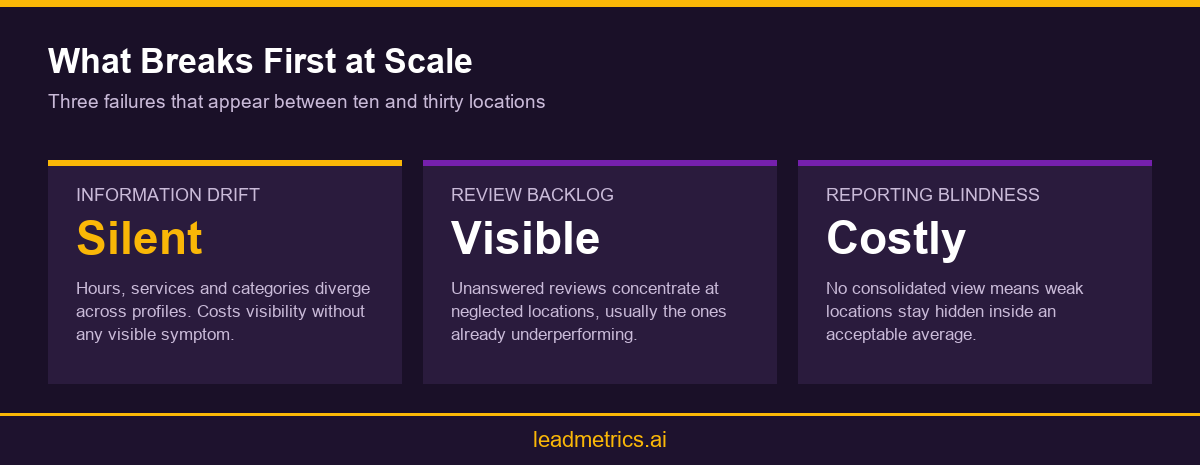
The failure mode at scale is rarely neglect. It is drift. One location updates its hours for a holiday and the others do not. A new service is added to three profiles and forgotten on the rest. Categories chosen by whoever set up each profile differ slightly, which quietly affects which searches each location appears for.
That inconsistency costs visibility and trust simultaneously. Google rewards accurate, complete and consistent information, and customers who find contradictory details across locations reasonably conclude the business is disorganised. Neither consequence announces itself, which is why multi location problems usually surface during an audit rather than through a complaint.
Review response is the second thing that breaks. A single owner can watch one profile. Nobody watches thirty without a system, and unanswered reviews accumulate at exactly the locations receiving least attention, which are frequently the ones already underperforming. The fundamentals of profile optimisation are covered in this guide to profile optimisation, and they remain the same at scale. Only the execution changes.
Scale introduces a governance question that single profile management never raises. Somebody must own the standard: which categories each location type uses, how descriptions are worded, what photographs are required, and how quickly reviews are answered. Software enforces a standard efficiently and cannot invent one, so the policy work has to happen first or the tool simply distributes inconsistency faster.
Local autonomy is the counterweight to consider. Location managers usually know their market better than head office does, and systems that centralise every decision tend to produce accurate profiles that feel generic. The workable balance is central control of structural fields, with local freedom over posts, photographs and review responses.
The Three Capabilities That Matter
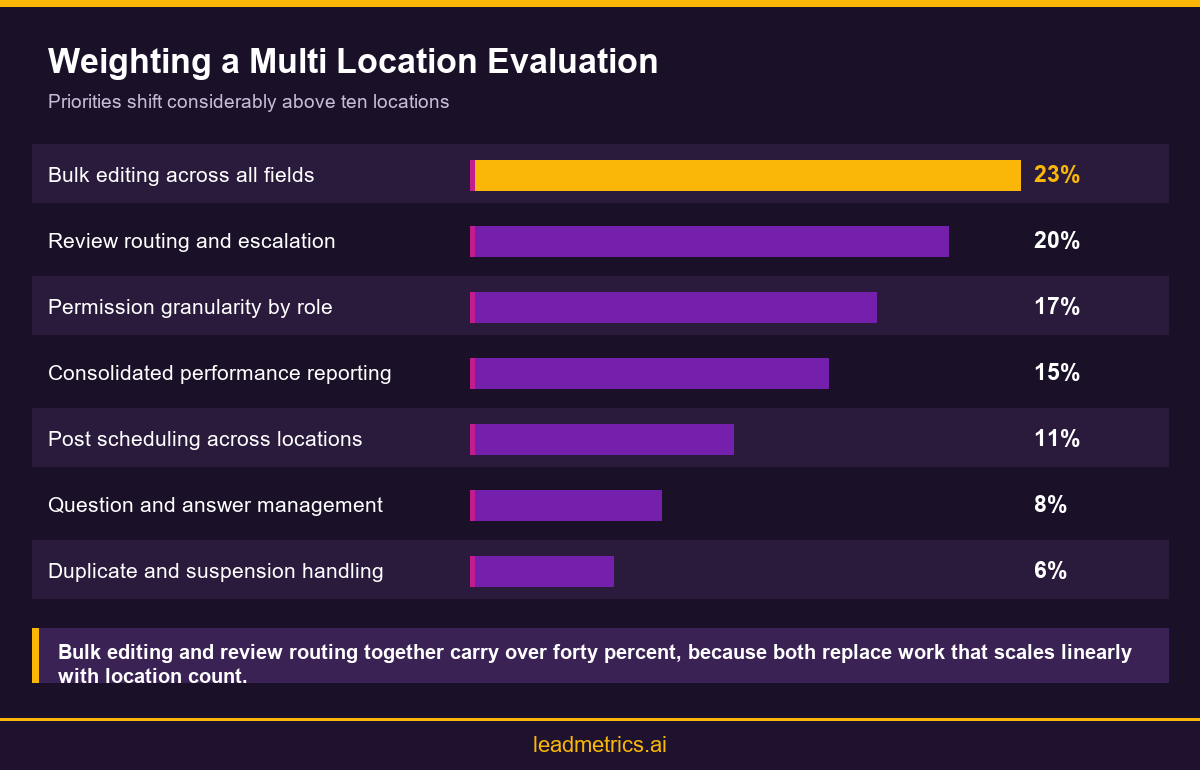
Bulk operations come first. Updating hours, services, attributes or descriptions across many profiles in one action is the difference between a fifteen minute task and a two day one. Check whether bulk editing covers every field you actually change, since many products support bulk updates for some attributes and not others, and the gaps are rarely documented prominently.
Permission granularity comes second. Multi location businesses usually want location managers able to respond to reviews and post updates, without being able to change categories, names or addresses. Products designed around single businesses frequently offer one administrator role, which forces you to choose between bottlenecking everything centrally or giving everyone full control.
Review routing comes third. Reviews should reach the person responsible for that location quickly, with escalation when negative feedback appears or when a response is overdue. Without routing, review management becomes one person's full time job, which is precisely the cost the software was meant to remove.
A fourth capability becomes valuable past roughly fifty locations: templating by location type. A business running flagship stores, standard branches and service points needs different defaults for each, and applying one template across all three produces profiles that are consistent and wrong. Ask whether templates can be grouped rather than applied globally.
Audit trails matter at scale too. When a profile's information changes, you need to know who changed it and when, particularly where several people hold editing rights. Without that record, diagnosing an unexplained ranking drop becomes guesswork, and the investigation usually costs more time than the original error did.
Reporting That Exposes Weak Locations
Averages hide problems in multi location businesses. A portfolio where most locations perform adequately and four perform badly will look acceptable in aggregate, and those four will keep underperforming until somebody looks at them individually. Reporting that only presents totals actively conceals the thing you most need to see.
Insist on per location breakdowns with comparison against the portfolio, so outliers surface automatically rather than through manual inspection. Calls, direction requests, website clicks, review velocity and average rating should all be visible by location and over time, because a location declining slowly is harder to notice and easier to fix early.
Then connect that to outcomes. Profile activity is a leading indicator, not a result. The locations worth investigating are those where visibility is reasonable and enquiries are not converting, since that pattern usually indicates a local operational issue rather than a marketing one, and no amount of profile optimisation will correct it.
Benchmarking within the portfolio is more useful than benchmarking against industry averages. Your own locations share an offer, a brand and broadly similar operations, which makes differences between them genuinely informative. A location receiving half the direction requests of comparable siblings has a specific problem worth investigating rather than a general one worth accepting.
Track review velocity alongside rating as well. A location holding a strong average while receiving almost no new reviews is gradually becoming less visible, because recency contributes to how reviews are weighted. That decline is invisible if you only monitor the average score, which is what most reporting defaults to showing.
Evaluating the Options
Test with your real portfolio rather than a demonstration account. Connect at least ten profiles during the trial, including any with unusual configurations such as service area businesses or locations sharing an address. Edge cases are where these products differ, and clean demonstration data hides exactly those differences.
Ask specifically about suspension and duplicate handling. Profiles get suspended, duplicates appear, and ownership disputes occur at multi location scale with predictable regularity. A product that surfaces these promptly and guides resolution saves considerable time, while one that simply reports an error leaves the work with you.
Confirm API access and export as well. Your location data, reviews and historical performance should be retrievable in full. Google's own Business Profile help documentation remains the authoritative reference for what is possible at the platform level, and any vendor claiming capabilities beyond it deserves a follow up question.
Finally, plan the onboarding sequence deliberately. Connecting fifty profiles at once and discovering inconsistencies across all of them simultaneously is demoralising and hard to prioritise. Connecting ten, establishing the standard, correcting those, then expanding in batches produces a cleaner result and gives your team a working process before volume arrives.
Conclusion
Managing profiles at scale is a consistency problem before it is a marketing one. Prioritise bulk editing that covers every field you change, review routing that reaches the right person quickly, and permissions that let location managers act without risking core data. Then insist on per location reporting, because averages conceal exactly the locations that need attention. Speak to the Leadmetrics team about managing multiple profiles from one place.
Share on Social Media
Frequently Asked Questions
At how many locations does software become necessary?

What breaks first at scale?
Why does permission granularity matter?
How quickly should reviews be answered?
What reporting should I require?
Do these tools handle suspensions?
Can I export my location data?
How does this connect to wider local marketing?