
Answer Engine Optimization: How Service Businesses Get Cited in ChatGPT, Gemini and AI Overviews

Answer engine optimization is the work of making your business the source that ChatGPT, Gemini, Copilot and Google's AI Overviews draw on and name when a buyer asks them a question. For service businesses in India and the UAE, it matters because fewer buyers now click through: Pew Research Center found that Google users clicked a traditional result in 8% of visits when an AI summary appeared, against 15% when it did not. If the answer already names three firms, the firms it leaves out rarely get a second look. This guide skips the theory and gives you a page-by-page playbook, built around the questions your buyers actually type into AI assistants. If you would rather work through it with specialists, you can speak with the Leadmetrics team about your own pages and prompts.
Key Takeaways
- AI assistants cite pages that state facts plainly, agree with your Google Business Profile, directories and reviews, and can be crawled by the search bots behind each assistant.
- Five page types carry most of the citation weight for local and B2B services: service pages, FAQ pages, location pages, your Business Profile, and third-party listings with reviews.
- Track a fixed set of buyer prompts every month, per market, and record whether you are mentioned, cited, or missing.
What does an answer engine actually read before it cites you?
An answer engine does not "rank" your page like a list of blue links. It retrieves a handful of relevant pages or passages and writes an answer from them. Your job is to be in that handful and easy to quote, and since retrieval often runs on a normal search index, crawlability still comes first.
Google is direct about this. Its guidance on AI features and your website says there are no additional requirements to appear in AI Overviews or AI Mode, and no special schema to add. A page has to be indexed and eligible to show with a snippet. Google also asks that structured data match the visible text, and that Business Profile information stays current. ChatGPT works on a similar principle: OpenAI's crawler documentation explains that OAI-SearchBot is used to surface websites in ChatGPT's search features, so a robots.txt rule that blocks it also keeps you out of those results.
What changes is the shape of the content that gets picked. Answer engines prefer flat, declarative statements, such as a Kochi accounting firm writing: "We handle GST registration for sole proprietors in Kochi and file the application once your documents are verified." They struggle with brochure copy like "Your trusted partner for all compliance needs." The first sentence answers a question. The second answers nothing.
So before you write anything new, check three basics on your most important pages:
- Access: robots.txt and your CDN allow Googlebot, Bingbot and OAI-SearchBot, and the pages are indexed.
- Text, not images: prices, service areas, timelines and credentials sit in HTML text, not inside banners or PDFs.
- Consistency: the business name, address, phone and service list match your Business Profile word for word.
If those foundations are weak, fix them first. The Leadmetrics AI answer visibility for your brand service starts the same way: it maps which prompts cite you and which pages those platforms draw from, before recommending changes.
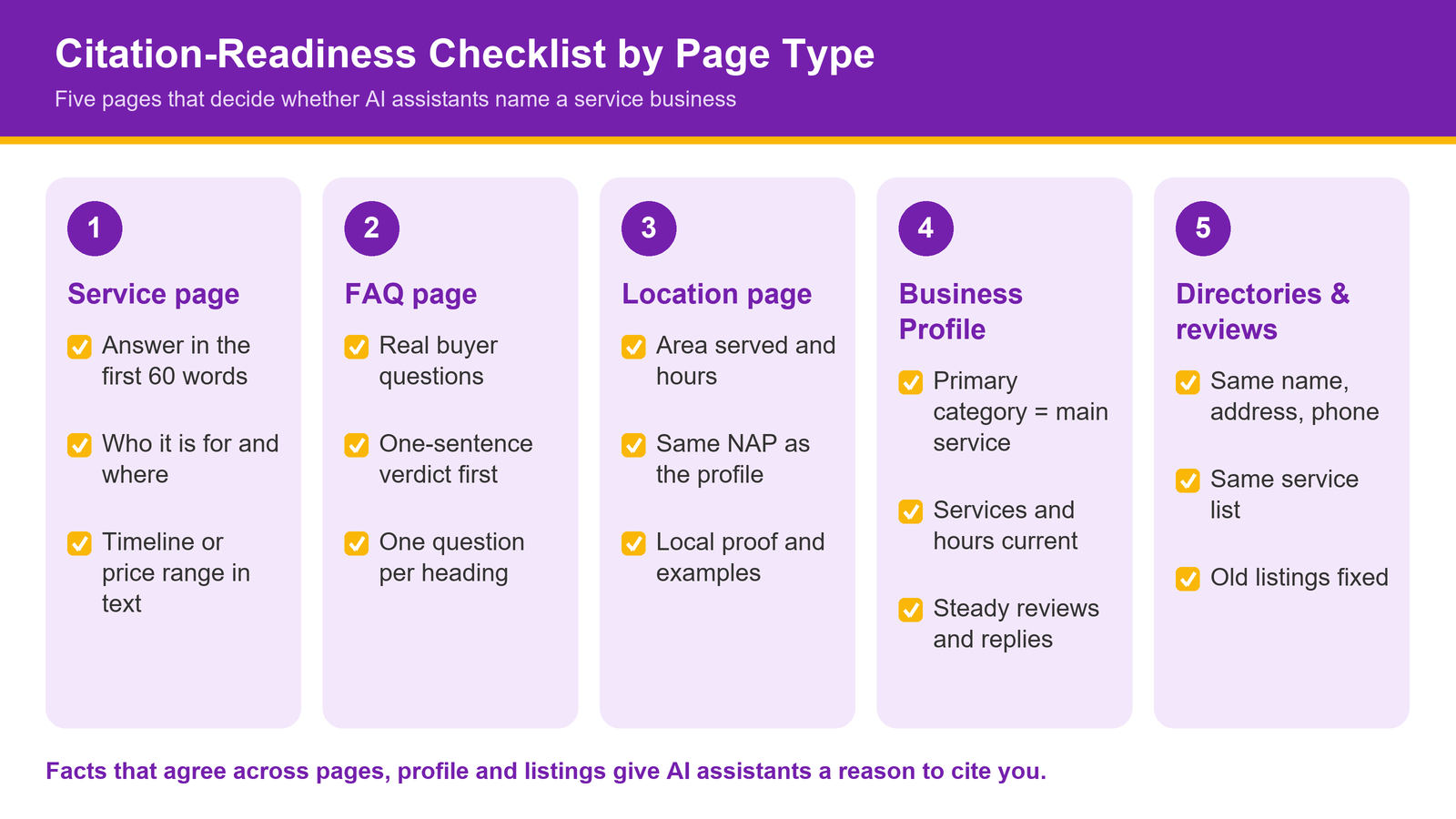
Which 5 page types get cited most often for local and B2B services?
You do not need to rewrite your whole site. For a clinic, a law firm or a logistics company, a small set of page types carries most of the citation weight. Treat each one as its own checklist.
| Page type | What the assistant looks for | Citation-ready when |
|---|---|---|
| Service page | Who it is for, what is included, where, how long, starting price or range | The first 60 words answer "what is it and who is it for" |
| FAQ page | Direct answers to the exact questions buyers ask | Each answer opens with a one-sentence verdict |
| Location page | Area served, address, hours, local proof | Matches the Business Profile and directories exactly |
| Google Business Profile | Category, services, hours, reviews, photos | Primary category matches the main service |
| Directories and review sites | Independent confirmation of the same facts | Same name, address, phone and services everywhere |
Service pages are where most businesses lose. They describe the firm instead of the service. Rewrite the top of each one so a stranger could repeat it accurately: the service, the buyer it suits, the city or emirate, the typical timeline, and any qualification or licence that matters.
FAQ pages work because they already match how people prompt assistants. Pull the questions from your sales calls, WhatsApp enquiries and Google Search Console queries, not from a generic list. "Do I need a trade licence to freelance in Dubai?" beats "Why choose us?" every time.
Location pages, your Business Profile and third-party listings act as corroboration. When an assistant sees the same facts on your site, on Google Maps and on two or three trusted directories, it has more reason to state them with confidence. That is the core of ai search optimization for a local firm: fewer, clearer facts repeated consistently.
How do you write answer-first content with a 40-60 word answer block?
The single most useful writing habit for AI citation is the answer block: a short paragraph of roughly 40 to 60 words placed directly under a question-style heading. It answers the question completely, in plain language, before the page explains anything else. Assistants can lift it whole, and human readers get their answer without scrolling.
A good answer block has three parts. Open with the direct answer. Add one qualifying detail, such as a condition, a range or a location. Close with the next step or the main exception. For example, a Bengaluru dental clinic might write (with its own figures): "Our implant treatment usually takes [your typical range] from consultation to final crown. The gap allows the implant to fuse with the jawbone. Patients with low bone density may need a bone graft first, which adds time."
There is research behind adding evidence to these blocks. The GEO study by Aggarwal and colleagues, accepted at KDD 2024, tested ways of changing content for generative engines and reported that the methods can boost visibility by up to 40% in generative engine responses. Methods that added citations, quotations and statistics were among the strongest. In practice, that means naming your sources, quoting a qualified person on staff, and giving real numbers you can stand behind.
Keep one question per heading, use the buyer's own words ("cost", not "investment"), and put tables, steps and exceptions after the block. Writing this way at scale is where AI drafting helps. Leadmetrics' answer-first content drafts are built around search intent, schema and internal linking, and specialist editors review them for accuracy and tone before anything is published. For a wider list of on-page tactics, see these GEO tactics for AI search.
Do your schema, GBP, directories and reviews agree with each other?
Entity signals are the facts about your business that exist beyond any single page: name, category, address, phone, services, licences and reviews. An answer engine is more willing to name you when these facts agree everywhere it looks.
Start with your Google Business Profile, because Google uses it heavily for local results. Google's own help page on how local ranking works names three factors: relevance, distance and prominence, with prominence supported by signals such as links from other websites and review count. The same profile also feeds what AI Overviews can say about you, so the primary category, services list and hours need to be exact.
Next, add structured data that mirrors what the page says. Google's LocalBusiness structured data guide covers the properties for name, address, opening hours and more. Schema does not earn citations on its own, as Google states for AI features, but it removes ambiguity when the visible text and the markup say the same thing.
Then audit your listings in this order: Google Business Profile and Bing Places, the two or three directories that rank for your service in your city, industry bodies or licensing registers, and the review platforms your buyers use. Fix name variations, old phone numbers and outdated service lists as you go. This is unglamorous work, but it is the part most ai seo services skip, and it is often why a well-written site still does not get named. A crawl-and-audit layer helps here: Leadmetrics' technical SEO foundations monitor 100+ SEO signals and flag technical and content issues before they cost visibility.
How do AEO and GEO differ in practice?
You will see both terms in proposals from any ai seo agency, often used as if they were the same thing. They overlap heavily, and the Leadmetrics feature page describes them as the same goal from two angles. The table below shows where the day-to-day work differs.
| AEO focus | GEO focus | |
|---|---|---|
| Main question | Will an assistant quote this page as the answer? | Is the brand visible and described correctly across generative systems? |
| Unit of work | A single question and its answer block | The brand as an entity across many prompts |
| Typical tasks | FAQ blocks, answer-first service pages, snippet eligibility | Entity consistency, third-party mentions, brand narrative, competitor gaps |
| Where you see it | AI Overviews, featured answers, assistant answers to specific questions | Recommendations and comparisons in ChatGPT, Gemini and Copilot |
| Best first fix | Rewrite the top of your top 10 service pages | Align GBP, directories and review profiles |
For a small service business, do both, in that order. Answer blocks are faster to ship and measure. Entity work compounds slowly, but it decides whether you appear when someone asks "best visa consultant in Abu Dhabi".
If you are building the workflow internally, automate the repetitive parts: crawling, prompt runs, change logs. Our piece on autonomous SEO workflows covers how agent-based tools handle that layer, with humans approving changes.
Which prompts should you track every month to measure citations?
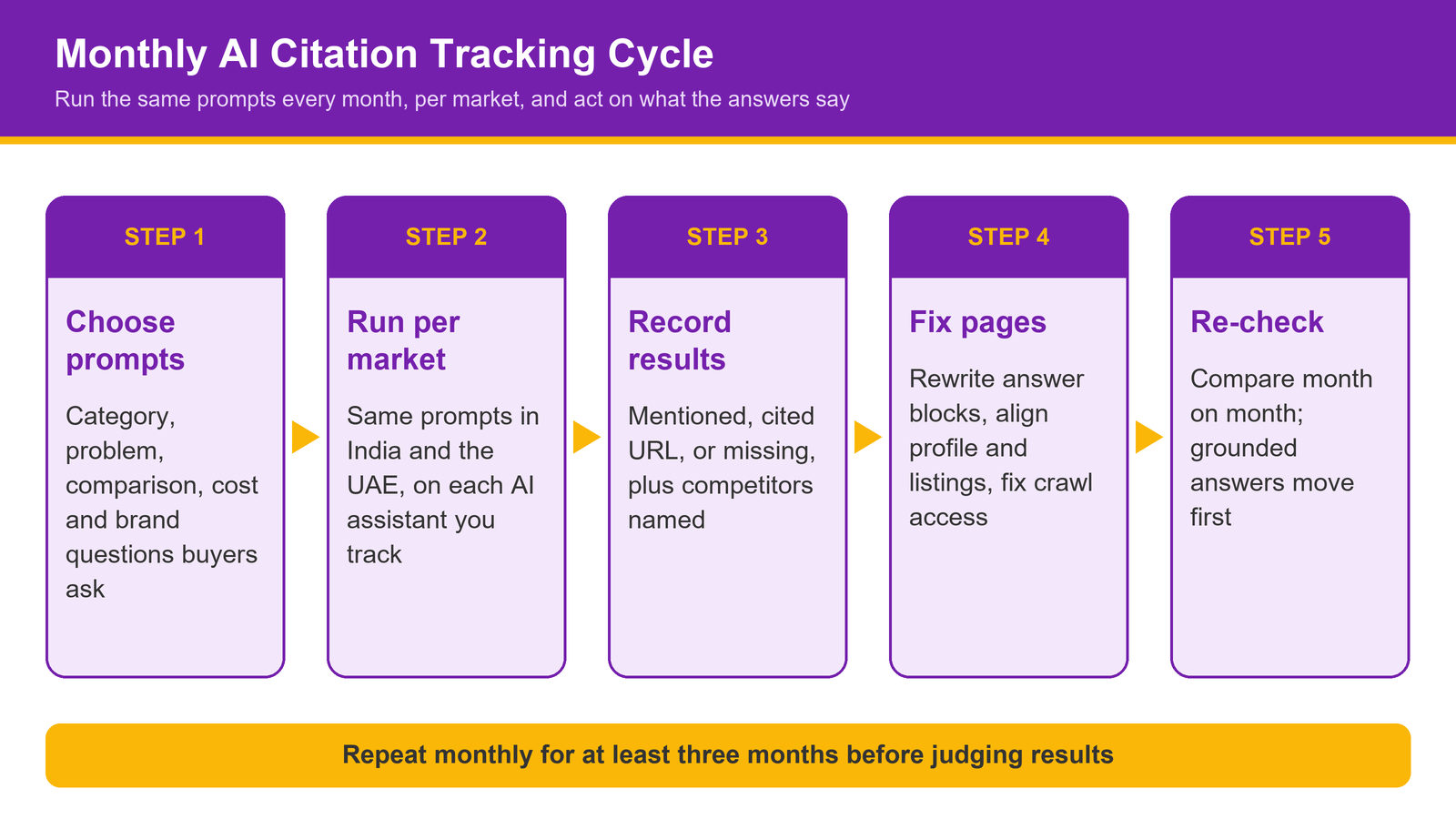
You cannot improve what you do not measure, and classic rank reports do not measure this. An AI answer has no page two. What you need instead is a fixed prompt set, run on a schedule, with a record of whether each answer mentions you, cites one of your URLs, or leaves you out.
Build the prompt set from five groups:
- Category prompts: "best chartered accountant for startups in Bengaluru"
- Problem prompts: "how do I recover a blocked Emirates ID payment"
- Comparison prompts: "in-house team or outsourced payroll for a 20-person company"
- Cost prompts: "how much does commercial interior fit-out cost in Dubai per square foot"
- Brand prompts: "is [your firm] good for corporate tax registration"
Run each prompt per market, because answers differ between India and the UAE. Record the platform, date, whether you were mentioned, which URL was cited, and which competitors appeared.
Then read the answers, not just the scores. If an assistant describes you as "a payroll software company" when you are a payroll service, that is a content problem you can fix. Leadmetrics can track where AI answers mention you, combining keyword position tracking with AI visibility monitoring across Google AI Overviews and conversational search.
On the Leadmetrics AEO side, the portal reports a GEO Score from 0 to 100 averaged over a rolling 14 days, a Brand Narrative showing how assistants describe you, and a Competitor Gap count of answers that name a competitor and not you. It also records whether each answer came from a live web retrieval or the model's training memory. That distinction matters: grounded answers move when your pages change, while ungrounded ones move only with time and reputation.
Conclusion
Getting cited by AI assistants is not a trick and not separate from good search work. It is clear, checkable content on the pages buyers care about, facts that agree across your site, Business Profile and listings, and a monthly habit of checking what assistants actually say.
Start with your top ten service pages and your Google Business Profile, set up a prompt list, and measure for three months before judging results. To see where your brand stands today, explore how Leadmetrics improves your visibility in AI answers, or book a short demo with our specialists to review your prompts and pages together.
Share on Social Media
Frequently Asked Questions
How long does it take to get cited in ChatGPT or AI Overviews?

Do I need special schema markup to appear in AI Overviews?
Is generative engine optimization different from SEO?
Can a small local business compete with large brands in AI answers?
Should I block AI crawlers from my website?
What should I look for when hiring for AI search work?
How many prompts should a service business track?