
Agentic AI for SEO: How Autonomous Optimisation Works

Most SEO tools advise. An agentic AI for SEO optimization tool acts. That distinction sounds like marketing language and turns out to be operationally enormous, because a system that executes changes needs guardrails, audit trails and a clear view of what it may do unsupervised. This guide explains how autonomous optimisation actually works, what it can safely handle alone, where it fails, and how to measure something that changes your site while you sleep.
Key Takeaways
- Assistive tools produce recommendations that queue up unactioned. Agentic systems execute, which is the entire value and the entire risk.
- Autonomy should be graduated. Start with reversible, low risk changes and widen scope as the audit trail earns trust.
- Measure leading indicators such as issues resolved and time to fix, because ranking movement lags execution by months.
Assistive Versus Agentic, Operationally
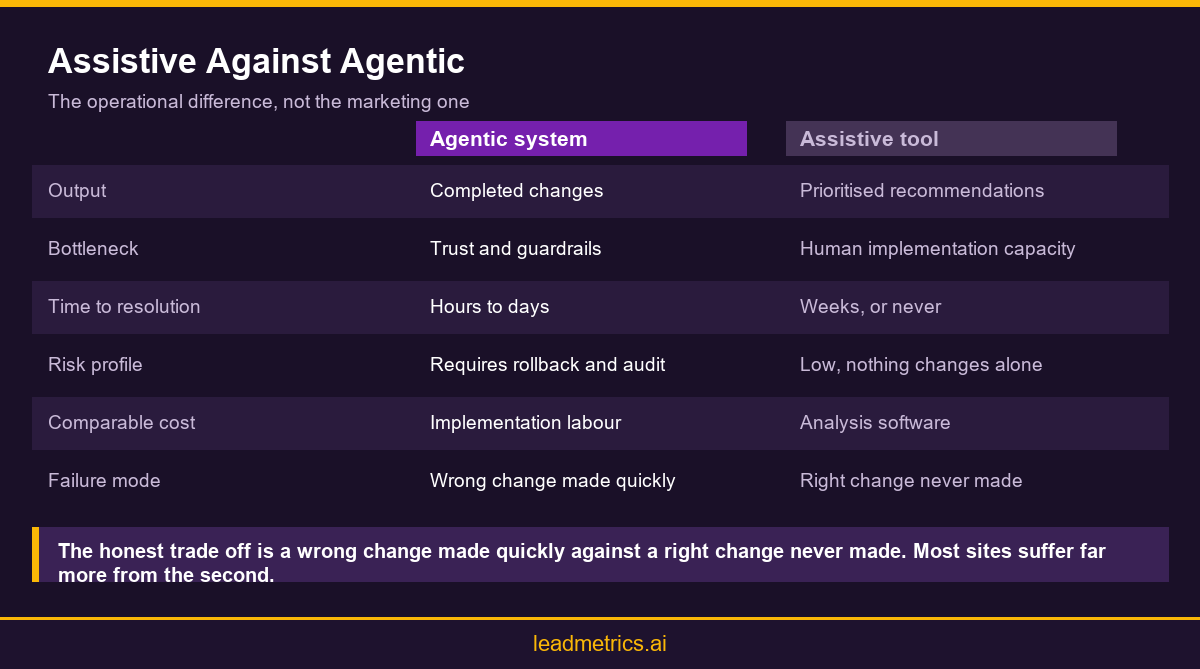
An assistive tool crawls your site, identifies problems and presents a prioritised list. Somebody then has to read that list, decide what matters, and implement the changes. In most organisations that final step is where the value evaporates, because the person who owns implementation has other work and the list grows faster than it is cleared.
An agentic system closes that gap by executing. It monitors continuously, prioritises by expected impact, makes the change, and records what it did. The difference is not intelligence, it is completion. A recommendation nobody implements has produced nothing, however accurate it was.
This is why audit backlogs are such a reliable symptom. Most sites carrying hundreds of unresolved technical issues are not short of analysis. They are short of execution capacity, and buying a better analyser will lengthen the list rather than shorten it.
A useful way to see the distinction is to look at any site that has run an audit tool for two years. The reports are excellent and the site is largely unchanged. That gap between knowing and doing is the entire problem agentic systems address, and it is considerably more common than a shortage of insight.
The distinction also changes who needs to be involved. Assistive tools are bought by specialists and consumed by specialists. Agentic systems touch production infrastructure, which means whoever owns the website needs to be part of the decision. Skipping that conversation produces an uncomfortable discovery later, usually at an inconvenient moment.
There is a useful intermediate category worth knowing about. Some products generate the change but deliver it as a pull request or a staged edit for human approval, which sits between advice and autonomy. For teams with engineering involvement this is frequently the most comfortable starting point, because it fits an existing review process rather than requiring a new one.
Why the Distinction Matters Commercially
Assistive tools are priced as software and consumed as reports. Agentic systems are priced as software and consumed as labour, which makes the relevant comparison not tool against tool but tool against the hours you would otherwise pay someone to spend implementing. That comparison usually favours autonomy considerably, provided the execution is trustworthy.
What an Agent Can Safely Execute Alone
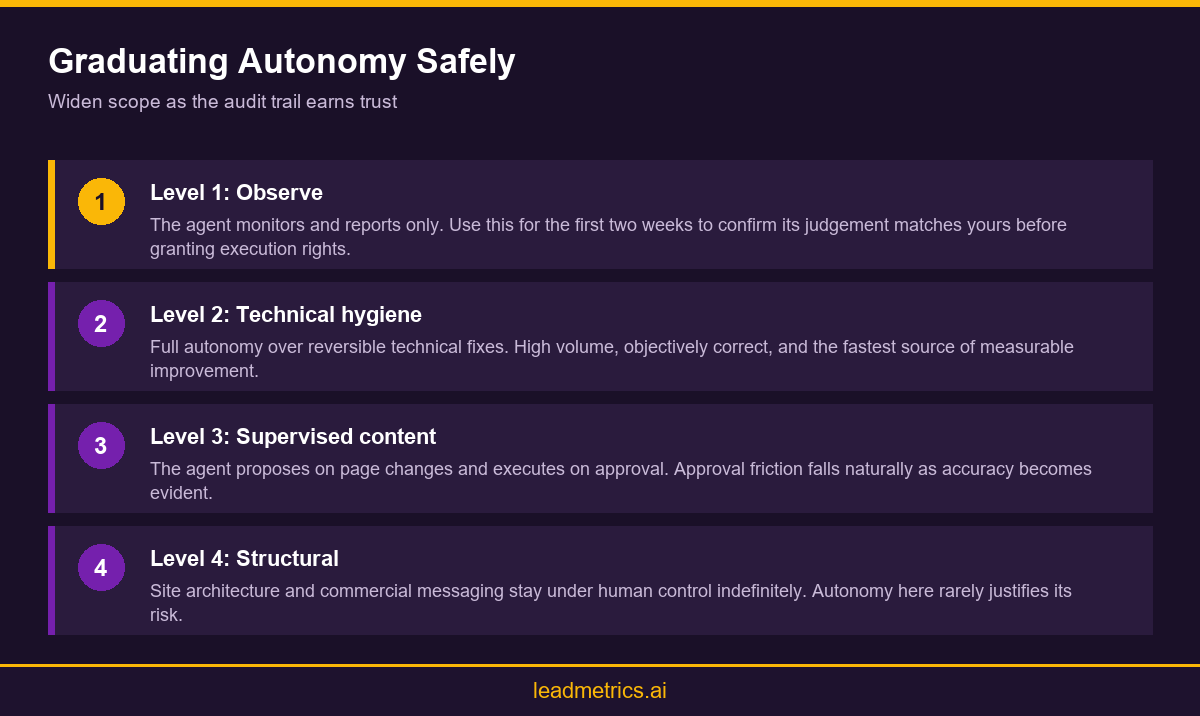
Autonomy should be graduated rather than binary. Some changes are reversible, low risk and high volume, which makes them ideal for unsupervised execution. Others touch commercial messaging or site structure and warrant a human gate regardless of how confident the system is.
A sensible default gives the agent full autonomy over technical hygiene, supervised autonomy over on page content changes, and no autonomy over anything affecting pricing, claims or navigation architecture. That boundary can widen as the audit trail demonstrates reliability, and widening it deliberately is far better than discovering the boundary was wrong after a bad week.
Set the boundary in writing before the first change is made, and review it monthly for the first quarter. Teams that leave autonomy scope implicit tend to discover it through an unwelcome change rather than through a decision. A short written policy naming what the agent may do unsupervised takes an hour to produce and prevents most of the disagreements that follow otherwise.
Volume is part of what makes graduated autonomy sensible. Technical hygiene issues appear in the hundreds or thousands on any sizeable site, and human handling of that volume is simply uneconomic at any realistic hourly rate. Commercial page changes appear in the dozens, where human review costs little and prevents expensive errors. The economics point clearly in both cases.
Page importance should shape the boundary as much as change type does. A title rewrite on a low traffic support article carries almost no risk, while the same change on your highest converting page deserves review regardless of how routine the change type appears. Tiering pages by commercial value and applying different autonomy rules to each tier is more precise than a single site wide policy.
Seasonality is worth building into the policy too. Many businesses have periods where site stability matters far more than optimisation, such as a major campaign or a peak trading window. Being able to pause autonomous execution during those windows, and knowing in advance how to do it, prevents a well intentioned change landing at the worst possible moment.
Safe for Full Autonomy
Broken internal links, missing alt attributes, malformed structured data, orphaned pages, redirect chains, image compression, sitemap maintenance and canonical errors. These are objectively correct or incorrect, reversible, and numerous enough that human handling is genuinely uneconomic.
Requires a Human Gate
Title and description rewrites on commercial pages, content consolidation, internal linking that changes page authority flow, and anything touching product claims. These carry judgement or commercial risk, and the cost of a confident mistake is materially higher than the cost of a short approval delay.
Guardrails That Make Autonomy Acceptable
Three mechanisms make autonomous execution defensible to whoever owns the website. A complete audit trail recording every change, its timestamp and its reasoning. A rollback capability that works at individual change level rather than restoring a whole backup. And rate limiting, so a misconfigured rule cannot make four thousand changes overnight.
Ask specifically how each works before granting any execution rights. A vendor who cannot demonstrate per change rollback is asking you to trust that nothing will go wrong, which is not a guardrail. The equivalent expectation in any other system that writes to production would be considered obviously insufficient.
Alerting is the fourth mechanism worth requiring, and it is frequently missing. You should know when the agent makes an unusually large number of changes, when it touches a page you have flagged as sensitive, and when its confidence in a change is low. Silence is comfortable and is not the same as safety.
Ask also who can grant and revoke execution rights, and whether that is logged. In agencies and larger teams this matters more than it first appears, because permission granted informally during a busy week tends to persist indefinitely without anyone revisiting whether it should.
Sampling is the practical complement to these mechanisms. Reviewing every change defeats the purpose, and reviewing none removes your ability to catch systematic errors. Reading a random sample of perhaps twenty changes each month takes under an hour and reliably surfaces the subtle rule problems that rate limiting alone will not prevent.
Keep the audit trail accessible to people beyond whoever configured the system. When a developer asks why a tag changed three weeks ago, the answer should be findable by them directly rather than requiring the SEO owner to interpret it. Audit trails that only one person can read tend to be treated as unreliable by everyone else.
The Rollback Test
During evaluation, have the agent make a change and then reverse exactly that change without touching anything else. If rollback means restoring a full site backup, you do not have rollback, you have disaster recovery. The two solve different problems and only one of them is relevant here.
Measuring Something That Runs Continuously
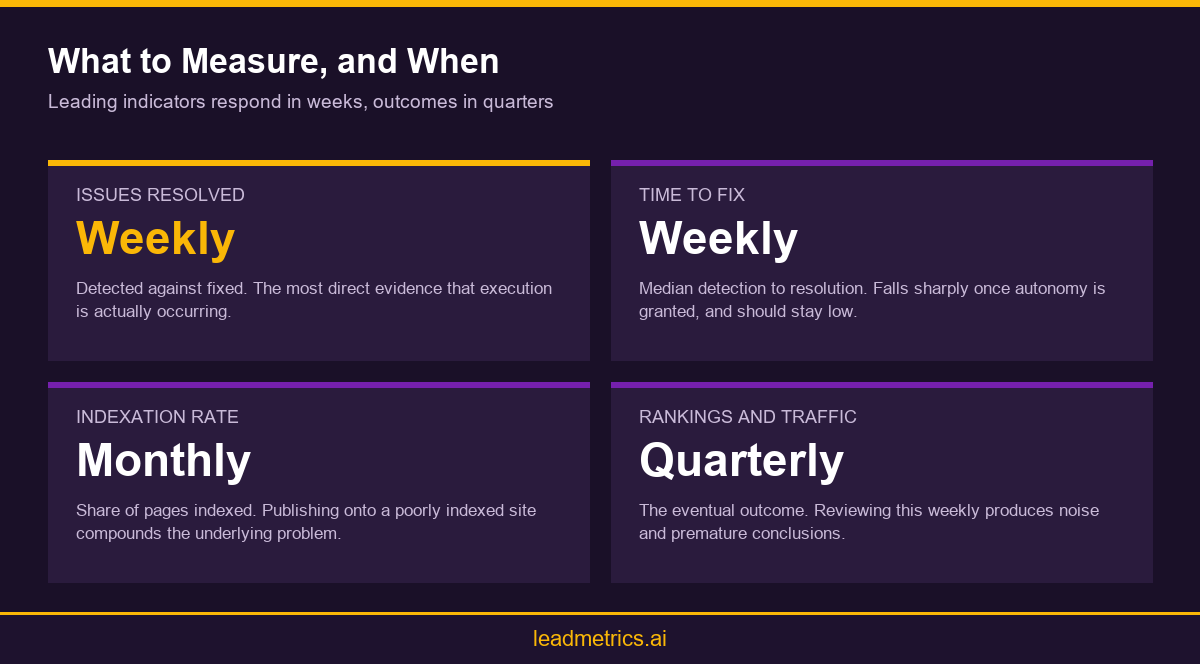
Ranking movement is the wrong primary metric for autonomous optimisation, because it lags execution by months and is influenced by factors the agent does not control. Judging an agent on rankings in month one produces a verdict unrelated to whether it is working.
Measure leading indicators instead. Issues detected against issues resolved. Median time from detection to fix. Percentage of the site free of technical errors. Crawl efficiency and indexation rate. These respond within weeks and genuinely reflect whether execution is happening. Indexation in particular is worth watching closely, because publishing more content onto a site that indexes poorly compounds the problem rather than solving it.
Rankings and traffic remain the eventual outcome, and should be reviewed quarterly rather than weekly. Google's own guidance on creating helpful and reliable content remains the governing principle underneath all of it, and no amount of autonomous technical execution compensates for content nobody wants.
Establish a baseline before granting any execution rights. Record the current issue count, the median age of open issues and the current indexation rate. Without that baseline you will have no defensible way to describe what changed, and the first quarterly review will become a discussion about impressions rather than evidence.
Separate what the agent influences from what it does not when reporting results. Traffic moves for many reasons, including seasonality, algorithm updates and your own campaigns. Attributing all of it to autonomous optimisation overstates the case and damages credibility the first time traffic falls for unrelated reasons. Reporting issues resolved and time to fix keeps the claim defensible.
Watch the trend rather than the absolute figure on issue counts. A rising count is not necessarily bad, since it often means detection improved or the site grew. What matters is whether the gap between detected and resolved is narrowing, because that gap is the thing the agent exists to close.
Where Autonomous Optimisation Fails
Three failure modes are worth anticipating. The first is confident wrongness at scale, where a rule that is subtly incorrect gets applied to thousands of pages before anyone notices. Rate limiting and sampling reviews exist precisely for this. The second is optimising the measurable at the expense of the meaningful, such as improving a technical score while making pages worse for readers.
The third is drift from commercial intent. An agent optimising for search performance may rewrite a page in ways that weaken its selling function, because nothing in its objective accounts for conversion. Keep commercial pages under supervision for this reason, and review a sample of changes monthly even on pages where autonomy is granted.
A fourth risk is subtler and worth watching in agencies and larger teams. As the agent handles more of the routine work, fewer people retain a working understanding of why the site is configured as it is. That knowledge gap surfaces during a migration or a redesign, when somebody needs to explain decisions nobody made consciously. A short written record of standing decisions prevents most of it.
A practical safeguard against all three failure modes is to keep a small holdout. Exclude a representative group of pages from autonomous changes entirely, then compare their performance against the optimised set over a quarter. It costs a little coverage and gives you the only genuinely clean evidence you will get about whether the automation is helping.
Be alert to changes that improve a metric while harming the reader. Aggressive keyword placement, over compressed images and heavily rewritten headings can all move a technical score in the right direction while making a page slightly worse to use. These rarely trigger any alert, which is exactly why periodic human reading of optimised pages remains necessary.
How This Fits a Wider Marketing Stack
Autonomous SEO is one component rather than a strategy. It improves the technical and structural foundation on which content and campaigns operate, which raises the return on everything else you do. On its own it will not generate demand for a proposition nobody wants.
In practice it sits alongside content production, paid media and lead handling. Where those functions live in separate tools, the agent optimises without visibility of what converts, which limits how intelligently it can prioritise. Consolidation matters here for the same reason it matters elsewhere, as set out in this guide to AI powered marketing for smaller businesses.
Discovery is also changing underneath all of this. A growing share of research begins inside AI assistants rather than search engines, which rewards content structured to be quoted rather than merely ranked. The strategic implications are covered in this guide to optimising across every answer platform, and regionally in how search, answer and generative optimisation now differ.
Content strategy remains the larger lever underneath all of this. Autonomous technical execution removes friction, which raises the return on good content and equally raises the return on poor content reaching more people. Sites with a thin or duplicated content base frequently find that fixing technical issues surfaces a content problem that was previously hidden behind a crawl issue.
That sequencing matters practically. Technical health first, because it is fast and mechanical. Content quality second, because it is slow and judgement heavy. Attempting both simultaneously with limited capacity usually results in neither being finished, and the technical work is the half that automation can genuinely take off your hands.
Consider how the agent's priorities interact with commercial reality. A system optimising purely for search performance will treat every page as equally worth improving, whereas your business almost certainly has a handful of pages that matter far more than the rest. Platforms that accept a commercial weighting produce noticeably better prioritisation than those working from technical severity alone.
Finally, remember that discovery through AI assistants rewards different properties than conventional ranking does. Clear structure, direct answers and citable statements matter more than keyword placement. Autonomous technical work supports that indirectly, but the content decisions behind it remain firmly human and are worth the attention they require.
Conclusion
Autonomy is valuable because execution, not analysis, is the real constraint on most sites. Grant it gradually, starting with reversible technical work and widening as the audit trail earns confidence. Insist on per change rollback and rate limiting before granting any execution rights. Measure issues resolved and time to fix weekly, and leave rankings to quarterly review. Handled that way, autonomous optimisation clears backlogs that would otherwise sit untouched for years. Speak to the Leadmetrics team to see it running against a real site.
Share on Social Media
Frequently Asked Questions
What separates agentic from assistive SEO tools?

Is it safe to let software change my live site?
Which changes should always stay under human control?
How quickly should results appear?
Can an agent damage my rankings?
Does this replace an SEO specialist?
What should I check before granting execution rights?
How does indexation fit into this?
Does autonomy work for small sites?
How does this affect visibility in AI assistants?