
Choosing an AI Driven SEO Management Platform

Choosing an AI driven SEO management platform is less about which tool finds the most issues and more about which one closes them. Most teams already have more analysis than they can act on. This guide sets out an evaluation framework built around workflow and execution rather than feature count, including the four questions that reliably separate management platforms from reporting dashboards with automation language attached.
Key Takeaways
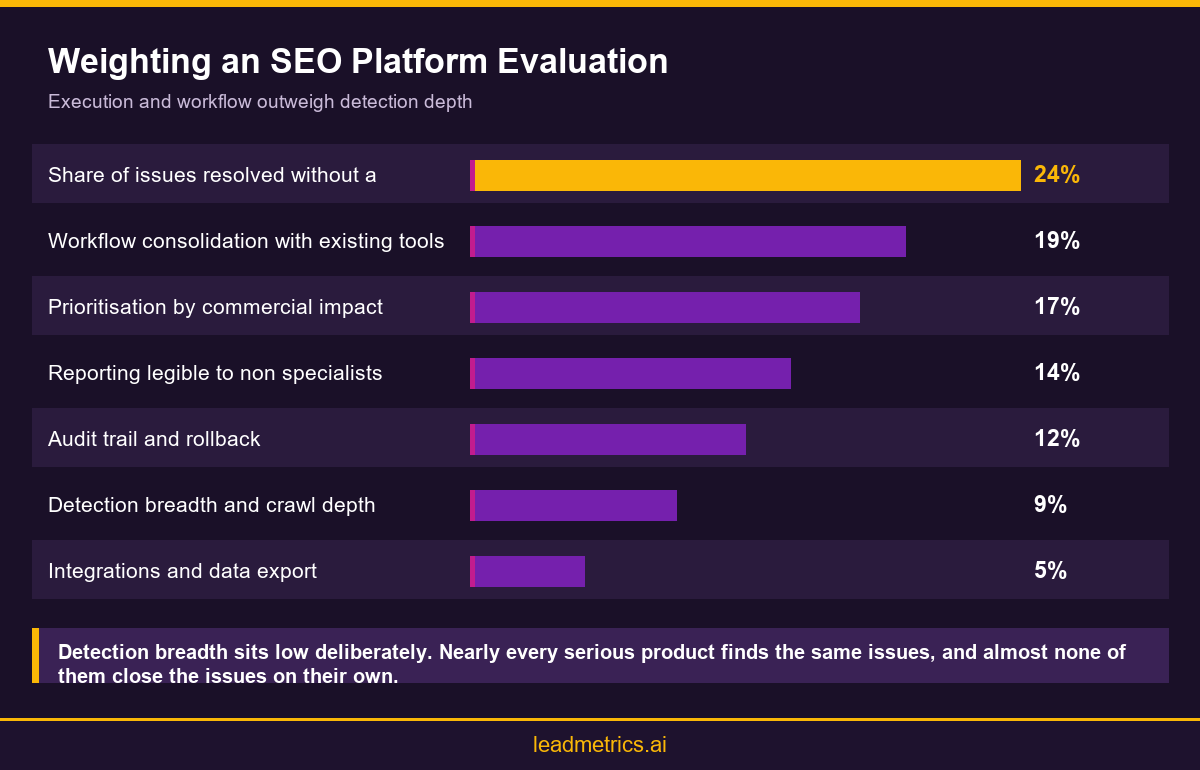
- Evaluate on issues closed rather than issues found. Detection is commoditised, execution is not.
- Workflow consolidation is the real product. If your team still tracks work in a separate system, nothing has been managed.
- Insist on reporting that a non specialist can read, because that is who approves the budget.
Management Platform or Reporting Dashboard
The category contains two quite different products sold with similar language. A reporting dashboard tells you the state of your site in detail. A management platform tells you the same things and then organises, assigns and in some cases performs the work required to change that state.
The test is simple. Ask what happens after the platform identifies a problem. If the answer is that it appears in a list, you are evaluating reporting. If the answer involves assignment, workflow or execution, you are evaluating management. Both are legitimate products, but only one addresses the constraint most teams actually have.
A third product shape sits between the two and is worth recognising. Some platforms organise and assign work without performing it, which is genuine management even though nothing is automated. For teams with implementation capacity but poor coordination, that can be exactly the right answer, and paying for execution they do not need would be waste.
Match the product to where your constraint actually sits. If work is identified and then forgotten, you need workflow. If work is identified, assigned and still not done, you need execution. Those are different purchases, and buying the wrong one produces a tool that everybody agrees is impressive and nobody credits with having changed anything.
Legacy matters here too. Teams that have used a reporting product for years frequently have established habits built around it, and switching to a management platform changes workflow rather than just tooling. Budget for that adjustment explicitly, because platforms judged during a period of workflow disruption tend to be judged unfairly.
The Four Questions That Separate Them
First, what proportion of detected issues can the platform resolve without a person. Second, where does work live once assigned, and does that duplicate a system your team already uses. Third, can it prioritise by commercial impact rather than by technical severity. Fourth, what does reporting show to somebody who does not work in SEO.
The third question deserves particular attention. Technical severity and commercial impact frequently diverge, and a platform that surfaces four hundred critical errors on pages nobody visits has sorted the problem rather than solved it. Prioritisation that understands which pages earn money is considerably more valuable than prioritisation that understands which errors are technically serious.
A fifth question is worth adding for anyone managing more than one site. Can the platform report across properties without requiring you to open each one separately. Agencies and multi brand businesses lose meaningful time to account switching, and consolidated views are frequently absent from products designed around a single site.
Ask how the platform handles issues it cannot resolve or assign, since every site has some. The useful behaviour is to surface them distinctly rather than mixing them into the same queue as actionable work. Queues containing items nobody can act on train teams to stop reading the queue, which undermines the entire system quietly and permanently.
Consider also how prioritisation adapts as the site changes. A page that mattered commercially last quarter may not this quarter, and a platform working from a static importance list will gradually drift out of alignment with the business. Ask whether prioritisation refreshes automatically and what data it draws on when it does.
Workflow Consolidation Is the Actual Product
If your team identifies issues in one system, tracks them in a second and implements them in a third, the platform has added a step rather than removed one. Genuine consolidation means work is created, assigned, completed and verified in the same place the problem was detected.
Check how this interacts with tools your team already lives in. A platform that pushes tasks into your existing tracker is frequently better than one demanding everyone adopt a new interface, because adoption fails quietly and the failure is usually attributed to the tool rather than to the switching cost.
Verification is the step most often missing from consolidation. Creating and assigning work is straightforward. Confirming the change was made correctly, and that it survived the next deployment, is where platforms differ. Ask what happens when a fix is marked complete but the underlying issue reappears, since silent regression is common on actively developed sites.
Watch for duplicate sources of truth as well. If the platform maintains its own issue status while your tracker maintains another, the two will diverge within weeks and your team will start trusting neither. One authoritative status, wherever it lives, is worth more than rich functionality split across two systems.
Permissions deserve a check before rollout rather than after. Decide who can create work, who can mark it complete, and who can change configuration. Small teams often skip this and discover later that anyone could alter settings affecting the whole site, which is rarely discovered at a convenient time.
Reporting for People Who Do Not Do SEO
The person approving your budget is rarely an SEO specialist. Reporting built for practitioners, dense with crawl statistics and technical scores, fails precisely where it matters most. What that audience needs is a short answer to what changed, what it produced, and what happens next.
Ask each vendor to show the report they would send to a finance director. The products that have thought about this produce something clear immediately. Those that have not will offer to build a custom dashboard, which is a reasonable answer that also tells you the work has been transferred back to you. The wider evaluation framework applies here too, as set out in this guide to choosing the right platform for lead generation, and general background on search engine optimisation practice is useful for anyone new to the category.
Frequency matters alongside format. Monthly reporting suits most stakeholders, while the working team benefits from something closer to weekly. Platforms that only produce one cadence push the other into somebody's manual routine, which is precisely the kind of small recurring task this category is supposed to eliminate.
One last test is worth running with any shortlisted product. Ask it to explain a single recommendation in plain language, without technical vocabulary. Products built with non specialist stakeholders in mind do this naturally. Those built purely for practitioners will produce something accurate and largely unreadable, which tells you exactly how the monthly reporting conversation will go.
Conclusion
Judge these platforms on what they close rather than what they find. Ask what proportion of issues resolve without a person, where assigned work lives, whether prioritisation reflects commercial impact, and whether reporting makes sense to whoever holds the budget. Those four questions separate management platforms from dashboards faster than any feature comparison. Speak to the Leadmetrics team to see how the workflow runs against your site.
Share on Social Media
Frequently Asked Questions
What is the main difference between these platforms?

Is detection breadth still important?
Should the platform replace our project tracker?
How should prioritisation work?
What reporting should I expect?
Do these platforms need technical staff?
How long before results are visible?
How does this relate to autonomous execution?