
How to Get Clients for a CA Firm Online: 9 Ways That Fit ICAI's 2026 Rules

If you are wondering how to get clients for a CA firm without relying only on referrals, the answer starts where your future clients already look: Google Maps, Google Search and, more and more, AI assistants like ChatGPT and Gemini. The rules have also moved. ICAI's Council approved amendments to the Advertisement and Website Guidelines in December 2025, as part of a revised Code of Ethics that applies from 1 April 2026. This guide covers nine practical ways for a chartered accountancy practice to win clients online in 2026, which ones suit a solo practice versus a multi-partner firm, and how to stay on the right side of the Code. If you would like a second opinion on your own firm's visibility, you can talk to the Leadmetrics team.
Key Takeaways
- People search for CAs locally and in large numbers, so your Google Business Profile and service pages do most of the work.
- ICAI's 2026 changes give firms more room online, but education still beats self-promotion: no "best CA" claims, no comparisons, no solicitation.
- Track every enquiry by service and channel, so you know which of the nine methods is actually bringing clients.
Why are referrals no longer enough for a CA practice?
Referrals still bring good clients, but they are slow, uneven and hard to plan around. A business owner who needs GST registration this week, or an NRI who needs help with a tax notice, often does not ask a friend first. They search, compare two or three firms, and call the one that looks clear, local and credible.
The search demand is real. Google Keyword Planner data for India (October 2025 to September 2026) shows about 74,000 average monthly searches for "ca near me" and about 40,500 for "chartered accountant firms near me". Those searches end on a map pack and a handful of websites. If your firm is not in that set, the enquiry goes to the practice down the road.
There is a second shift. Buyers now ask AI assistants questions like "which CA in Kochi handles startup compliance?" Google says that to appear in AI Overviews and AI Mode there are no special tricks: it asks for helpful, reliable, people-first content, crawlable pages, and Business Profile information that stays current. In other words, the same groundwork that wins Maps searches also feeds AI answers.
So the real question is not whether a CA firm should be online. It is how to show up in the right places, in a way that fits professional ethics. That is the gap the Leadmetrics programme for CA and audit firms was built for.
What do ICAI's 2026 rules allow CA firms to do online?
ICAI's 447th Council meeting approved the revised 13th edition of the Code of Ethics, with changes to the Advertisement and Website Guidelines. According to ICAI's press release, the changes widen the scope of the advertisement "write-up", allow members and firms to use push technology for services that are not exclusive to the CA profession (such as consultancy and accounting), and permit network firms registered with ICAI to run their own websites. ICAI's Ethical Standards Board confirmed in May 2026 that the revised Code applies from 1 April 2026, with Volume I holding the domestic guidelines.
That is a real opening, but it is not a free-for-all. The safest reading for marketing is "education, not solicitation". Use the table below as a working guide, and have a partner check anything borderline against the current Volume I text.
| Generally safe | Check against the Code first | Avoid |
|---|---|---|
| Accurate firm details on Google, your website and directories | Paid ads for services that only CAs can provide, such as audit or certification | "Best CA in the city" or "No. 1 firm" claims |
| Explainers on GST, ITR, TDS and compliance deadlines | Email or WhatsApp campaigns to people who are not yet clients | Comparisons with other firms |
| Service pages that describe what you do, for whom and where | Publishing client names or logos | Discount offers and fee undercutting |
| Partner articles and talks on LinkedIn | Featuring client praise on your own website | Guarantees of outcomes, such as refunds or notice results |
The same principle runs through every method below: say what you do, accurately, and help people understand their problem. Let the client make the choice.
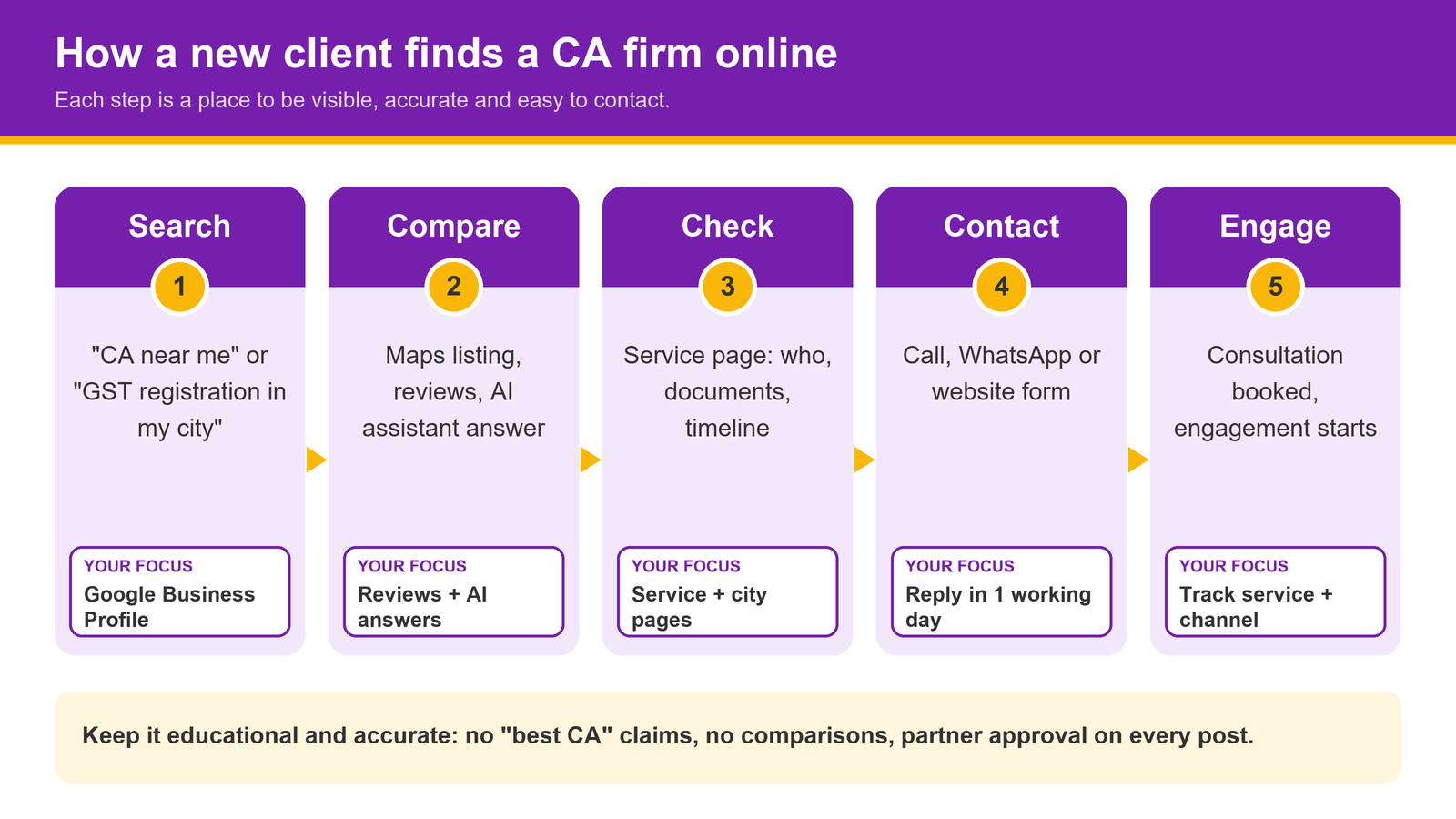
How to get clients for a CA firm online: 9 ways that work
These nine methods are ordered roughly by how quickly they tend to show results for a typical practice. You do not need all nine at once. Start with the first three and add the rest as you go.
1. Make your Google Business Profile complete and accurate
For "ca near me" searches, your Google Business Profile is often the first and only thing a prospect sees. Google lists three factors in how local ranking works: relevance, distance and prominence. It also says businesses with complete and accurate information are more likely to show up in local results.
For a CA firm, "complete" means:
- Primary category: set to Chartered accountant, with Tax consultant or Accountant as secondary categories if they fit.
- Services: listed individually, such as GST registration, ITR filing, tax audit, company incorporation and NRI taxation.
- Firm details: name, address and phone that match your ICAI records and your website exactly.
- Updates: hours, holiday closures and photos of the actual office kept current.
- Posts: short updates before filing deadlines, such as "Advance tax second instalment due on 15 September: what to keep ready."
If you run more than one office, each branch needs its own verified profile. Our guide to managing Business Profiles across several locations covers how to keep them consistent.
2. Build one page per service, per city
Most CA websites have a single "Services" page listing fifteen things in one paragraph. That page cannot rank for "GST registration consultant in Thrissur" and "tax audit for doctors in Kochi" at the same time. This is the core of SEO for chartered accountants: give every important service its own page, and give every city you serve its own page if you have an office or regular clients there.
A strong service page answers six questions in plain text near the top: what the service is, who needs it, what documents are required, the usual timeline, what the client receives at the end, and how to start. Add a short FAQ at the bottom using the exact questions clients ask your team on the phone.
3. Publish deadline and change explainers
Tax and compliance deadlines create predictable spikes in searches. Every year people look for help with ITR due dates, advance tax instalments, GST return changes and Budget announcements. A firm that publishes a clear explainer two to three weeks before each deadline is visible exactly when people need help.
Keep each piece factual and current: what changed, who it affects, what to do before the due date, and the common mistakes your team sees. Plan these on a calendar at the start of the financial year. AI-drafted articles that a partner then reviews for technical accuracy are a practical way to keep up; Leadmetrics' AI content drafting works this way, with nothing published until it is approved.
4. Get named in AI answers
When someone asks ChatGPT or Google's AI Mode "who can help with a GST notice in Coimbatore?", the answer draws on pages it can read and trust. Firms that state facts plainly (services, city, credentials, typical timelines) on their site, and repeat the same facts on Google and directories, are easier to cite.
Write a 40 to 60 word direct answer under each question-style heading on your service pages. Keep your firm details consistent everywhere. Then check monthly whether assistants mention you for your key services. Our post on getting cited in AI answers covers the page-level work in detail, and Leadmetrics' answer engine optimization tracks which prompts name your firm.
5. Run a simple, honest review process
Google says more reviews and positive ratings can help your local ranking, and that replying to reviews shows you value feedback. For a CA practice, the natural moment to ask is after a completed filing, audit or incorporation, when the client has seen the result.
Keep it clean: ask every client the same way, never offer anything in return, and reply to every review politely, without sharing any client details. Do not copy Google reviews onto your website as testimonials unless you have checked the Code allows it.
6. Share partner expertise on LinkedIn
LinkedIn suits marketing for chartered accountants because the audience is business owners, CFOs and finance managers. Posts that explain a change ("What the new TDS rule means for your vendor payments") build recognition without any self-promotion.
One or two posts a week from a partner's own profile is enough. Repurpose your deadline explainers into short posts and carousels. A tool that schedules posts and keeps them on a calendar, such as Leadmetrics' social media management, saves hours, but the partner's voice and judgement should stay in every post.
7. Answer every enquiry fast, and track where it came from
Lead generation for accounting firms often fails after the enquiry, not before it. A WhatsApp message that sits unanswered over a weekend, or a website form that goes to an unchecked inbox, loses the client to the next firm on the list.
Set a rule: every enquiry gets a reply within one working day, with the next step. Record each one in a single place with three fields at minimum: the service asked about, the channel it came from, and the outcome. Leadmetrics' CRM and lead management tracks calls, forms and WhatsApp enquiries by service and channel for exactly this reason.
8. Keep existing clients informed by email
Your current clients are your best source of new work, both for additional services and for referrals. A monthly compliance calendar or a short alert when rules change keeps your firm front of mind.
Send only to people who have agreed to hear from you. India's Digital Personal Data Protection Rules were notified in November 2025 with a phased compliance period and require a clear consent notice, so collect consent properly at onboarding. Treat email to strangers as a Code question too, per the table above.
9. Keep your firm details consistent across listings
Listings on directories, professional platforms and maps services all act as corroboration for Google and AI assistants. If one says "Associates", another "& Co." and a third has your old phone number, you look like three different firms.
Make a list of every place your firm appears, fix the name, address, phone and services to match your ICAI records, and check it every quarter. This is slow work, but it supports every other method on this list.
Which methods should a small CA practice start with?
The right starting point depends on your size and capacity. A sole practitioner cannot run nine channels well, and does not need to. The table below suggests a starting set by firm type.
| Firm type | Start with | Add next | Weekly time from partners |
|---|---|---|---|
| Sole practitioner | Business Profile, 3 to 5 service pages, review process | Deadline explainers | About an hour |
| 2 to 5 partners | All of the above plus LinkedIn | AI answer checks, client email | One to two hours, shared |
| Multi-branch firm | One profile and page per office, enquiry tracking | Full content calendar, monthly AI visibility checks | A marketing owner plus partner review |
Whatever your size, make one partner responsible for approving anything published in the firm's name. That one habit protects both quality and compliance.
How do you know if online marketing is bringing in clients?
Measure enquiries and engagements, not likes. Each month, look at four numbers: profile actions on Google (calls, direction requests, website clicks), enquiries by service, enquiries by channel, and how many became paying engagements.
Look for patterns over three months, not one. SEO and content usually take three to six months to show steady results, while profile fixes can show up sooner. If one service gets plenty of enquiries but few engagements, the issue is probably pricing or follow-up, not visibility.
Track rankings too, both in classic search and in AI answers. A simple keyword and AI visibility tracking routine tells you which service pages are moving and which need work.
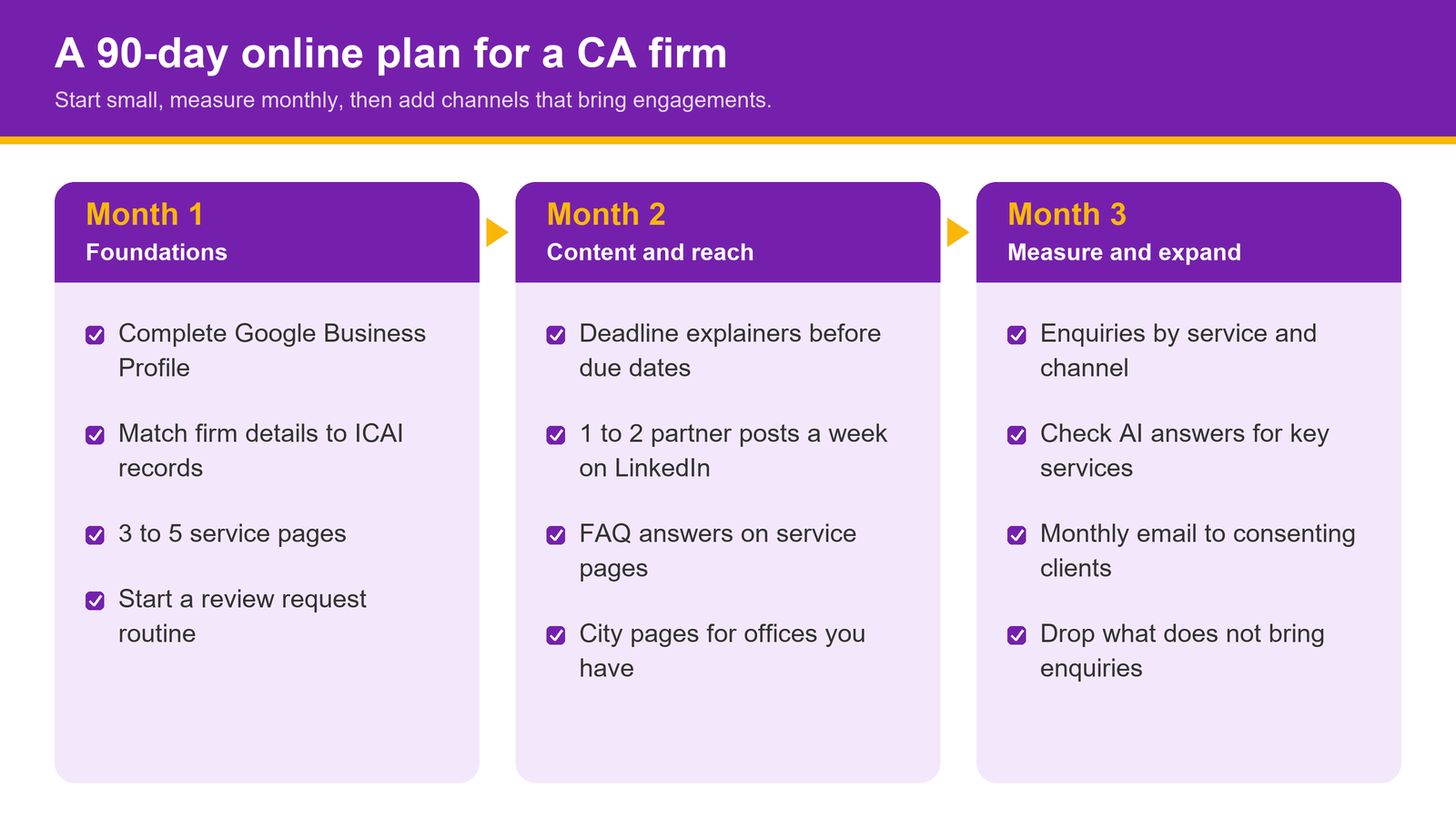
One example of the approach in practice: a CA-led tax and advisory firm started with its Business Profile, a set of focused service pages and a steady review process, then added deadline content. Within a quarter, several of its high-intent tax search terms reached page one of Google. You can read the full tax advisory case study for what was done month by month.
Conclusion
Winning clients online as a CA firm in 2026 comes down to being easy to find, easy to understand and easy to contact, while staying within the Code. Start with an accurate Business Profile, service pages that answer real questions and a fair review process. Then add deadline content, partner posts on LinkedIn and proper enquiry tracking, and check every month which of them brings engagements.
If you want help running this without taking partners away from client work, see how Leadmetrics supports chartered accountancy and audit practices, with every post, page and review reply waiting for partner approval before it goes live. Or start with a free visibility audit of your firm to see where you stand on Google, Maps and AI search today.
Share on Social Media
Frequently Asked Questions
Can CA firms advertise online in 2026?

How can a new CA firm get its first clients online?
Is SEO worth it for a small CA practice?
Can a CA firm ask clients for Google reviews?
How long does it take for online marketing to bring clients to a CA firm?
Should CA firms use social media for marketing?
Can AI tools help a CA firm with marketing?
What should a CA firm's website include to get more enquiries?