
Leadmetrics vs Uplaneads: Paid Only or Full Funnel

Comparing Leadmetrics vs Uplaneads is really a question about where your growth is coming from. Uplaneads is built for paid advertising, generating ad variations with matching landing pages and steering budget across channels automatically. Leadmetrics covers paid media as one channel among several, alongside organic search, local listings and lead handling. This comparison explains when each shape is the right one.
Key Takeaways
- Uplaneads is advertising first, generating ads and landing pages at volume and reallocating spend toward what performs.
- Leadmetrics treats paid as one channel inside a wider system covering organic, local and post capture handling.
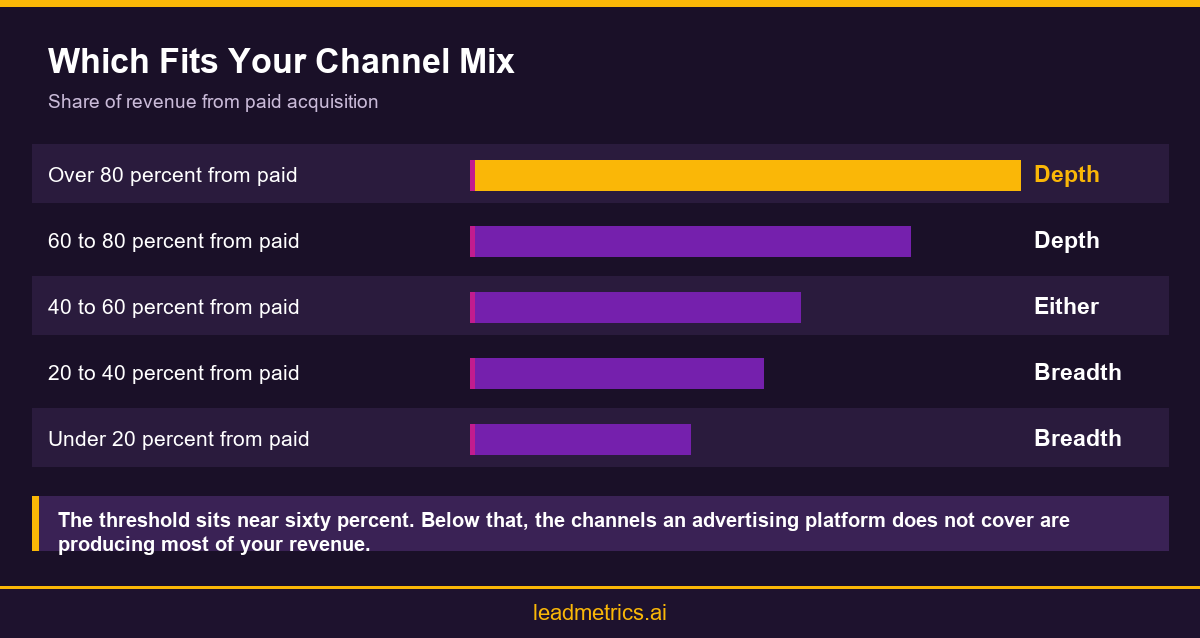
- Heavy advertisers with everything else working should favour depth. Businesses building several channels need breadth.
Two Different Product Shapes
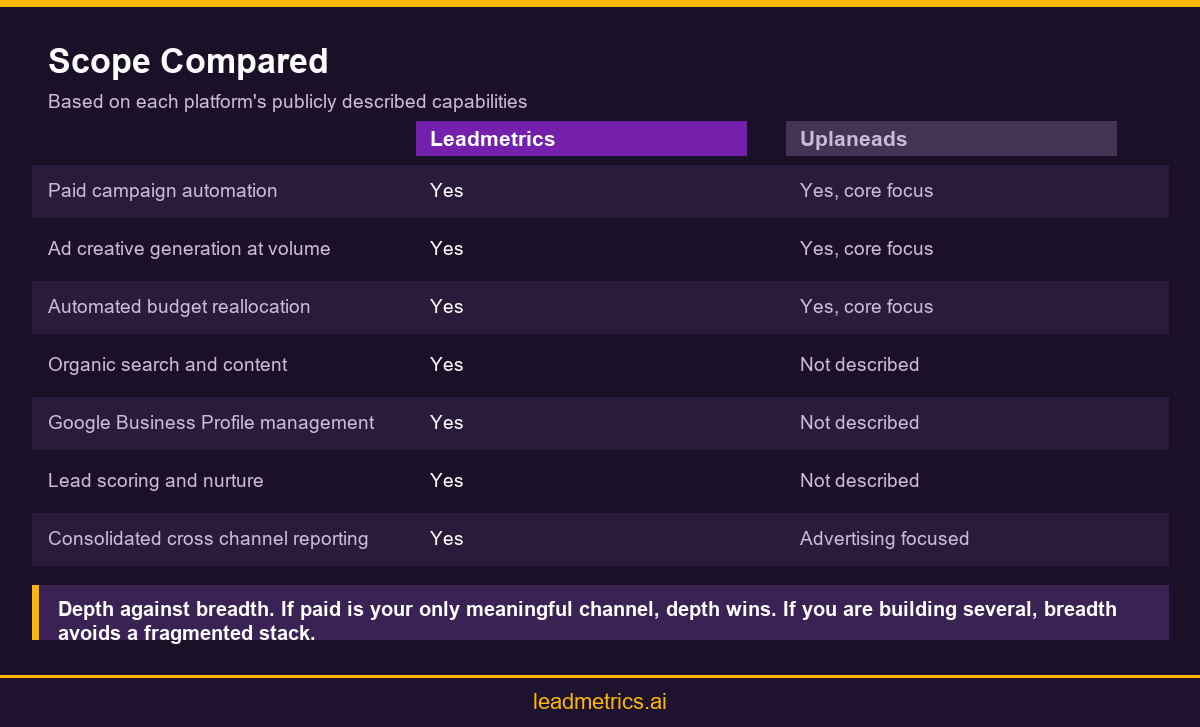
Uplaneads describes itself as replacing marketing agencies with AI, and its published capabilities concentrate on advertising. It generates ad variations with matching landing pages, deploys across Meta, Google and LinkedIn from one place, and allocates spend automatically toward the best performing channels and creatives. The learning loop connects to business outcomes rather than surface engagement metrics.
That is a coherent and genuinely useful product for a specific customer: one whose growth depends on paid acquisition and whose constraint is producing and testing enough creative. Creative volume is a real bottleneck, and solving it properly is worth more than a broad product that does the same job shallowly.
Leadmetrics is shaped differently. Paid media optimisation sits alongside organic search, content production, Google Business Profile management, lead scoring and automated nurture, with reporting consolidated across all of them. The bet is that most businesses are not purely paid acquisition businesses, and that attribution improves when channels share a system.
There is an underlying philosophical difference worth surfacing. An advertising platform assumes demand can be bought efficiently, which is true when margins support it and the auction is not brutal. A funnel platform assumes demand should be built across several channels so acquisition cost falls over time. Both are legitimate strategies, and the right one depends on your margin, your patience and how competitive your category has become.
When Advertising Depth Is the Right Buy
If paid acquisition drives most of your revenue and your bottleneck is creative production and testing velocity, a specialist product will serve you better. Generating many variations with matching landing pages and letting budget follow performance is precisely the work that separates profitable advertising from expensive advertising.
This is particularly true at higher spend levels. Once monthly budget is substantial, small improvements in allocation efficiency produce larger absolute returns than adding another channel would. A business spending heavily with a functioning website and reliable enquiry handling should optimise what it already runs rather than widening scope.
Uplaneads is also the more honest choice if you already have organic and local covered elsewhere. Paying twice for the same capability helps nobody, and a narrower product avoids the situation where you buy breadth and use a third of it. You can review their stated capabilities at the Uplaneads website alongside this comparison.
Speed is the other argument for depth. Paid acquisition produces results in days, while organic and local work compound over quarters. Businesses that need revenue this month should be honest that a broader platform will not deliver it faster, and that buying breadth while urgently needing cash flow is usually the wrong sequencing.
Creative fatigue is worth factoring in too. Advertising performance decays as audiences see the same creative repeatedly, which means production volume is not a one off requirement but a continuing one. Platforms built around generating variations at scale address a recurring problem rather than a temporary one, which is a genuine argument in their favour.
When Breadth Avoids a Fragmented Stack
The case reverses for businesses building several channels at once. If organic search matters, if local discovery through Google Business Profile drives enquiries, or if a meaningful share of contact arrives through messaging rather than ads, an advertising platform covers one part of a wider picture.
Fragmentation has a real cost that rarely appears in comparisons. Separate tools mean separate reporting, manual reconciliation and attribution that breaks at every boundary. A lead that discovers you organically, returns through an ad and converts after a follow up sequence will be credited to whichever system was looking, and usually to the last one.
Paid performance also improves when the system can see what converts downstream. Optimising toward form submissions is straightforward. Optimising toward submissions that become revenue requires the advertising layer to know which leads closed, which only happens when capture and scoring share a system. The practical mechanics are covered in this guide to reducing cost per lead on Meta campaigns and in running Google Ads with automated optimisation.
Cost structure changes the calculation over time as well. Paid acquisition cost tends to rise as competition increases, while organic and local visibility, once established, cost comparatively little to maintain. Businesses relying entirely on paid frequently find their economics tightening year on year without any change in their own performance.
That does not argue against advertising, which remains the fastest route to revenue. It argues for building something alongside it, so acquisition cost is not the only lever you have when the auction gets more expensive. The balance between the two is the strategic question underneath this comparison.
Practical Differences Worth Testing
Three things are worth verifying during any trial rather than assuming. First, how each handles attribution once a lead leaves the advertising system. Ask specifically whether closed revenue can be traced back to a campaign, not merely a conversion event. Second, whether landing pages generated automatically can be edited by you, since automatically produced pages that cannot be adjusted become a constraint quickly.
Third, regional support and billing. Vendors operating on North American hours answer urgent questions overnight, and foreign currency billing carries exchange exposure that compounds across a multi year relationship. For businesses in India or the Gulf these practical factors frequently matter more than any feature difference, particularly during onboarding when questions are frequent.
Finally, test both against the same channel for six weeks rather than deciding from demonstrations. Comparison articles, this one included, are written by parties with an interest. Your own numbers over a short parallel run settle the question far more convincingly than any published analysis.
One further check concerns data ownership on the advertising side. Confirm that campaign history, creative assets and performance data remain exportable and that campaigns live in your own ad accounts rather than the vendor's. Where campaigns sit inside a vendor account, leaving means starting again with no learning history, which is a substantial switching cost that rarely appears in any contract discussion.
Conclusion
This decision follows your channel mix rather than your preference. If paid acquisition produces most of your revenue and creative velocity is the constraint, a specialist advertising platform is the better buy and Uplaneads is built for exactly that. If you are building organic, local and paid together, breadth prevents the fragmented stack and broken attribution that eventually forces consolidation anyway. Work out your split first. The Leadmetrics team can review it with you.
Share on Social Media
Frequently Asked Questions
What is the core difference?

Which is better for heavy advertisers?
Does Uplaneads handle organic search?
Why does attribution break across tools?
Can I run both?
Which is faster to get running?
Does creative volume really matter?
How do I decide without a long trial?