
How to Run Google Ads with AI Optimization in 2026

How to Run Google Ads with AI Optimization in 2026
Manual bid management cannot keep pace with how fast auctions move today. Every search query triggers a fresh auction, and the businesses winning consistently are the ones letting AI driven Google Ads optimization adjust bids, targeting, and creative in real time. This guide explains how AI optimized Google Ads campaigns actually work in 2026, how to structure campaigns so the algorithm has enough signal to perform well, and what changes in your reporting once AI takes over the levers a human used to adjust manually.
Key Takeaways
AI adjusts bids, audiences, and budget allocation continuously across every auction, something no human team can match at scale.
Campaigns structured with clear conversion signals give AI more to learn from, producing better results faster than loosely organised account structures.
Pairing AI driven SEO with Google Ads optimization captures both paid and organic intent from the same search behaviour.
Why Google Ads Needs AI Optimization in 2026
Google's auction system processes signals that no human can track manually: device, location, time of day, search history, and dozens of other variables that shift the value of any given click within milliseconds. Manual bid adjustments, even when reviewed daily, are already outdated by the time a marketer makes a change, because the underlying auction conditions have moved on. Even experienced PPC managers checking an account multiple times a day are still working from a snapshot that is already several hours stale by the time they finish reviewing it, let alone acting on what they find.
AI driven optimization reacts instantly, adjusting bids for every auction based on the real-time likelihood of conversion. Businesses that review client results consistently see lower cost per lead after switching from manual bidding, simply because the algorithm catches patterns a human reviewing weekly reports would never notice, such as a specific audience segment converting at twice the average rate only during certain hours.
Competition has also intensified across nearly every industry, pushing average cost per click upward year over year. Businesses still relying on static bid rules are effectively competing with one hand tied, since competitors using AI driven platforms are adjusting their bids hundreds of times a day while manual accounts adjust once or twice a week at best.
Seasonal and event driven demand shifts add another layer AI handles better than manual rules. Search volume and intent can spike unpredictably around holidays, news events, or competitor activity, and a bidding strategy built on last month's averages will consistently misjudge these moments. AI driven bidding recognises these shifts as they happen rather than reacting days later once a marketer notices the change in a report.
How AI Optimizes Bidding and Targeting
AI bidding strategies work by predicting the probability that a specific auction will lead to a conversion, then bidding accordingly. A search from a user with a strong history of converting on similar campaigns receives a higher bid than one from a user showing weak intent signals, even if both searched the exact same keyword.
Targeting works the same way. Instead of relying on broad demographic guesses, AI continuously expands or narrows audience segments based on which groups are actually converting. Cross-channel signals from social engagement can feed into this targeting too, giving the algorithm a fuller picture of intent before a user ever clicks a Google ad.
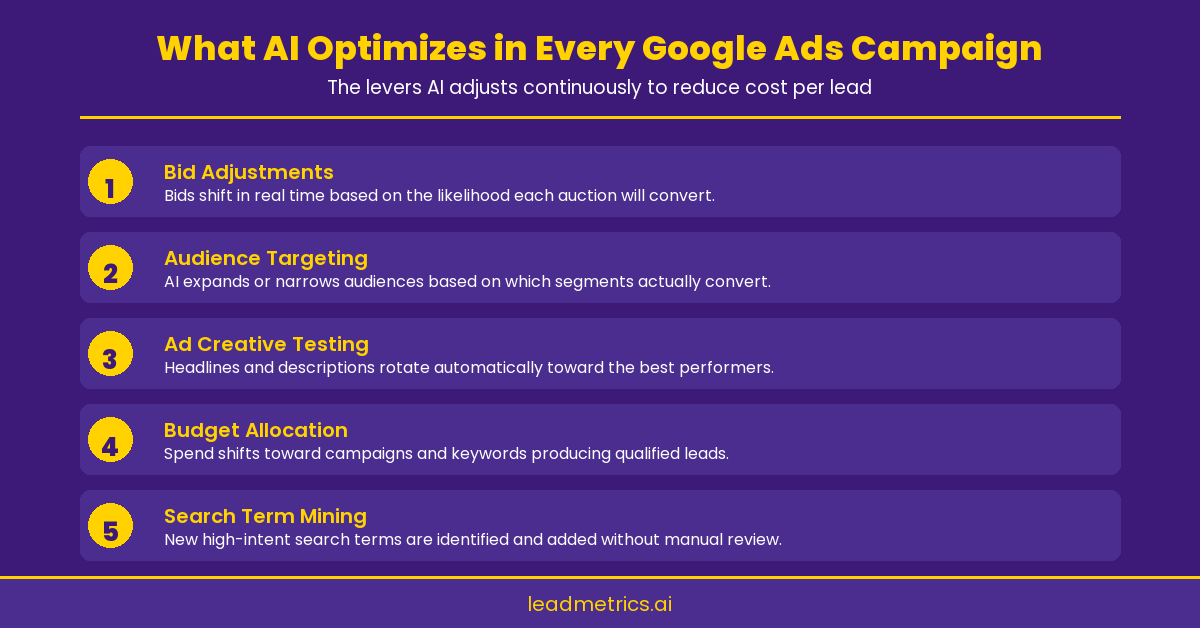
Budget allocation follows the same logic. Rather than splitting spend evenly across campaigns based on a plan set at the start of the month, AI shifts budget toward whichever campaigns and keywords are currently producing the most qualified leads, pulling back from underperforming segments before they waste significant spend.
Ad creative is optimized using the same principle. Multiple headline and description combinations run simultaneously, with the system automatically serving the best performing variations more often as data accumulates. Tailored ad copy aligned to specific audience segments gives this testing process more useful variation to work with than a single generic message applied across every campaign.
Structuring Campaigns for AI to Optimize Effectively
AI performs best when it has clear, accurate conversion signals to learn from. Campaigns tracking only superficial actions, like a page view, give the algorithm far less useful information than campaigns tracking genuine business outcomes, like a qualified form submission or a booked call.
Account structure still matters even with AI managing bids. Grouping keywords by tight thematic relevance, rather than dumping everything into one broad campaign, helps the algorithm understand intent more precisely. Tailored campaign strategies built around specific products or services consistently outperform generic, catch-all campaigns because the AI has cleaner signal within each group rather than averaging performance across unrelated offers. Aligning this structure with social campaigns further sharpens the signal, since consistent messaging across channels reinforces the same intent the algorithm is learning to recognise.
Conversion tracking setup deserves particular attention before activating AI optimization. If your tracking misattributes leads or double counts conversions, the algorithm will optimize toward the wrong outcome with complete confidence, since it has no way of knowing the data feeding it is flawed. Reviewing how other businesses structure their tracking before launch avoids costly early mistakes.
Landing page quality also influences how well AI can optimize a campaign. An algorithm can send highly qualified traffic to a page, but if that page fails to convert visitors at a reasonable rate, the system has no way to compensate through bidding alone. Many accounts that appear to underperform after switching to AI bidding are actually suffering from a landing page problem the algorithm cannot fix on its own, no matter how precisely it targets the right audience. A connected platform that links campaign performance directly to landing page conversion data makes it far easier to spot this kind of bottleneck before it quietly erodes account performance for weeks.
Measuring Results: What Changes With AI Optimization
Daily bid checking becomes far less useful once AI is managing the account, since the algorithm is already reacting faster than any manual review cycle could. Attention shifts instead toward strategic questions: are the right conversion actions being optimized for, and is overall cost per qualified lead trending in the right direction over weeks rather than days.
Channel attribution becomes more important than ever. Paid search rarely operates in isolation, and understanding how it interacts with organic visibility and social retargeting gives a clearer picture of total marketing efficiency than looking at Google Ads performance alone. Compare Leadmetrics plans to see how a connected reporting dashboard handles this kind of cross-channel attribution automatically.
Review cadence should shift from daily tweaks to weekly or fortnightly strategic check-ins. Use that time to evaluate whether conversion tracking still reflects genuine business value, whether new campaigns need to be added, and whether budget caps are limiting the algorithm's ability to capture available demand.
Benchmarking against comparable accounts helps set realistic expectations during this transition. Reviewing client results from businesses that made a similar shift from manual to AI driven bidding gives a grounded sense of typical timelines, since most accounts see meaningful improvement within the first 30 to 60 days as the algorithm accumulates enough conversion data to optimize confidently.
Conclusion
AI optimized Google Ads campaigns react to auction conditions in real time, something manual bid management simply cannot replicate at scale. By structuring campaigns with clean conversion signals and tight thematic grouping, businesses give the algorithm what it needs to consistently lower cost per lead, whether that traffic arrives through organic search or paid placements. Explore Leadmetrics pricing plans to see how AI driven Google Ads optimization fits your current budget, or get in touch to review your account structure.