
AI Content Generator for Business Blogs: Where It Helps, Where It Fails, and the Editing Workflow

An AI content generator can turn a keyword and a few notes into a full blog draft in minutes, but a fast draft is not the same as a post that earns trust, rankings or citations. According to Ahrefs' 2026 survey of 301 marketers, 93% now use AI to create or help create content, yet 66% say they trust AI-written content only after a human has reviewed it. That gap between drafting and publishing is where most business blogs win or lose. This guide sets out what the tools do well, where they break, and a 7-step editing workflow your team can run on every post. If you would rather have the process set up for you, speak with the Leadmetrics team about your content calendar.
Key Takeaways
- AI drafts are strong on structure, speed and first-pass coverage, and weak on facts, sources, originality and brand voice.
- A fixed 7-step edit (brief, draft, fact check, sources, brand voice, internal links, E-E-A-T) turns a generic draft into a publishable post.
- Choose tools by workflow fit: a writing tool gives you drafts, while a content marketing platform also covers briefs, review, SEO checks and publishing.
What is an AI content generator actually good at?
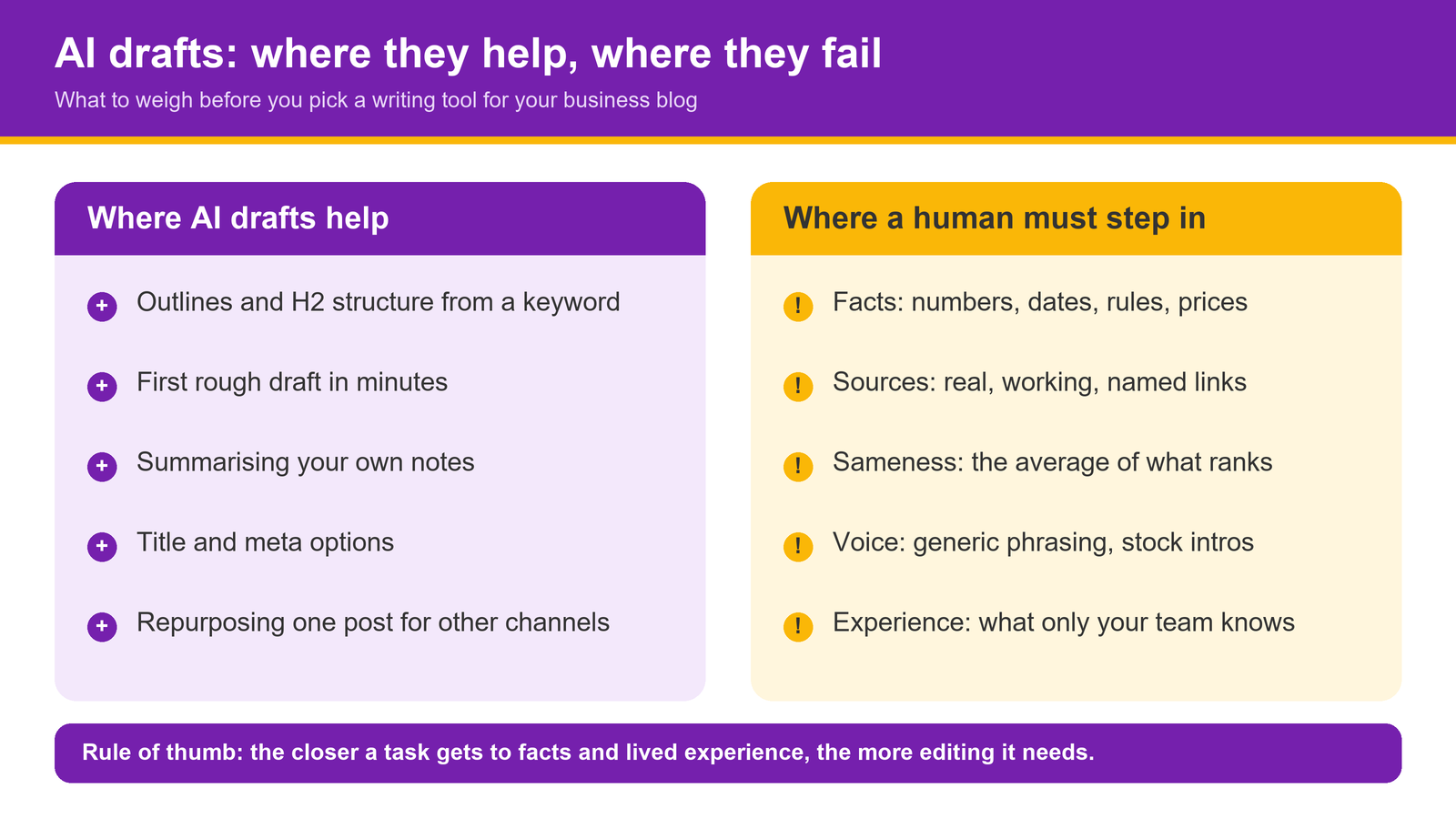
Used well, an AI writing assistant removes the slowest parts of blogging: the blank page, the first outline and the first rough draft. It can propose an H2 structure from a keyword, summarise your own notes, rewrite a dense paragraph in plain English and produce five title options in seconds. For a small team publishing four to eight posts a month, that time saving is real.
It is also good at coverage. Ask for the questions a buyer might have about a service and a model will usually list the obvious ones, which is a useful check that your outline is not missing a section. It can turn one approved article into a LinkedIn post, an email and a Google Business Profile update, which is how the AI content creation workflow in Leadmetrics approaches repurposing: one expert-approved article becomes many channel assets.
Google has said plainly that the method of production is not the issue. Its guidance on AI-generated content rewards helpful, original content however it is produced. So the question for a business blog is not "should we use AI?" but "what does the draft still need before it deserves to rank?"
Where does it fail: facts, sources, sameness and voice?
The failure points are predictable, which is good news, because predictable problems can be caught with a checklist.
| Failure point | What it looks like in a draft | Why it matters |
|---|---|---|
| Facts | Confident numbers, dates, rules or prices that are out of date or invented | One wrong claim damages trust in the whole page |
| Sources | "Studies show" with no study, or links to pages that do not exist | Readers and AI answer engines both look for checkable sources |
| Sameness | The same intro, the same five tips, the same closing line as every other post on the topic | Nothing in the post gives a reason to choose you |
| Voice | Generic, formal phrasing that could belong to any company | The post does not sound like the business that published it |
Sameness is the quiet risk. A model trained on the open web tends to produce the average of what already ranks, which is the opposite of what a search engine or a reader needs from the eleventh page on the same question. Google's spam policies describe scaled content abuse as generating many pages "without adding value for users", and publishing unedited drafts in volume moves a site toward that line.
Voice is where buyers notice first. A Dubai interiors studio and a Kochi accounting firm should not sound the same, yet raw drafts for both will often open with the same sentence about today's fast-paced world.
This is why the best AI for content writing is rarely the one with the most fluent first draft. It is the one that fits into a process where a person checks facts, adds evidence and shapes the voice before anything goes live.
Which briefs make AI drafts better?
Most weak drafts start with a weak prompt. "Write a blog about digital marketing for dentists" leaves the model to guess the reader, the angle, the length and the facts, and it fills every gap with the average answer. A brief closes those gaps before the draft exists.
A useful brief has five parts: the task (what to write and how long), the context (who the reader is, what they already know, what you offer), the instructions (the angle, the H2s, what to avoid), examples (a past post whose tone you like, or a sample paragraph) and the output format (markdown, table, FAQ block). The Leadmetrics AI Prompt Creation feature structures prompts around the same five inputs, Task, Context, Instructions, Examples and Output Format, so teams can get better briefs through prompt creation instead of rewriting prompts from scratch.
Add the facts the model cannot know. Your service areas, pricing approach, turnaround times, the questions your sales team hears every week and two or three real customer situations belong in the brief, not in the edit. If you want ready-made starting points, our 25 marketing prompt templates include a bad-versus-good pair for each channel.
Finally, tell the model what not to do: no statistics unless supplied, no invented quotes, no named competitors, a banned-phrase list for your brand. Constraints like these save more editing time than any other line in the brief.
What does a 7-step editing workflow look like?
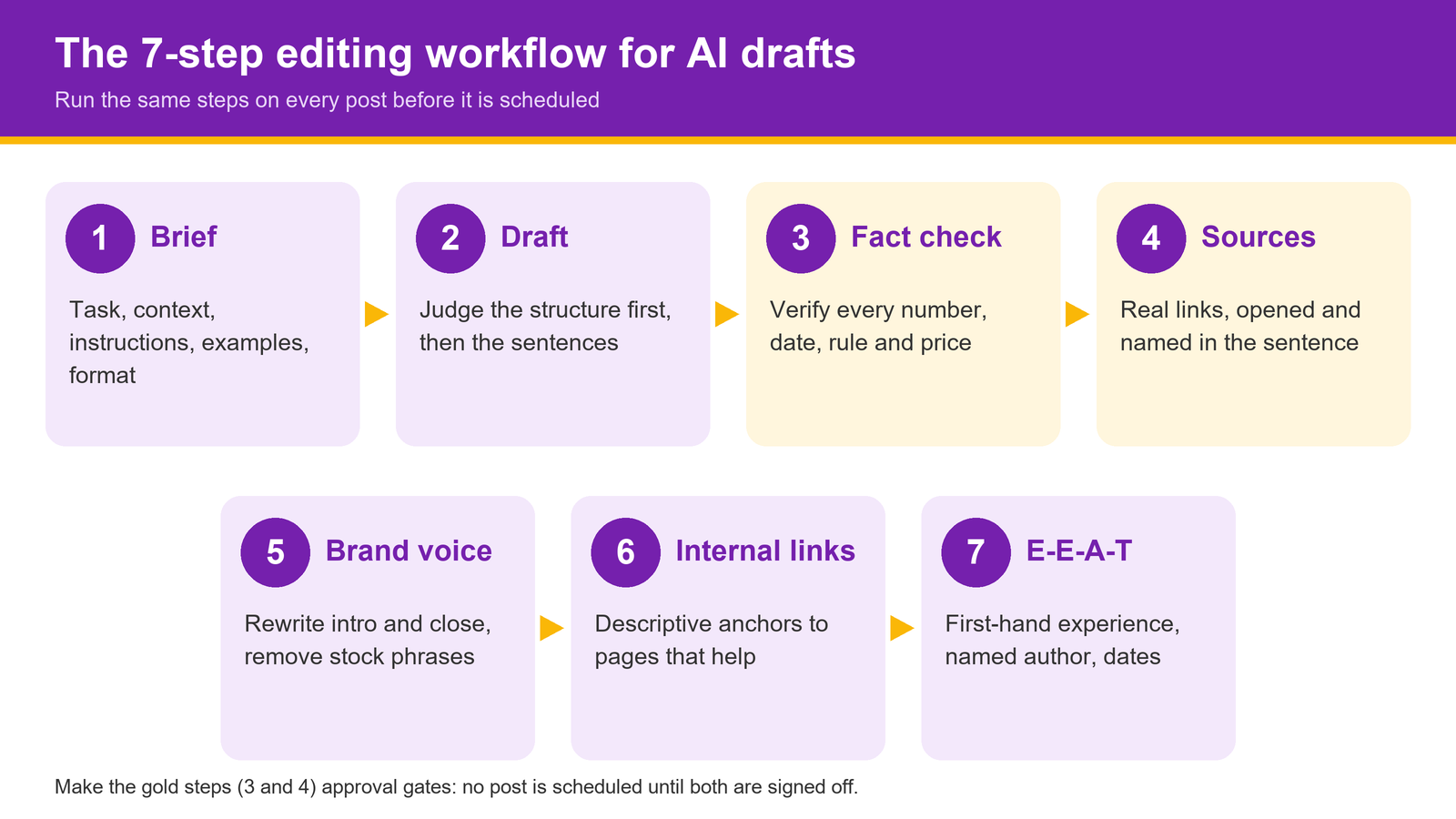
Run the same seven steps on every post. Fixed steps make quality repeatable when several people, or several tools, are involved.
- Brief. Confirm the brief covers task, context, instructions, examples and format, and that it lists the facts and sources the post must use.
- Draft. Generate the draft, then read it once without editing to judge structure. If the H2s do not answer the reader's real question, fix the outline and regenerate rather than patching paragraphs.
- Fact check. Highlight every number, date, rule, price, product claim and named organisation. Verify each against a primary source or delete it. Anything about your own business gets checked by the person who owns that fact.
- Sources. Replace vague attributions with real links, open every link to confirm it loads and says what the sentence claims, and name the source in the sentence itself.
- Brand voice. Rewrite the intro and conclusion by hand, remove stock phrases and match your style guide on spelling, tone and terms (for example, Indian English and INR or AED where prices come up).
- Internal links. Link to the service or feature pages and older posts that genuinely help the reader, with descriptive anchor text. Never use the post's own target keyword as an anchor.
- E-E-A-T. Add first-hand experience, a named author with relevant expertise and clear dates. Google's guidance on helpful, people-first content says that of experience, expertise, authoritativeness and trust, "trust is most important".
Steps 3 and 4 are the ones teams skip under deadline pressure, and they are the ones that cause the most damage when skipped. Build them into the approval stage so a post cannot be scheduled until both are signed off.
How do you add first-hand experience and evidence?
First-hand experience is the one thing no model can generate for you, and it is what separates a useful post from a rewritten summary of page one. Here is a short before and after for a hypothetical AC servicing company in Dubai. The bracketed parts are where the business adds its own records.
Before (raw AI draft):
In today's fast-paced world, regular AC maintenance is essential for every home. Experts recommend servicing your unit at least twice a year to ensure optimal performance and avoid costly breakdowns.
After (edited):
Most of the breakdown calls our Dubai technicians attend in [month] trace back to [the issue your team sees most, from your job logs]. That is why we suggest booking a service in [month] before peak summer demand. In [number] service visits last year, [the specific fix your team made most often] was the most common repair.
The edited version is shorter on adjectives and longer on things only this business knows: its own call patterns, its own advice and its own numbers. Those details also make the paragraph more quotable for AI answer engines, which tend to lift specific, declarative statements.
Other evidence you can add without much effort: a photo from a real job, a quote from your service head, a small table from your own data, or a worked example with real (anonymised) figures. If you publish in India, note that the IT Rules updated on 10 February 2026 define "synthetically generated information" as audio, visual or audio-visual material that appears real, so AI-generated images that look like real people or events need more care than the text of your post.
When the post is ready, check its structure with on-page SEO checks and make sure the key answers sit near the top of each section. Writing content that AI answers can cite follows the same rule: a direct answer first, then the supporting detail, which our guide to the answer-first content block explains page type by page type.
Should you choose an AI content marketing platform or a writing tool?
An AI powered writing tool is built to produce text. You bring the brief, you do the fact check, and you copy the result into your CMS. That suits a single writer or a business publishing a few posts a month with an in-house editor.
An AI content marketing platform covers more of the workflow around the draft: briefs and prompts, SEO checks, review and approval, scheduling and performance tracking. The trade-off is setup time in exchange for fewer handovers between tools.
| Question | Writing tool fits when | Platform fits when |
|---|---|---|
| Who reviews drafts? | One person edits everything | Several people approve, or you want expert editorial review included |
| How many channels? | Mainly the blog | Blog plus social, email, ads and GBP from one brief |
| How is SEO handled? | Separately, in other tools | Keyword intent, schema and internal linking built into the draft |
| Who publishes? | Manual copy and paste | Scheduling and publishing from the same workflow |
Leadmetrics sits in the second column. Its content workflow runs strategy, create, review and publish, with specialist editors reviewing AI drafts for accuracy, tone and brand consistency, and nothing going live without your approval. For a wider view of how teams use AI content tools across channels, and for ranking across AI platforms once posts are live, see our earlier guides.
Whichever you pick, judge it on the workflow, not the demo. Ask to see how a draft moves from brief to fact check to approval, who can edit at each stage, and whether you can enforce your own banned phrases and style rules.
Conclusion
AI drafting is now standard practice, and the businesses that benefit are the ones that treat the draft as step two of seven, not the finished post. Brief properly, check every fact and link, rewrite the voice, add what only you know and make authorship clear. That routine is what turns fast drafts into pages people trust.
If you want drafting, SEO checks, expert review and publishing in one place, see how the Leadmetrics content workflow handles blogs and 30+ other content types, or book a call with our team to plan your next quarter of posts.
Share on Social Media
Frequently Asked Questions
Does Google penalise content written with an AI content generator?

What is the best AI for content writing for a small business?
How long should editing an AI draft take?
Should we disclose that a blog post used AI?
Can an AI powered writing tool match our brand voice?
What should never be left to AI in a blog post?
How do we stop AI drafts all sounding the same?