What's Inside a Leadmetrics GBP Optimization Audit
 General
Most small business owners assume their Google Business Profile is "fine" because it exists and shows a phone number. Then a competitor two blocks away shows up first in the map pack, gets the call, and gets the customer. If you want to know exactly why that happens and what to fix first, the fastest path is not another generic checklist. It is a structured audit built for your profile specifically. Here is exactly what happens when you request a GBP optimization audit from Leadmetrics, and what you walk away with.
Key Takeaways
- A Leadmetrics GBP optimization audit scores your profile across six categories: completeness, categories and attributes, photos and posts, review velocity, citation consistency, and structured data.
- The audit is run by Leadmetrics' AI-driven maps optimization engine, not a manual checklist, so it benchmarks your profile against real local competitors instead of generic best practices.
- You get a prioritized fix list, not just a score, so the highest-impact changes happen first.
Why a GBP Audit Comes Before Any Optimization Work
Google Business Profile is still the highest-ROI local channel most small and mid-sized businesses under-invest in. It costs nothing to claim, it sits directly in the map pack above organic results, and it is often the first thing a prospect sees before they ever visit a website. Yet most profiles are optimized once, at setup, and never touched again.
That gap matters more than owners think. Local buyers read reviews before they call. According to BrightLocal's Local Consumer Review Survey, the overwhelming majority of consumers say a business's online reputation directly influences whether they choose it. If your profile has stale photos, missing categories, or unanswered reviews, that is the story it tells before your team ever gets the chance to.
An audit exists to replace guesswork with a scored, prioritized view of exactly where your profile is losing visibility and trust, before a single change is made. Without one, most teams end up fixing whatever is easiest to notice, like a wrong phone number, while a much bigger issue, like a mismatched category or a stalled review response rate, keeps quietly costing them the map pack.
The Six-Point Scorecard Inside Every Audit
Every Leadmetrics GBP optimization audit runs the same structured scorecard, so results are comparable over time and across locations. The categories map directly to the signals Google itself documents in its guidelines for representing your business on Google.
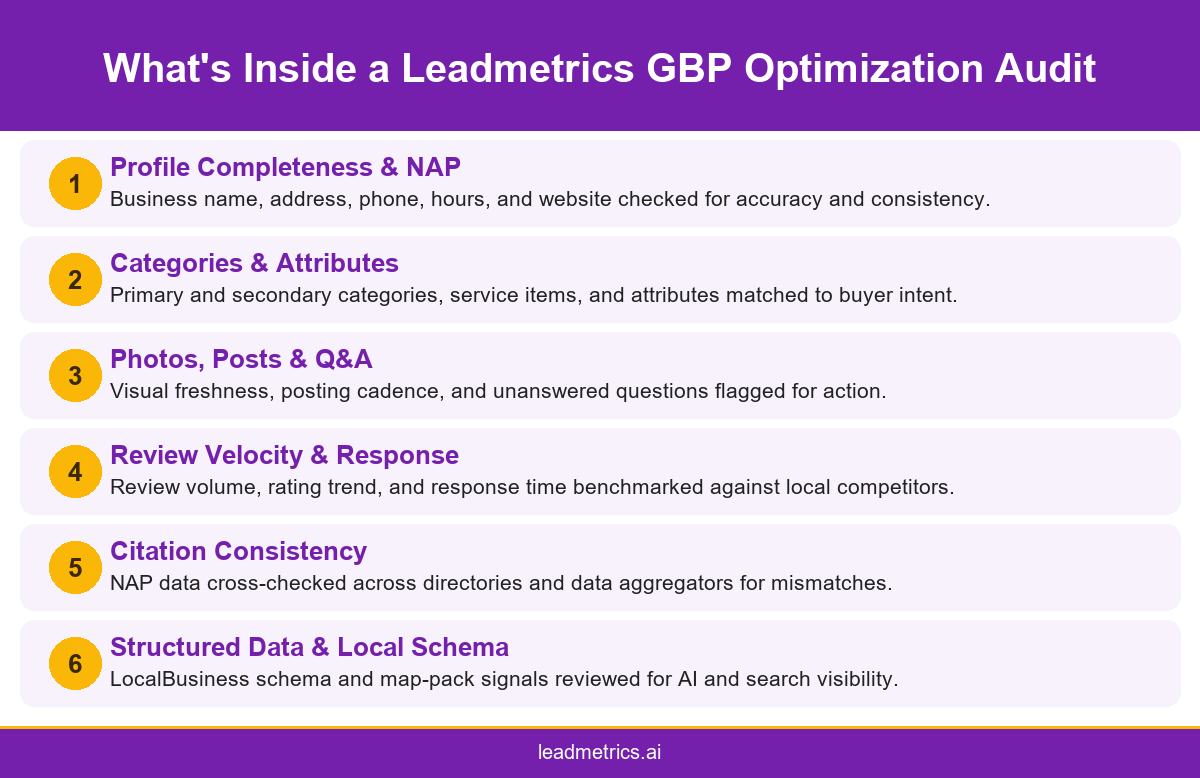
The first check is profile completeness and NAP, meaning name, address, and phone number, matched against how Google's own help documentation defines an accurate, fully verified listing. The second is category and attribute alignment, checking whether your primary and secondary categories match what buyers actually search for, not just what sounds closest to your business type.
From there, the audit reviews photo freshness and posting cadence, review velocity and response time compared to nearby competitors, citation consistency across directories and data aggregators, and finally structured data and local schema, which increasingly determines whether AI answer engines and Google's own AI Overviews surface your business at all.
Category mismatches are one of the most common findings, and one of the easiest to miss without a structured check. A clinic listed only under "Doctor" instead of also carrying "Cosmetic Dentist" or "Pediatric Dentist" will lose every search built around that specific service, even with a strong review count and complete profile otherwise. The same pattern shows up across almost every vertical: a restaurant missing a "Outdoor Seating" attribute, a contractor missing service-area categories for suburbs they actually cover, a retailer with the wrong secondary category pulling in the wrong search intent entirely. None of these show up by glancing at a profile. They show up when every category and attribute is checked against what local competitors are ranking for.
How the Audit Runs, Start to Finish
The process is intentionally short on your end. You connect or share access to your Google Business Profile, and Leadmetrics' AI powered GBP management tool scans the profile against the six-point scorecard above, cross-referencing it with three to five local competitors in your category and service area.
Within a short turnaround, you receive a scored report and a prioritized fix list, ranked by expected impact rather than alphabetically or by how easy each fix is. Some items, like adding missing service categories or correcting NAP mismatches, can be automated directly through the platform. Others, like responding to a backlog of unanswered reviews, are flagged with drafted responses ready for your approval.
Multi-location businesses get the same scorecard run against every location individually, then rolled up into a single view, so a strong flagship location does not mask a weak one two cities over. That comparison alone is usually enough to show ownership exactly where marketing spend and attention are misallocated across a footprint.
Self-Serve Audit Software vs. Hiring a Local SEO Agency
Most existing local SEO content treats an audit as something an agency does for you, on a retainer, on their schedule. That is a real option, and for some businesses it still makes sense. But it also means paying for manual labor on work that AI can now do faster and repeat monthly at no added cost.
This is the same tradeoff explored in why local SEO packages in Dubai fail and in the step-by-step approach covered in Leadmetrics' local SEO playbook for small businesses. A self-serve, software-driven audit does not replace judgment entirely, but it removes the monthly retainer for the parts of local SEO that are mechanical: consistency checks, competitor benchmarking, and repeatable fixes. For the broader version of this argument across an entire marketing stack, see AI marketing platform vs agency: what's better in 2026.
Where a GBP Audit Fits in Your Lead Generation Funnel
A higher-scoring profile does not just look better. It converts differently. Every call, direction request, and website click from your Google Business Profile is a top-of-funnel lead, and how that lead gets captured, scored, and followed up on matters as much as how it was generated in the first place. If you want the fuller picture of what happens after a GBP-sourced lead comes in, Leadmetrics' complete guide to AI lead generation for businesses walks through the rest of that funnel end to end.
This is also where local SEO management software tends to get compared directly against point tools built specifically for GBP and reviews. If you are evaluating options, Leadmetrics vs Grexa: which AI marketing platform delivers better ROI breaks down how a unified platform compares to a GBP-focused specialist tool on cost and outcomes.
What You Actually Get When It's Done
At the end of the audit, you get three things: a scored report across all six categories, a ranked fix list separating automated changes from ones that need your approval, and a baseline to measure future GBP impressions, calls, and direction requests against. Nothing is optimized silently in the background. Every change is visible, and every recommendation ties back to a specific score category, so you can see exactly why your profile moved up or down over time.
Because the scorecard is standardized, it also becomes a repeatable benchmark rather than a one-time snapshot. Running the same audit again after 30 or 60 days shows whether the fixes actually moved the needle on impressions and calls, instead of leaving you to guess whether last month's changes did anything at all.
Conclusion
A Google Business Profile that has never been audited is a guess, not a strategy. The fastest way to find out where yours is leaking visibility, calls, and reviews is a structured, scored look at all six areas that actually move local rankings. If you are ready to see your own scorecard, request a GBP optimization audit with Leadmetrics and get a prioritized fix list instead of another generic checklist.
About Author
Frequently Asked Questions
What is a GBP optimization audit?

How do I request a GBP optimization audit from Leadmetrics?
How long does the audit take to complete?
Does the audit fix issues automatically, or just report them?
How is this different from a generic GBP checklist I could run myself?
Can the audit cover multiple business locations at once?
How often should a business re-run its GBP audit?
Does a stronger GBP score also help with AI search visibility?
Do I need to already use Leadmetrics for other marketing to request an audit?
What does local SEO management software actually automate versus an agency?
What is a GBP optimization audit?
How do I request a GBP optimization audit from Leadmetrics?
How long does the audit take to complete?
Does the audit fix issues automatically, or just report them?
How is this different from a generic GBP checklist I could run myself?
Can the audit cover multiple business locations at once?
How often should a business re-run its GBP audit?
Does a stronger GBP score also help with AI search visibility?
Do I need to already use Leadmetrics for other marketing to request an audit?
What does local SEO management software actually automate versus an agency?
Share on Social Media
Ready to start
sourcing leads Online?
Explore more with Leadmetrics