
AI Lead Generation for Businesses: The Complete Guide

AI Lead Generation for Businesses: The Complete Guide
Every business needs leads. But finding the right leads at the right time, through the right channel, is where most marketing teams fall short. AI lead generation changes that equation entirely. Instead of relying on guesswork and manual sorting, AI platforms analyse behavioural signals, predict buying intent, and automate follow-up so your sales team spends time closing deals, not chasing cold contacts. This complete guide covers how AI lead generation works, how to score and nurture leads automatically, and how businesses across the UAE, India, UK, and US are using it to drive measurable growth.
Key Takeaways
AI lead generation platforms use machine learning to identify, score, and nurture leads automatically, reducing manual effort by up to 80%.
Businesses using AI for lead generation report significantly higher conversion rates because AI prioritises high-intent leads over raw volume.
The most effective AI lead generation strategies combine paid campaigns, SEO, and automated follow-up into a single, connected workflow.
What Is AI Lead Generation and Why It Matters in 2026
Lead generation is the process of attracting potential customers and capturing their contact details. Traditional approaches rely on manual outreach, generic email blasts, and broad advertising with limited targeting precision. Results are unpredictable, expensive to scale, and difficult to attribute accurately to specific marketing activities.
AI lead generation replaces that with a data-driven system. AI platforms analyse hundreds of variables simultaneously, including browsing behaviour, search intent, engagement history, and demographic data, to identify prospects most likely to convert. Instead of casting a wide net and hoping for the best, businesses focus resources on contacts already showing buying signals.
The business case is compelling. Research from McKinsey on AI in marketing shows that companies using AI in marketing and sales see a 50% increase in leads and appointments, alongside a reduction in cost per lead of up to 40%. For businesses operating in competitive markets like Dubai, Bangalore, London, or New York, that level of efficiency is not optional. It is a competitive requirement.
The Shift from Manual to AI-Driven Lead Generation
In a traditional setup, a marketing or sales team manually reviews enquiries, qualifies prospects through calls or emails, and decides who moves to the next pipeline stage. This process is slow, inconsistent, and heavily dependent on individual judgment. Two sales reps applying the same criteria can produce very different qualification outcomes, creating unpredictable revenue forecasts.
AI reverses this entirely. Qualification happens automatically the moment a prospect interacts with your content or campaigns. By the time a lead reaches your sales team, it has already been scored, segmented, and tagged with the appropriate follow-up sequence. Your team focuses entirely on high-priority conversations rather than administrative qualification tasks.
This shift is particularly valuable for SMBs and scale-up businesses that need to compete with well-resourced competitors without expanding headcount. With AI handling qualification and nurturing, a small team can manage a pipeline that would previously require three or four full-time sales staff.
Why Businesses Across UAE, India, UK, and US Are Adopting AI
Market conditions vary across regions, but the core challenge is consistent: generating quality leads at a sustainable cost. In the UAE, rapid economic growth and a highly competitive digital landscape make AI a strategic differentiator. In India, the sheer scale of the B2B and consumer markets makes manual lead management practically impossible beyond a certain business size. In the UK and US, rising customer acquisition costs are driving businesses toward AI-powered efficiency to protect their margins.
Businesses using Leadmetrics can build tailor-made digital marketing strategies that adapt in real time to shifting market signals, ensuring lead generation campaigns remain relevant regardless of the geography or sector they target.
How AI Lead Scoring Works: Qualifying Leads Automatically
Not all leads are equal. Some contacts visit your website once and never return. Others browse pricing pages, read multiple blog articles, download resources, and attend webinars before making a purchase decision. AI lead scoring assigns a numerical value to each prospect based on their behaviour, helping your team know exactly who deserves immediate attention and who needs more nurturing time.
The scoring model is built on two categories of data. Explicit data is what a prospect tells you directly: job title, company size, industry, and geographic location. Implicit data is what their behaviour reveals: which pages they visited, how long they stayed, which emails they opened, and which actions they completed. AI combines both data types to produce a dynamic, real-time score that updates every time the prospect interacts with your brand.
This eliminates one of the most common pipeline problems: sales teams chasing cold leads while high-intent prospects fall through the cracks. With AI scoring in place, your pipeline reflects actual buying readiness rather than simply the order in which contacts were added to your database.
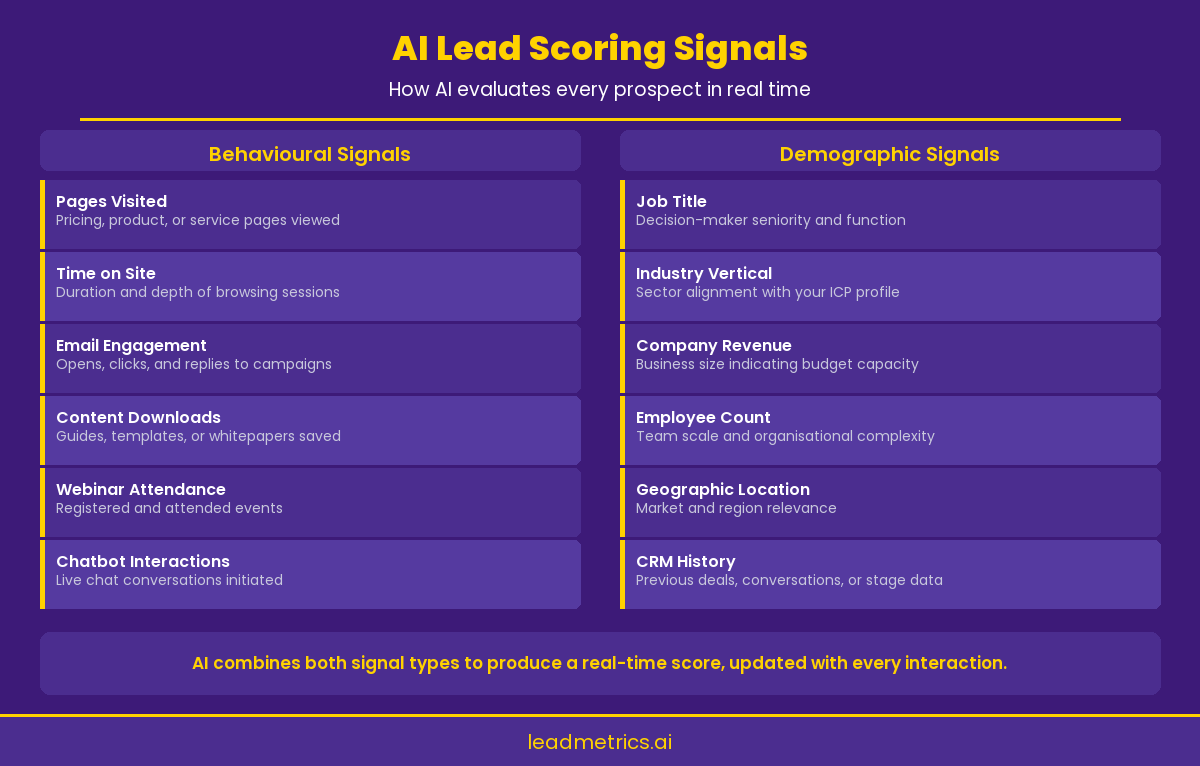
Behavioural and Demographic Signals AI Analyses
AI lead scoring models evaluate dozens of signals simultaneously. On the behavioural side, key signals include website pages visited, particularly pricing or service pages, time spent on site, email open and click rates, content downloads, webinar attendance, social media engagement, and live chat interactions. Each signal indicates a different level of purchase intent.
On the demographic side, the model considers job title, seniority level, industry vertical, company revenue, number of employees, and geographic location. The relative weight assigned to each signal is determined by your historical conversion patterns. If businesses in a particular industry convert at three times the average rate, the model automatically assigns higher scores to new prospects from that segment.
Over time, the scoring model learns from every closed deal recorded in your CRM, continuously refining the accuracy of its predictions as more conversion data flows through the system.
Real-Time Scoring Versus Traditional Batch Scoring
Traditional lead scoring runs on scheduled updates, refreshing scores once a day or once a week. This creates a dangerous lag in your pipeline. A prospect who fills out a high-intent contact form on Monday morning may not reach your sales team until Tuesday or Wednesday, by which point their interest has cooled and a competitor may have already made contact.
AI scoring operates in real time. The moment a prospect completes a high-intent action, such as visiting your pricing page, clicking through a campaign email, or spending several minutes reading a product comparison article, their score updates instantly. If the updated score crosses a defined threshold, an automated task fires immediately: the lead is assigned to a sales rep, an initial follow-up message is sent, and the contact record is updated in your CRM. All of this happens without human input, within minutes of the prospect's action.
AI Lead Nurturing: Automated Follow-Up Sequences That Convert
Most leads are not ready to buy when they first interact with your brand. Research consistently shows that only 3% to 5% of any given market is actively in a purchasing mindset at any point in time. The remaining 95% need time, relevant information, and consistent engagement before they commit to a decision.
AI lead nurturing keeps your brand visible and valuable throughout that extended journey. Instead of sending the same generic email sequence to every prospect regardless of where they are in their decision process, AI platforms personalise every communication based on the prospect's current stage, their previous engagement history, and the content they are most likely to respond to next.
The result is a nurturing system that feels personal even at significant scale. Every touchpoint is relevant to the specific individual, which builds genuine trust, reduces unsubscribe rates, and substantially improves conversion rates when the prospect is finally ready to act.
You can amplify lead nurturing results by pairing it with AI-driven social media optimization to maintain consistent brand presence across channels while automated email and retargeting sequences run simultaneously in the background.
Designing an AI-Powered Drip Sequence
A well-designed AI drip sequence operates across three distinct phases. The awareness phase delivers educational content: blog posts, industry guides, explainer videos, and thought leadership pieces that establish your expertise without pushing a direct sale. The goal is to build credibility and help the prospect understand the problem you solve.
The consideration phase shifts to product-specific content. This includes case studies showing measurable results, comparison articles that position your solution against alternatives, customer testimonials, and detailed breakdowns of features and capabilities. The prospect is evaluating options and needs concrete evidence to support their decision.
The decision phase focuses on conversion: free trial offers, live demo invitations, limited-time promotions, and direct outreach from a named account manager. The key difference from traditional automation is that AI determines which phase a prospect belongs to based on real-time behaviour signals, not simply the number of days since they first subscribed.
Personalisation at Scale Without Additional Effort
Personalisation at scale used to require intensive manual segmentation. Someone had to build separate contact lists, write multiple versions of each email, and actively manage which segment received which message at which stage of the funnel. For most teams, this was either impossible to maintain or reduced to superficial first-name personalisation that fooled no one.
AI handles this entirely automatically. The platform pulls dynamic content fields into every message, including the prospect's name, company name, industry, specific pages they visited, and the products or services they engaged with. It selects the most relevant content block for each individual based on their segment profile and determines the optimal send time based on their historical email engagement patterns.
For businesses managing hundreds or thousands of active leads simultaneously, this depth of personalisation would be humanly impossible without AI. With it, every lead receives a curated, relevant experience that feels personal, without requiring any additional effort from your marketing team.
Running an AI Lead Generation Campaign: A Step-by-Step Process
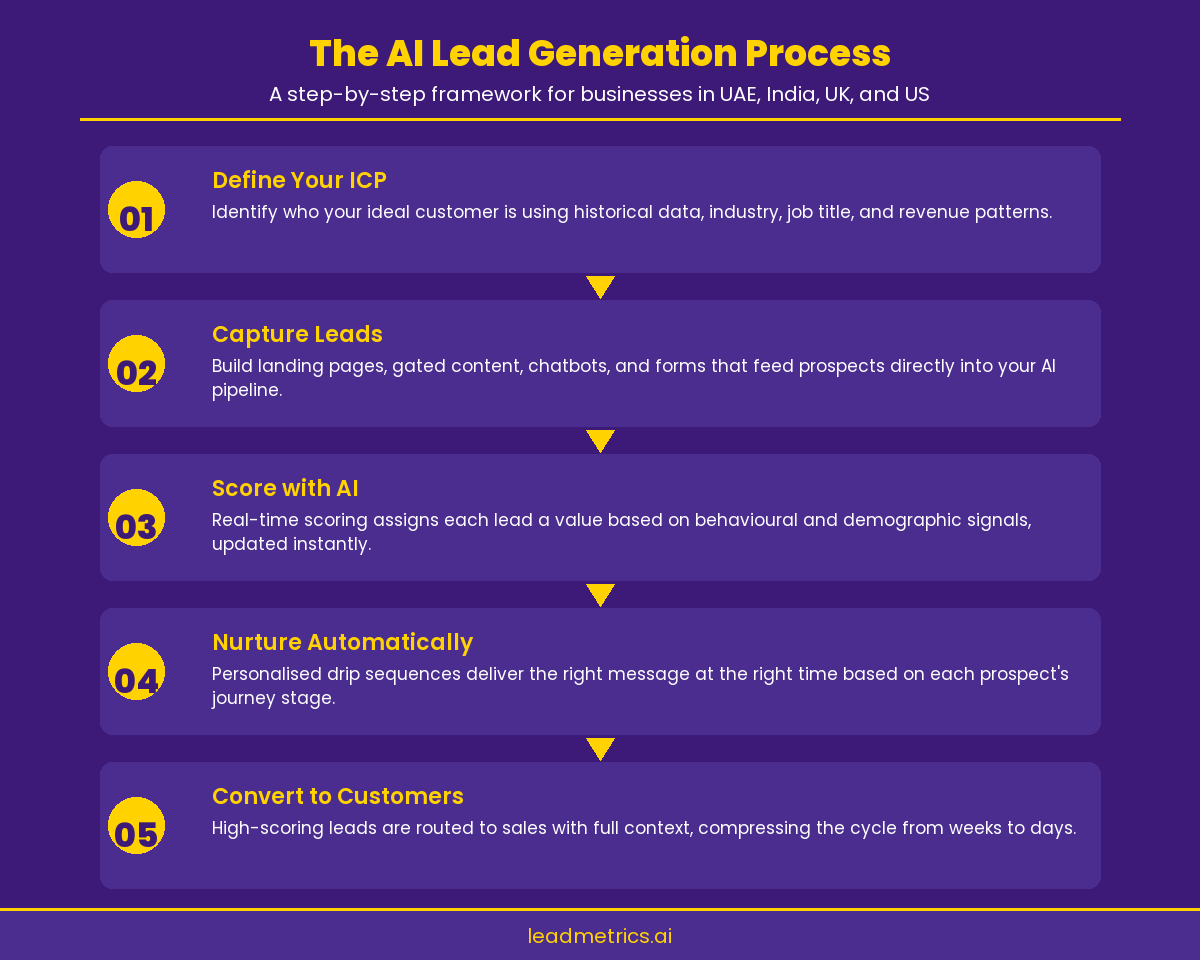
Understanding what AI lead generation does is useful. Knowing how to build and execute a campaign from the ground up is where results begin. The following five-step framework applies to businesses of any size across any market.
Step 1: Define Your Ideal Customer Profile
Before AI can identify your best leads, you need a precise picture of what a good lead looks like. Build your Ideal Customer Profile using data from your existing best customers. Look for patterns in industry sector, company size, annual revenue, geographic location, job title of the decision-maker, and the core problem that prompted them to buy. The more precise your ICP, the more accurately AI can target, attract, and score new prospects who match that profile.
Step 2: Build Your Lead Capture Infrastructure
You need multiple entry points where prospects can identify themselves and enter your pipeline. These include landing pages designed for specific campaigns, contact and quote request forms on your service pages, gated content such as industry guides, templates, or calculators, and chatbots that qualify visitors in real time. Every entry point must connect directly to your AI platform so each new contact is captured, tagged by source, and added to the scoring model immediately.
Step 3: Launch Multi-Channel Campaigns
AI lead generation performs best when campaigns operate across multiple channels simultaneously. Google Ads optimization drives traffic from high-intent search queries. AI-driven SEO captures organic search traffic over a longer horizon. Social media builds brand awareness and retargets visitors. Email campaigns re-engage dormant contacts. AI unifies data from all these channels so you can identify which combination produces the highest-quality leads at the lowest cost, and allocate budget accordingly.
Step 4: Activate Lead Scoring and Nurturing
Once leads start entering your pipeline, activate your scoring model and nurturing sequences. Set clear score thresholds that trigger specific actions: a score of 60 adds the lead to an automated nurturing sequence, a score of 80 triggers a sales alert, a score of 95 initiates immediate personalised outreach. Review and adjust these thresholds monthly based on actual conversion data from your CRM.
Step 5: Measure, Learn, and Optimise
AI lead generation campaigns are not set-and-forget. Schedule fortnightly reviews of key metrics including cost per qualified lead, lead-to-opportunity conversion rate, average pipeline velocity, and channel attribution. Use what you learn to sharpen your ICP definition, refine targeting parameters, and update scoring model weights. The AI system improves with every cycle because each new closed deal adds more training data to the model.
AI Lead Generation Across Key Industries and Markets
AI lead generation strategy differs significantly based on industry, typical sales cycle length, regulatory environment, and market maturity. Here is how it applies across the markets Leadmetrics serves.
Real Estate in UAE
Property buyers in Dubai and the wider UAE market conduct extensive online research before making direct contact with an agent or developer. They compare developments, filter price ranges, explore different communities, and read multiple buying guides over weeks or months before committing to a viewing.
AI lead generation captures these researchers early in the process, scoring each prospect based on the properties they view, the price ranges they filter, and the depth of their engagement with specific listings. By the time a prospect books a viewing, the agent already has a comprehensive picture of their preferences, timeline, and budget. This improves the quality of first conversations and compresses the sales cycle.
Healthcare in UAE and India
Healthcare lead generation requires careful attention to sensitivity and regional compliance requirements. AI helps by ensuring that only prospects who match specific qualifying criteria receive targeted communication. A specialist clinic can build an audience of users who have searched for relevant symptoms or treatments, score them based on geographic proximity and engagement depth, and nurture them with educational content before inviting them to book a consultation.
B2B Lead Generation in India
India's B2B market is vast and characterised by long decision-making cycles that involve multiple stakeholders across finance, operations, and senior management. AI lead nurturing sustains consistent brand presence across a 60 to 180-day decision cycle without requiring manual intervention. Businesses can pair AI lead generation with AI-driven search engine optimisation to capture both inbound organic traffic and paid leads in a single, unified pipeline, giving the sales team complete visibility from first touch to close.
What to Look for in AI Lead Generation Software
The software you choose determines how much value you extract from AI lead generation. The market includes dozens of tools, ranging from single-purpose point solutions that handle only one part of the process to comprehensive platforms that manage everything from campaign creation through to revenue attribution.
Essential Features to Prioritise
The platform you choose should deliver multi-channel campaign management covering paid search, social media, email, and SEO within a single interface. Real-time lead scoring with a customisable model that learns from your own conversion data is essential. Automated nurturing sequences with dynamic content personalisation ensure every lead receives relevant follow-up without manual effort. Seamless CRM integration enables clean handoff to your sales team. Transparent reporting that connects campaign spend to lead quality, pipeline stage, and revenue is non-negotiable.
Centralised dashboards matter because they eliminate the data fragmentation that affects businesses running separate tools for ads, email, CRM, and analytics. When all campaign, lead, and conversion data lives in one place, your team makes faster decisions with greater confidence and leadership has an accurate picture of marketing ROI.
Red Flags to Avoid When Evaluating Platforms
Be cautious of platforms that require extensive manual configuration before running basic campaigns. Avoid tools that report vanity metrics such as impressions and reach without connecting them directly to lead quality and conversion outcomes. Watch for proprietary data formats that make it difficult to migrate or integrate with your existing systems.
Transparency in attribution is essential. If a platform cannot show you exactly which campaign, keyword, or content piece produced a specific qualified lead, you cannot optimise intelligently. Review client results to understand how platforms perform under real-world conditions, not just in controlled sales demos.
Measuring AI Lead Generation Success: The KPIs That Matter
Too many businesses track the wrong metrics and draw the wrong conclusions. Impressions, total website visitors, and raw lead volume are useful context indicators, but they do not tell you whether your lead generation is working. These are the performance indicators that genuinely measure success.
Cost Per Qualified Lead (CPQL): Total campaign spend divided by the number of leads that meet your ICP criteria and score above your minimum threshold. This is far more meaningful than a basic cost-per-lead figure because it filters out low-quality contacts that will never convert.
Lead-to-Opportunity Rate: The percentage of generated leads that progress to a genuine sales opportunity. A consistently low rate signals a mismatch between your targeting and your ICP definition, or a gap in your nurturing sequence that is failing to move prospects forward.
Pipeline Velocity: How quickly leads move through your sales pipeline from first contact to a closed outcome. AI should accelerate this metric by ensuring leads are better qualified and better prepared when they reach your sales team, reducing discovery time in early conversations.
Lead Quality Score Distribution: The statistical spread of lead scores across your active pipeline. A healthy pipeline has most leads clustering in the mid-to-high score range. A pipeline dominated by low-scoring contacts indicates a campaign targeting problem that needs to be addressed upstream.
Channel Attribution: Which specific channels, campaigns, and content pieces produce the highest-quality leads at the lowest cost. AI makes this visible by connecting every lead back to its original source, even when prospects have touched multiple channels before converting. This data drives intelligent budget allocation.
Review these five metrics on a fortnightly basis. For industry benchmarks, the Salesforce State of Marketing report provides useful comparison data for lead generation performance across industries and company sizes.
Conclusion
AI lead generation is no longer a future capability reserved for enterprise businesses with large technology budgets. It is the operational standard for any business serious about sustainable growth in 2026 and beyond. The combination of real-time scoring, automated nurturing, and multi-channel campaign management allows businesses of all sizes to find, qualify, and convert leads at a speed and efficiency that manual processes cannot match. Whether you are targeting property buyers in Dubai, decision-makers in Delhi, or SMBs in London, the principles are the same: define your ICP, build your infrastructure, and let AI do the work.
Explore Leadmetrics pricing to find the right plan for your business, or get in touch today to start a conversation with the Leadmetrics team.
Share on Social Media
Frequently Asked Questions
What is AI lead generation?

AI lead generation uses machine learning to identify, attract, score, and nurture potential customers automatically. Unlike traditional methods, AI analyses behavioural and demographic signals in real time to prioritise prospects with the highest buying intent, reducing wasted effort and cost per acquisition.
How does AI lead scoring work?
AI lead scoring assigns a numerical value to each prospect based on behaviour such as pages visited, emails opened, and forms submitted, alongside demographic data including industry, job title, and company size. The score updates in real time and triggers automated follow-up when a threshold is reached.
What is the difference between AI lead generation and traditional lead generation?
Traditional lead generation relies on manual qualification, generic outreach, and slow follow-up. AI lead generation automates the entire process, identifying high-intent prospects instantly, personalising communication at scale, and reducing cost per qualified lead by up to 40% compared to manual methods.
How long does it take to see results from AI lead generation?
Most businesses see measurable improvements in lead quality within the first 30 to 60 days. Full campaign optimisation typically takes 90 days as the AI system accumulates enough conversion data to refine scoring predictions and improve nurturing sequence performance.
What industries benefit most from AI lead generation?
Real estate, healthcare, financial services, B2B software, and professional services see the highest ROI from AI lead generation. These industries have longer sales cycles and multiple decision touchpoints, which AI nurturing handles efficiently across markets including UAE, India, UK, and US.
How much does AI lead generation software cost?
Pricing varies based on features, contact volume, and channel coverage. Entry-level platforms start at a few hundred dollars per month, while comprehensive platforms with CRM integration and real-time scoring are priced for growing SMBs and mid-market businesses. Explore Leadmetrics plans to see pricing options.
Can small businesses use AI lead generation?
Yes. AI lead generation is accessible to businesses of all sizes. Platforms designed for SMBs offer simplified dashboards, pre-built campaign templates, and affordable pricing. The key advantage is the ability to compete with larger competitors without needing a large sales or marketing team.
What data does AI need to score leads accurately?
AI lead scoring models need website engagement data, email interaction data, CRM deal history, and campaign source data. The more historical conversion data the model has, the more accurate the scoring becomes. Most platforms improve significantly after the first 90 days of live data.
How does AI lead nurturing differ from traditional email automation?
Traditional email automation sends the same sequence based on time delays. AI nurturing adapts in real time based on each prospect's behaviour, skipping irrelevant content, accelerating through stages when intent spikes, and personalising every message based on the individual's profile and history.
How do I measure the success of my AI lead generation campaign?
Track cost per qualified lead, lead-to-opportunity rate, pipeline velocity, and channel attribution. These metrics reveal lead quality rather than just volume. Run a free marketing audit to benchmark your current performance and identify gaps in your lead generation funnel.