
Leadmetrics vs Madison: Which Suits Local Businesses

Researching Leadmetrics vs Madison usually means you run a local business and want one system instead of five. Both platforms target that problem and both automate work that used to need a person. They diverge on what happens after someone becomes interested, and on how much weight each places on reputation versus pipeline. This comparison sets out those differences plainly, including the cases where Madison is the better answer.
Key Takeaways
- Madison concentrates on local visibility and reputation, with particularly strong review generation through text, email and QR requests.
- Leadmetrics covers a wider funnel, adding lead scoring, nurture sequences and paid media optimisation alongside local work.
- If reviews and social presence are your gap, the narrower product is the better buy. If enquiries arrive and stall, breadth earns its cost.
What Each Platform Is Built Around
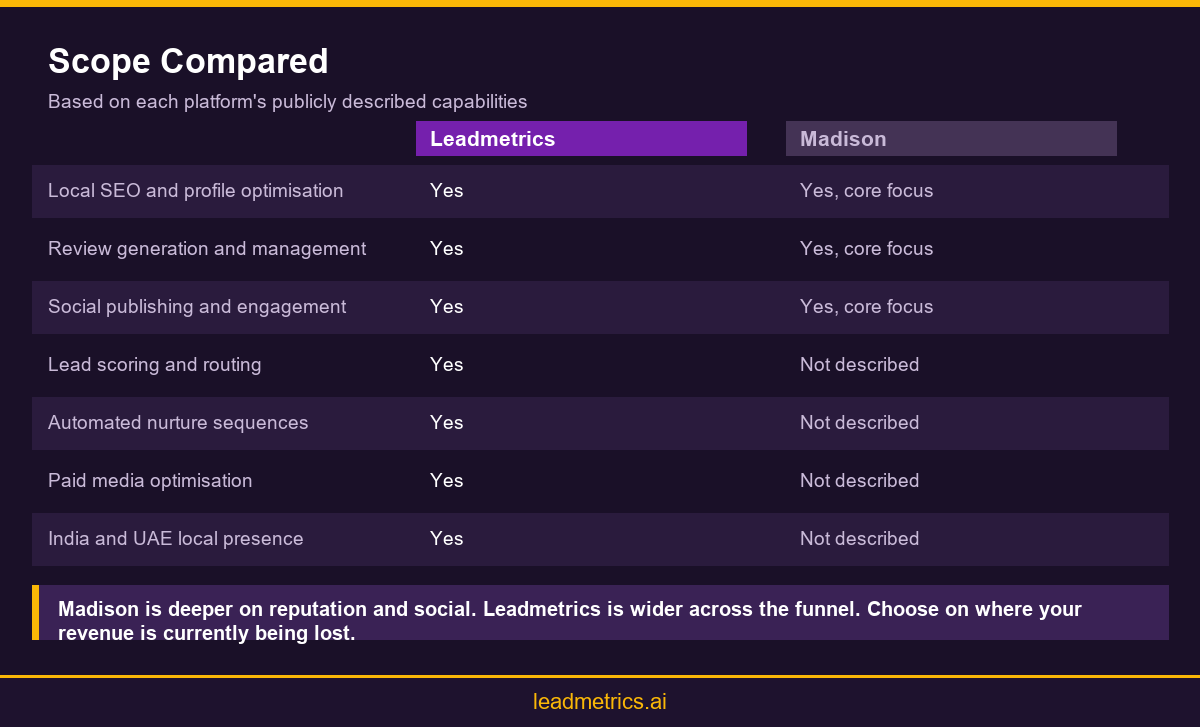
Madison positions itself as an AI marketing specialist for local businesses. Its published capabilities centre on four areas: social media management including publishing and comment handling, local SEO covering category selection and profile descriptions, review management with requests sent by text, email and QR code, and an analytics dashboard bringing those together. The product is deliberately shaped around a business that serves customers in a place.
Leadmetrics covers local visibility too, then continues further along the funnel. Alongside search, content and profile management it handles lead scoring, automated nurture, paid media optimisation across Google and Meta, and consolidated reporting spanning organic, local, social and paid. The additional scope is the difference, and whether that difference is worth paying for depends entirely on where your funnel currently leaks.
Neither product supplies strategy. Both execute against decisions you have already made about who you serve and what you charge. A business still unsure of its positioning will find either platform amplifies that uncertainty rather than resolving it, which is worth settling before evaluating software at all.
One shared characteristic is worth noting before comparing them. Both depend heavily on the quality of what you already have, particularly your service information, your photographs and a clear sense of who you serve. Neither product compensates for a business that has not decided what it is good at, and both will distribute that ambiguity faster than a human team would.
That makes your own readiness part of the evaluation. A business with accurate listings, a defined audience and a working offer will get value from either platform. A business without those will struggle with both, then attribute the disappointment to the software rather than to the groundwork that was missing.
Where Madison Is the Stronger Choice
Review generation is Madison's clearest strength, and it should not be understated. Requesting reviews through text, email and QR code, then routing positive responses toward Google, is a genuinely effective mechanism for local businesses whose ranking and conversion both depend on visible reputation. A restaurant, clinic or salon with thin review volume will feel that impact quickly.
The product is also narrower, which makes it easier to adopt. A business owner running marketing alongside three other responsibilities will configure a focused tool faster and use more of it. Breadth only pays when somebody actually operates it, and unused capability is pure cost regardless of how impressive it looked during a demonstration.
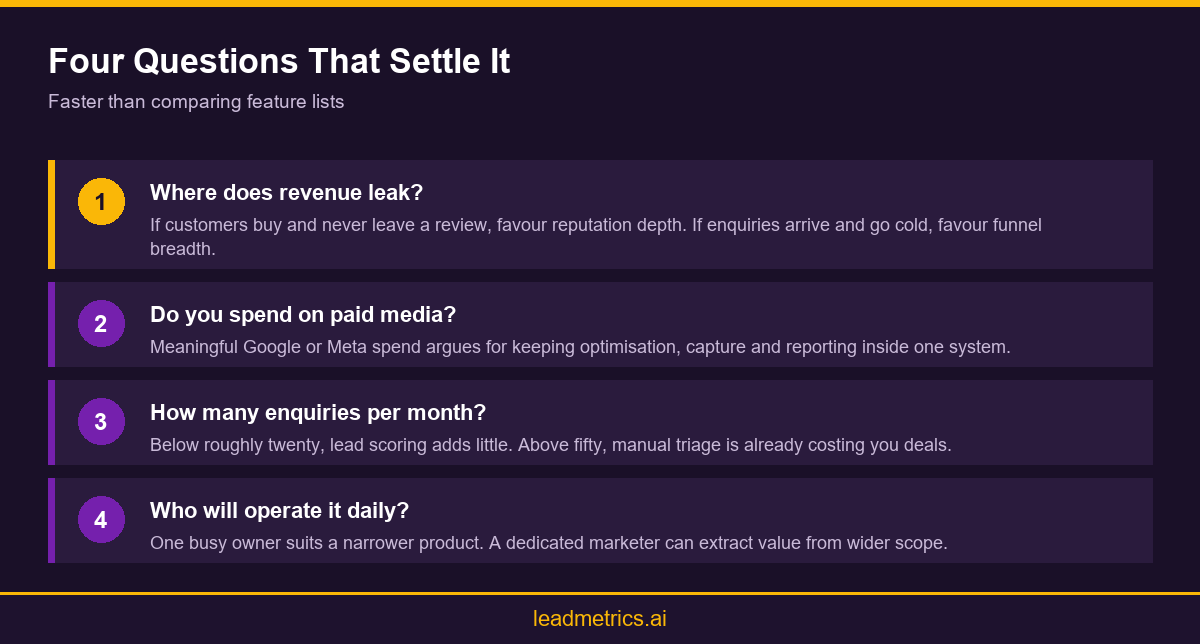
If your situation is that customers find you, buy, and leave without being asked for a review, and your social profiles sit neglected, then reputation and presence are your bottleneck. Fixing that with a product built specifically for it is a better decision than buying wider scope you will not reach.
Simplicity has a second benefit that is easy to overlook. Narrower products generate fewer decisions, and decision load is a real constraint for owners already stretched across operations, staffing and finance. A tool presenting four clear actions each week gets used. One presenting forty possible actions frequently gets opened, closed and avoided.
Review volume also compounds in a way other marketing activity does not. Each review improves local ranking slightly and improves conversion slightly, and both effects persist. A business starting from a low base will usually see clearer returns from a focused review programme over six months than from any other single marketing activity available to it.
Where the Wider Funnel Matters
The argument shifts when enquiries already arrive and value leaks afterwards. If people call, message or submit forms and responses take hours, if nobody follows up more than once, or if you cannot say which channel produced actual revenue rather than clicks, additional reviews will not fix the underlying problem.
That is where lead scoring, routing and automated nurture earn their place. Ranking enquiries so the busiest person works the right ones first, and sequencing follow up so early leads are not abandoned, addresses a different failure from the one Madison targets. The mechanics are covered in this complete guide to automated pipeline building.
Paid media is the second divergence. Businesses spending meaningfully on Google or Meta benefit from optimisation sitting in the same system as capture and reporting, because attribution survives the handoff. Where those functions live in separate tools, you end up reconciling numbers manually, which is exactly the work a platform was supposed to remove.
Response speed is the specific metric worth measuring before deciding. Count how many enquiries you received last month and how many were answered within an hour. Most local businesses find that gap considerably larger than expected, and it is usually costing more revenue than any visibility problem they are currently trying to solve.
Follow up depth is the companion measure. Most small businesses contact an enquiry once and stop, while most considered purchases require several touches across a fortnight. Automated sequencing closes that gap without adding work, which is a different kind of value from attracting more enquiries in the first place.
Regional Fit and Practical Factors
Two practical considerations frequently outweigh features for businesses in India or the Gulf. The first is support hours and billing. A vendor operating on North American time answers urgent questions overnight, which is tolerable occasionally and genuinely disruptive during onboarding. Local invoicing removes exchange exposure and monthly reconciliation work that nobody budgets for.
The second is which local channels are genuinely covered. In Indian cities a meaningful share of first contact happens through Google Business Profile and messaging apps rather than web forms. Platforms designed around Western web funnels frequently under serve both. Leadmetrics operates entities and profiles in India and the UAE, which affects invoicing, support timing and local channel handling. For a business selling wholly into North America, none of this matters.
Verify claims rather than accepting them. Madison publishes its pricing openly, which makes comparison straightforward, and you can review its stated capabilities directly at the Madison AI website. Reading both vendors' own material alongside a comparison like this one is the sensible approach, since every comparison carries the interests of whoever wrote it.
Test both against the same period rather than sequentially. Running one platform in spring and another in autumn produces a comparison contaminated by seasonality, which is particularly distorting for local businesses. A parallel trial on a single outcome over six weeks is a considerably more reliable basis for the decision.
Conclusion
Both products remove work that used to require people, and either can be correct. Madison is the stronger fit when reputation and local presence are the gap, particularly for businesses that never systematically ask for reviews. Leadmetrics is the stronger fit when enquiries already arrive and value is lost afterwards, or when paid media spend makes unified attribution valuable. Diagnose the leak before comparing interfaces. The Leadmetrics team can review your funnel and tell you honestly which applies.
Share on Social Media
Frequently Asked Questions
What is the main difference between them?

Which is better for review generation?
Is wider scope always better value?
Which suits a single location business?
Does Madison handle paid advertising?
How should I compare them fairly?
What about pricing?
Where should I start if I am unsure?