
2027 and the End of Manual Lead Scoring: What AI-Native CRMs Change for B2B Marketers

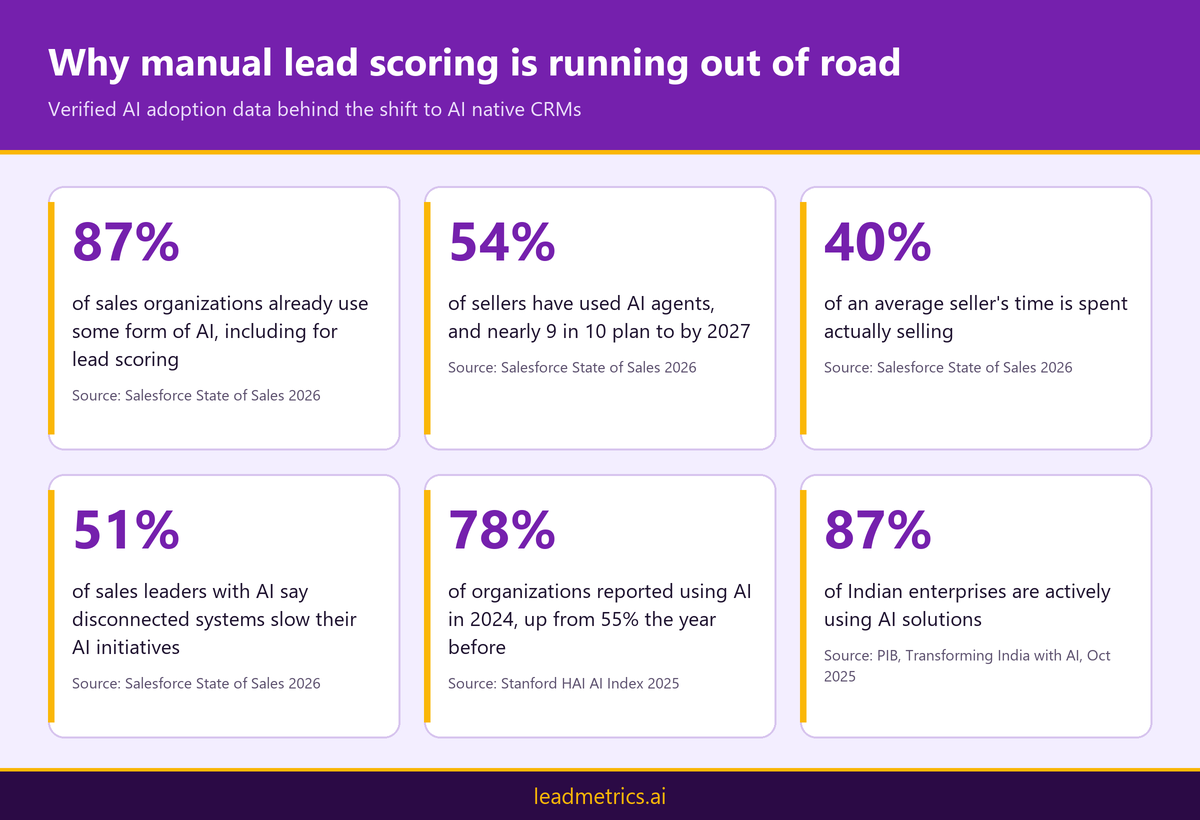
Enterprise AI is no longer a side project in India. A Government of India briefing on AI adoption reports that 87% of enterprises are actively using AI solutions. Yet many B2B teams still rank leads with point rules written years ago in a spreadsheet. That gap is why an AI CRM for lead management is becoming the default layer for marketers heading into 2027. If you want to see how this applies to your own funnel, talk to the Leadmetrics team before you plan next year's stack. This guide explains what manual scoring gets wrong, what AI native CRMs change, and how agencies can prepare.
Key Takeaways
- Manual lead scoring relies on static point rules that rarely change, while an AI CRM for lead management reweights every signal as new deals close.
- AI in sales is already mainstream, so hand tuned scoring now puts B2B teams behind competitors whose models learn from every conversion.
- Agencies choosing the best CRM for B2B marketing agencies with AI automation should prioritise connected data, multi client controls and human review.
Why Manual Lead Scoring Is Running Out of Road
Manual scoring assigns fixed points to actions such as form fills, downloads and page visits. It worked when buying journeys were short and predictable. Today, B2B buyers research across many channels before they speak to sales, and static rules cannot keep up with how often those signals change.
A typical setup looks simple. A marketer assigns ten points for a demo request, five for a webinar, and subtracts points for a free email domain. The rules made sense when they were written. Most were never revisited.
The problem is not effort. It is drift. Buyer behaviour changes every quarter, but static rules do not. A pricing page visit that once signalled intent may now be routine research. Meanwhile, sellers are losing selling time to admin. The Salesforce State of Sales 2026 research, based on a survey of 4,050 sales professionals, found that the average seller spends only 40% of their time actually selling. Gen Z reps sit at 35% and lose about two hours each week to manual data entry.
Adoption has already moved past the pilot stage. The same Salesforce study reports that 87% of sales organizations use some form of AI for tasks like prospecting, forecasting, lead scoring or drafting emails. Globally, the Stanford HAI 2025 AI Index found that 78% of organizations reported using AI in 2024, up from 55% the year before. When most competitors score leads with models that learn, a hand tuned spreadsheet becomes a disadvantage. It also makes reporting harder, because nobody can say which rule actually predicted revenue.
What an AI-Native CRM Actually Changes
An AI native CRM treats scoring as a living model rather than a settings page. It watches how leads behave, learns which patterns end in closed deals, and updates priorities without waiting for someone to rewrite the rules. For B2B marketers, that changes daily workflow as much as it changes the numbers.
It is not a legacy database with a chatbot added on top. Intelligence sits in the core workflow, so capture, qualification, scoring and follow up share the same data. Three shifts matter most for B2B marketers.
First, scoring becomes continuous. Instead of a nightly batch, every email click, form fill and return visit updates the lead's priority. Our guide on how AI qualifies leads automatically covers the mechanics in detail.
Second, context replaces points. A useful AI CRM for lead management reads lead source, engagement, pipeline stage and customer journey signals together. That is how Leadmetrics lead capture and scoring tools approach the problem, pairing automated qualification with follow up and nurturing in one system.
Third, action follows the score. A high intent signal can trigger an alert, a task or an automated nurture sequence without anyone exporting a list first. Data quality then becomes the limiting factor. Salesforce found that 51% of sales leaders with AI say disconnected systems are slowing their AI initiatives. It also found that 79% of high performers prioritise data hygiene, compared with only 54% of underperformers. Over time, a connected model also shows marketers which campaigns produce leads that close, not just leads that fill in a form.
What This Means for B2B Marketing Agencies
Agencies run lead management for many brands at once, which multiplies every weakness of manual scoring. The right platform lets one team apply client specific scoring, keep data separated and prove results in reporting, without adding headcount for every new account they take on.
Every account has its own ideal customer profile, its own funnel and its own definition of a qualified lead. Maintaining separate rule sets by hand does not scale.
This is why planning for AI powered lead management software for agencies 2027 looks different from single brand CRM buying. Agencies need client data kept apart, role based permissions for account managers and clients, and one dashboard that shows every pipeline. The Leadmetrics platform for marketing agencies is built around those needs, with multi client management, role based access control and a reviewer portal that can carry the agency's own brand.
Agencies also need a clear review step. AI can score and suggest, but a strategist should still decide what reaches a client's sales team. Leadmetrics keeps every output human approved for exactly this reason.
Evaluating AI powered lead management software for agencies 2027 roadmaps also means thinking about workload. Salesforce found that 48% of sales professionals say they lack the bandwidth to do adequate cold outreach. Agencies that automate scoring and follow up free their strategists for the conversations and campaigns clients actually pay for.
When you assess the best CRM for B2B marketing agencies with AI automation, ask three questions. Does scoring learn from each client's own conversions? Can your team see why a lead scored high? Do the scores connect to campaign and revenue reporting that clients already trust?
How to Prepare Your Pipeline Before 2027
Preparation is mostly about data and process, not software. Teams that tidy their records and connect their channels first get far more value from AI scoring, because the model has clean outcomes to learn from on day one.
You do not need to rebuild everything at once. Most teams move from manual scoring to an AI CRM for lead management in stages, and each stage pays off on its own.
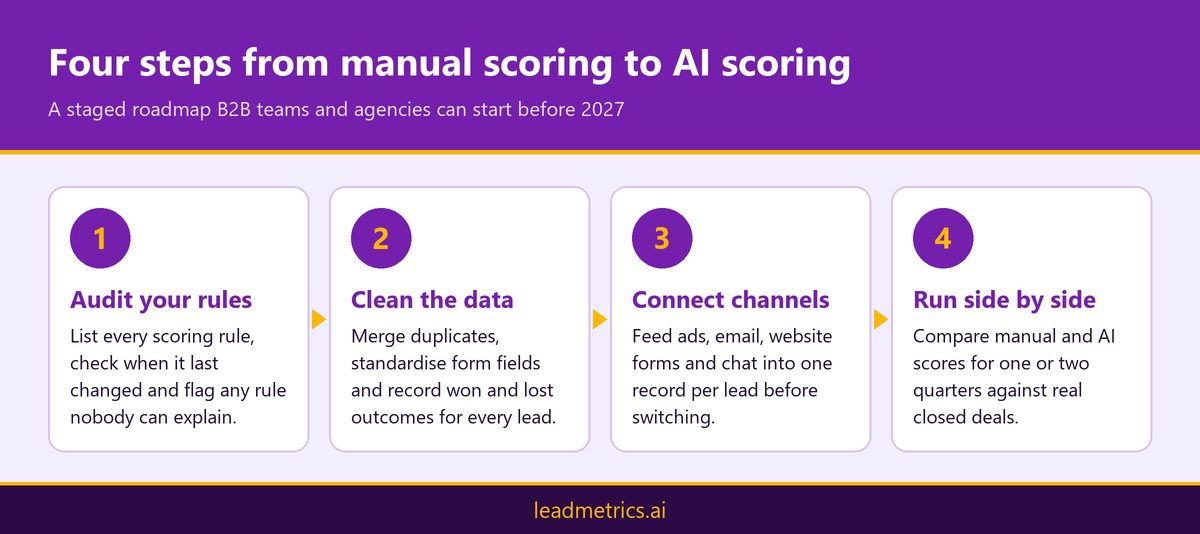
Step 1: Audit your current rules. List every scoring rule and check when it last changed. Flag any rule nobody on the team can explain.
Step 2: Clean the data. Merge duplicates, standardise form fields and make sure won and lost outcomes are recorded. AI models learn from outcomes, so missing results weaken every prediction.
Step 3: Connect your channels. Ads, email, website forms and chat should feed one record per lead. Check which of your current tools connect with the platform before you switch.
Step 4: Run both models side by side. Keep manual scores visible for one or two quarters and compare which approach predicts closed deals more accurately. Treat this period as training for your team as much as for the model, because reps trust scores once they see them match real results.
The outlook for Indian B2B firms supports moving early. The same government briefing notes that about 26% of Indian companies have achieved AI maturity at scale, according to a BCG survey. That leaves plenty of room for teams that prepare their data now to pull ahead as AI scoring becomes standard.
Conclusion
Manual lead scoring will not vanish overnight, but its limits are clear. Static rules drift, sellers lose hours to admin, and competitors already score with models that learn. An AI CRM for lead management keeps priorities current, links every score to a follow up, and gives agencies one view across every client. Teams that clean their data and test AI scoring now will enter 2027 with a sharper, faster pipeline. Ready to see what this looks like for your funnel? Book a conversation with the Leadmetrics team and map your first step.
Share on Social Media
Frequently Asked Questions
What is an AI CRM for lead management?

How is AI lead scoring different from manual lead scoring?
Will manual lead scoring disappear by 2027?
What data does an AI native CRM need to score leads well?
Why do marketing agencies need AI powered lead management software?
What should agencies look for in the best CRM for B2B marketing agencies with AI automation?
How long does it take to move from manual to AI lead scoring?
Can AI lead scoring work for small B2B teams?
Does AI lead scoring replace the judgement of sales teams?