
How AI Lead Scoring Works: Qualifying Leads Automatically

How AI Lead Scoring Works: Qualifying Leads Automatically
Not every lead deserves the same amount of attention. Some contacts visit your website once and disappear, while others read multiple articles, compare pricing, and return several times before they are ready to talk to sales. AI lead scoring tells the difference automatically, assigning every prospect a value based on real behaviour rather than guesswork. This guide explains how AI driven lead scoring actually works, what signals it relies on, and why real-time scoring outperforms the batch processes many teams still use.
Key Takeaways
AI lead scoring combines explicit data, like job title and company size, with implicit behaviour, like pages visited and emails opened, into a single, constantly updating score.
Scoring models trained on your own historical conversion data become more accurate over time, unlike static rules that never adapt.
Real-time scoring lets sales teams act on high-intent signals within minutes, instead of discovering them in a report days later.
What Is AI Lead Scoring and Why It Matters
Lead scoring assigns a numerical value to every contact in your pipeline, reflecting how likely they are to convert into a paying customer. Traditional scoring relied on static rules built by a marketing team: five points for visiting the pricing page, three points for opening an email, and so on. These rules rarely reflected what was actually driving revenue, because nobody revisited them once they were set.
AI lead scoring replaces guesswork with a model trained on your own data. Instead of fixed point values, the system learns which combinations of signals actually correlate with closed deals, and adjusts its weighting continuously as new conversions come in. Businesses that review client results consistently see fewer sales hours wasted chasing contacts who were never going to buy, simply because the model gets sharper with every deal it observes. Pairing accurate scoring with consistent social engagement tracking gives the model an even fuller view of intent before a prospect ever reaches a landing page.
This matters most for teams with limited sales capacity. A small team cannot call every lead with equal urgency, and without accurate scoring, the highest-intent prospects often sit in a queue behind contacts who will never respond. AI driven prioritisation ensures the contacts most likely to convert reach a rep first, regardless of when they entered the pipeline.
The shift also changes how marketing and sales collaborate. When scores are transparent and consistently applied, both teams work from the same definition of a qualified lead instead of arguing over whose criteria should win. Paid campaign teams can see exactly which ad sets produce high-scoring leads, while sales can trust that anything reaching their queue has already cleared a meaningful bar, reducing the friction that often exists between the two functions.
How AI Lead Scoring Models Work
Every scoring model starts with a training period, during which the AI studies historical data from your CRM: which leads converted, which stalled, and what behaviour preceded each outcome. Paid campaign data and organic search behaviour both feed into this training set, since buyers arriving through different channels often show different conversion patterns.
Once trained, the model scores new leads in real time as they interact with your website, emails, and ads. Each new data point, a page view, a download, an email click, adjusts the score immediately rather than waiting for a scheduled refresh. Social engagement data adds another layer, since a prospect who likes, comments, or shares your content is showing a different kind of intent than one who simply scrolls past an ad.
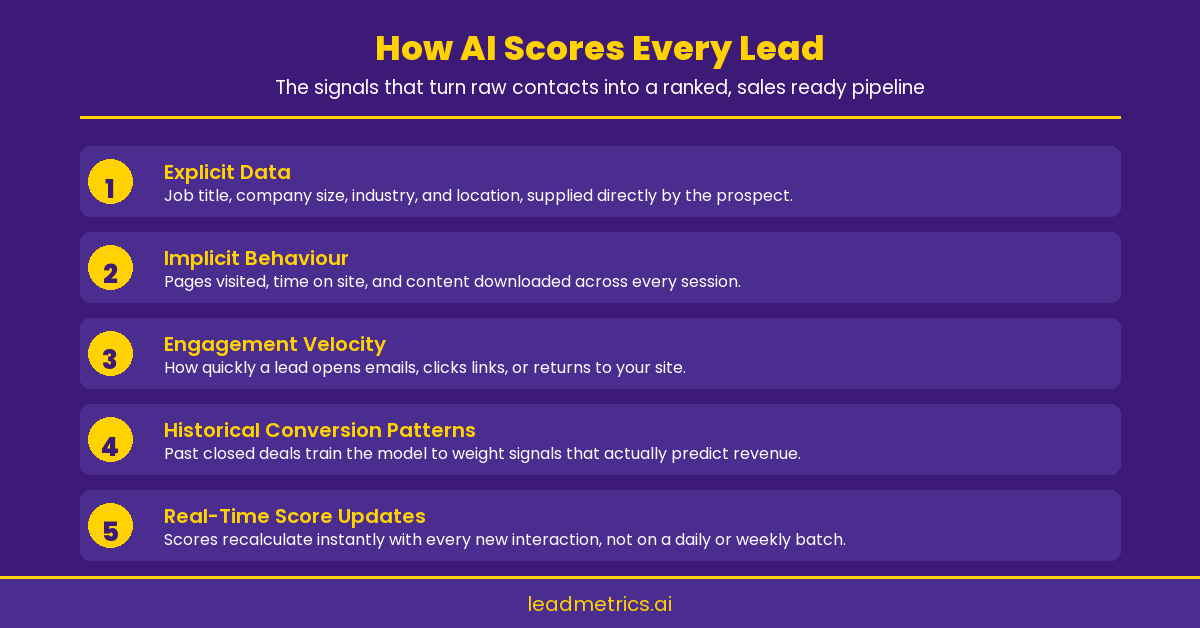
The output is a single number, but the model behind it is constantly recalculating, weighing dozens of signals against patterns it has learned from every previous deal. This is fundamentally different from a static rules engine, which never improves no matter how much data flows through it.
Most platforms also let you set score thresholds that trigger specific actions automatically. A score of 60 might add a lead to a nurturing sequence, a score of 80 might alert a sales rep, and a score of 95 might trigger immediate personalised outreach. Reviewing how other businesses set these thresholds is a useful starting point, though the right values ultimately depend on your own historical conversion data rather than a generic benchmark. Get in touch if you want help setting initial thresholds before your model has accumulated enough history to calibrate itself.
Behavioural vs Demographic Signals
Lead scoring models generally combine two categories of data. Demographic, or firmographic, signals are what a prospect tells you directly: job title, company size, industry, and geographic location. These signals filter out contacts who will never be a good fit regardless of how engaged they appear, such as a student researching a topic out of curiosity rather than a business need.
Behavioural signals capture what a prospect actually does: which pages they visit, how long they stay, which emails they open, and which content they download. A visitor who reads a pricing page twice and downloads a comparison guide is showing far more purchase intent than one who lands on a blog post once and leaves. SEO driven content often attracts this second type of visitor early in their research, well before they are ready to engage with a sales rep.
The most accurate models weigh both categories together rather than relying on either alone. A senior decision maker at a perfectly matched company who has shown no engagement at all is a weaker lead than a mid-level employee who has visited your pricing page five times this week. AI continuously adjusts how much weight each category deserves based on what your own conversion history actually shows.
Data quality determines how well any scoring model performs. Incomplete CRM records, duplicate contacts, and inconsistent form fields all weaken the signals a model has to work with. Businesses that invest in clean data collection through well structured campaign landing pages and consistent CRM hygiene typically see scoring accuracy improve within the first few months, simply because the model has clearer signals to learn from rather than noisy or conflicting data.
Real-Time Scoring vs Traditional Batch Scoring
Traditional lead scoring often runs on a schedule, refreshing once a day or once a week. This creates a dangerous lag. A prospect who fills out a high-intent form on Monday morning might not be flagged to a sales rep until Wednesday, by which point a competitor may have already responded and their interest has cooled.
AI driven scoring updates the moment a qualifying action happens. If a lead crosses a defined threshold, such as visiting a pricing page immediately after opening a campaign email, an automated task can fire instantly: the lead is assigned to a rep, a follow-up message is sent, and the CRM record updates, all within minutes of the original action. A centralized platform makes this possible by connecting scoring directly to your campaigns and CRM, rather than treating each as a separate system that only syncs periodically.
For businesses running frequent campaigns, this speed advantage compounds over time. Every day saved between a high-intent action and a sales response improves the odds of converting that lead before interest fades or a competitor intervenes. Compare Leadmetrics plans to see what a real-time scoring setup would look like for your current lead volume.
Teams switching from batch to real-time scoring often underestimate how much this changes daily workflow. Reps stop starting their morning by sorting a static list and instead receive a live feed of newly qualified leads throughout the day. Social and retargeting campaigns can also respond to score changes automatically, showing a different ad to a lead whose score just crossed a high-intent threshold than to one still early in their research.
Conclusion
AI lead scoring turns a noisy pipeline of unranked contacts into a prioritised list your sales team can act on immediately. By combining demographic fit with real behavioural signals, and updating every score in real time, AI removes the guesswork that static rules-based scoring never solved. Whether your team is managing dozens of leads a week or thousands, accurate scoring means time goes where it has the best chance of producing a result. Explore Leadmetrics pricing plans to see how AI lead scoring fits your pipeline, or get in touch to discuss your current setup.
Share on Social Media
Frequently Asked Questions
What happens after a lead crosses a high score threshold?

Most platforms trigger an automated action, such as alerting a sales rep, sending a personalised follow-up, or moving the contact into an accelerated nurturing sequence, all within minutes of the score change.