
AI Lead Generation Software: A Complete Buyer's Guide

AI lead generation software promises fewer wasted hours and better quality pipeline, but the category is crowded and the marketing claims sound identical across vendors. This guide cuts through that. You will learn what these platforms genuinely do, how automated scoring works under the bonnet, the nine criteria that separate a serious platform from a dashboard with a chatbot bolted on, and what a realistic first ninety days looks like. It is written for owners and marketers in India and the UAE who are evaluating a purchase, not researching a concept.
Key Takeaways
- These platforms do four connected jobs: capture, score, route and nurture. A tool that does only one of the four is a point solution, not a platform.
- Scoring quality depends entirely on the outcome data you feed it. Thin CRM history produces confident but useless scores.
- Weight your evaluation toward integrations, attribution, data residency and exportability. Those four decide whether you can ever leave.
What This Software Actually Does
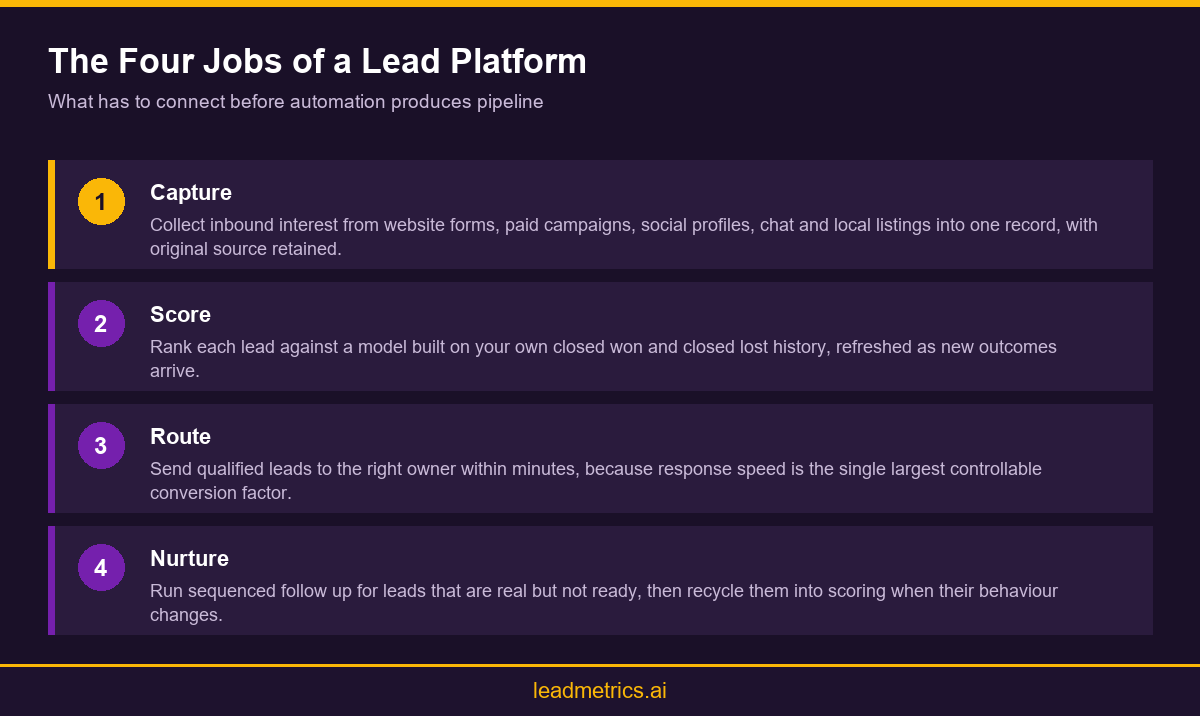
Strip away the positioning and these platforms perform four connected jobs. They capture inbound interest across your website, paid campaigns, social profiles and local listings. They score each lead against a model of who historically converts. They route qualified leads to the right owner quickly. Then they nurture everyone else with sequenced follow up until those contacts are either ready to buy or clearly cold.
The value sits in the connection between those four jobs, not in any single one of them. A form builder captures. A CRM stores. An email tool sends. Plenty of businesses already own all three and still lose leads, because nothing in that stack decides which lead matters or triggers the next action. The same consolidation logic runs through the wider category of AI powered marketing tools built for smaller businesses, where joining systems usually beats adding another point tool.
Be sceptical of any vendor that cannot explain how a single lead travels from first touch to sales handoff inside their product. If the demonstration jumps between three separate interfaces, you are looking at a bundle rather than a platform, and you will quietly own the integration work. Ask to see one record move end to end. It is the fastest way to tell a designed system from an assembled one.
One useful diagnostic before you shortlist anything: count how many enquiries reached you last month and how many received a reply within an hour. Most businesses discover the gap is larger than they assumed, and that gap, rather than any shortage of demand, is usually the problem worth solving first. Software that closes it pays for itself quickly. Software that adds another dashboard to check does not.
Finally, note what sits outside this category entirely. These platforms do not create demand. They handle demand that already exists more reliably than a person juggling other work can. If your problem is that nobody is enquiring, the answer is upstream in positioning, offer and visibility, and buying lead handling software will simply give you a very efficient way to process an empty queue.
How Automated Lead Scoring Works
Scoring is where most of the intelligence sits, and where most of the disappointment comes from. A model learns from your historical outcomes. It examines which firmographic traits, behaviours and sources preceded a closed deal, then applies those patterns to incoming leads. The output is a rank, not a verdict. Treating it as a verdict is how teams lose good leads that happened to arrive through an unusual route.
Modern scoring draws on established predictive analytics techniques, applied to a narrow commercial question. That narrowness is a strength. You are not asking the system to understand your market, only to notice that leads resembling these forty previous customers tend to close, and leads resembling those two hundred tend not to.
It also helps to understand what scoring cannot do. It cannot tell you whether your offer is priced correctly, whether your positioning resonates, or whether a lead who looks perfect on paper has already signed with a competitor. Those remain commercial judgements. Scoring narrows where attention goes, which is valuable precisely because attention is the scarcest resource in a small sales team, but it does not substitute for knowing your market.
Ask to see the score distribution across a sample of your own leads during the trial. A healthy distribution spreads across the range. A distribution where almost everything lands in the middle indicates the model has found no meaningful signal, which usually traces back to insufficient or poorly labelled history rather than to any weakness in the algorithm itself.
The Data It Needs
A useful model needs several hundred labelled outcomes at minimum, covering both wins and losses. Losses matter more than teams expect, because a model trained only on wins has nothing to contrast against and will happily rank everything highly. If your CRM records outcomes inconsistently, fix that before buying anything. The mechanics are covered in more depth in this breakdown of how automated qualification ranks inbound enquiries.
Where Scoring Goes Wrong
Two failure modes dominate. The first is a cold start, where the model has too little history and simply mirrors your loudest channel. The second is drift, where the model keeps scoring against a market that has since moved. Ask any vendor how often models retrain, and what happens in month one when history is thin. A credible answer includes a rules based fallback and a stated retraining cadence.
Reading Scores Correctly
Scores are most useful as bands, not numbers. Splitting into three or four bands and measuring contact rate and conversion within each band tells you whether the model separates quality at all. If band one and band three convert at similar rates, the model is not working, regardless of how precise the underlying numbers look on a dashboard.
Nine Criteria That Separate Platforms
Feature lists converge quickly in this category. Almost every vendor claims scoring, automation and reporting, and almost every demonstration looks competent. The differences that matter show up in less glamorous places, and they are the ones that determine whether the purchase still looks sensible eighteen months later.
Work through them in order of consequence. Integration depth comes first, because a platform that cannot read the systems you already run will never score accurately. Attribution comes second, because without it you cannot defend the spend to anyone holding a budget. Exportability comes third, because it is the only genuine protection against a supplier relationship that turns.
Score each shortlisted vendor against all nine rather than reacting to whichever demonstration was most polished. Many of the same tests apply when you are comparing platforms on return rather than feature count, and the discipline of scoring forces the conversation away from interface aesthetics and toward operational fit.
One practical warning on trials. Vendors configure demonstration environments with clean data and generous assumptions, which makes every platform look capable. Insist on running the trial against your own records, including the messy ones. The platforms that handle duplicate contacts, partial records and inconsistent source tagging without complaint are the ones that will survive contact with your actual operation. Those that require pristine input will quietly shift that cleaning work onto your team.
Weighting is a conversation as much as a calculation. Run the exercise with whoever owns sales, not only marketing, because the two functions weight speed, volume and qualification quite differently. A platform chosen purely on marketing criteria frequently produces beautiful reporting alongside a sales team that quietly reverts to working its own list, which is the most expensive failure mode in this category.

Build, Buy or Keep the Agency
Three routes exist and each fails in a different way. Building gives you exact fit and full control, then quietly consumes engineering capacity forever, including the maintenance nobody budgets for. Buying gives you speed and a maintained product, at the cost of working inside someone else's model of how leads should flow. Keeping an agency gives you people who think, but the cost scales with volume and the institutional knowledge walks out when the contract ends.
For most businesses under fifty staff, buying wins on arithmetic alone. The honest comparison is not platform against agency in the abstract. It is platform cost against the fully loaded cost of a retainer plus the tools the agency still expects you to pay for separately. That trade off is examined directly in this analysis of choosing between software and a retained team, and again from the internal angle in what changes when you automate instead of hiring.
Above roughly fifty staff the calculation shifts. Larger teams tend to need strategic direction more than execution capacity, and a hybrid of platform plus a smaller strategic advisor usually outperforms either option on its own. The mistake at that size is buying a platform and expecting it to supply judgement.
There is a fourth route that deserves mention, because a surprising number of businesses end up there by accident: running a platform while still paying an agency to operate it. This occasionally makes sense during a transition, but it frequently persists long after the transition should have ended, and you end up carrying both cost structures. If you choose it deliberately, set a date for the handover and hold to it.
Whichever route you choose, write down the assumption you are testing and the date you will test it. Teams that commit to a specific review point make clear decisions at that point. Teams that do not tend to drift, renewing by default and accumulating tools nobody has evaluated in two years. The discipline costs nothing and consistently improves the quality of the eventual decision.
Integration, Compliance and Data Residency
Two technical questions decide more than any feature demonstration. First, can the platform read from and write to the systems you already operate, including your CRM, ad accounts, analytics and local listings. Second, where does your customer data physically live, and can you retrieve it in a usable form on demand.
Data residency now matters commercially as much as legally. Businesses selling into regulated sectors across India and the UAE are increasingly asked where lead data is stored, and a vague answer costs deals. Vendors operating to recognised standards such as ISO 27001 information security management will answer this quickly and in writing. Those who cannot supply it during a sales cycle will not supply it during an audit either.
Compliance questions are also worth raising early because they filter the shortlist efficiently. Ask each vendor three things in the first call: where data is stored, how long it is retained, and what the deletion process looks like when a customer requests it. Those three questions eliminate weaker vendors faster than an hour of feature comparison, and they cost you almost nothing to ask.
Consider the reverse direction too. Beyond reading your systems, can the platform write back usefully. Pushing a score into your CRM so a salesperson sees it where they already work is far more valuable than requiring them to open a second application. Adoption in sales teams follows convenience closely, and a system that demands a context switch tends to be ignored regardless of how good its reasoning is.
The Export Test
Before signing anything, ask for a full export of a trial dataset. Not a formatted report, the underlying records with every field intact. If export turns out to be a support ticket rather than a button, treat that as a serious warning. Portability is the difference between a supplier relationship and a hostage situation, and verifying it early costs you nothing.
Integration Depth Versus Integration Count
A long logo wall of integrations means very little. What matters is whether the connection is bidirectional, how often it syncs, and what happens when it fails. A one way nightly push into your CRM is not an integration in any meaningful sense. Ask specifically about sync frequency and error handling.
Implementation and the First Ninety Days
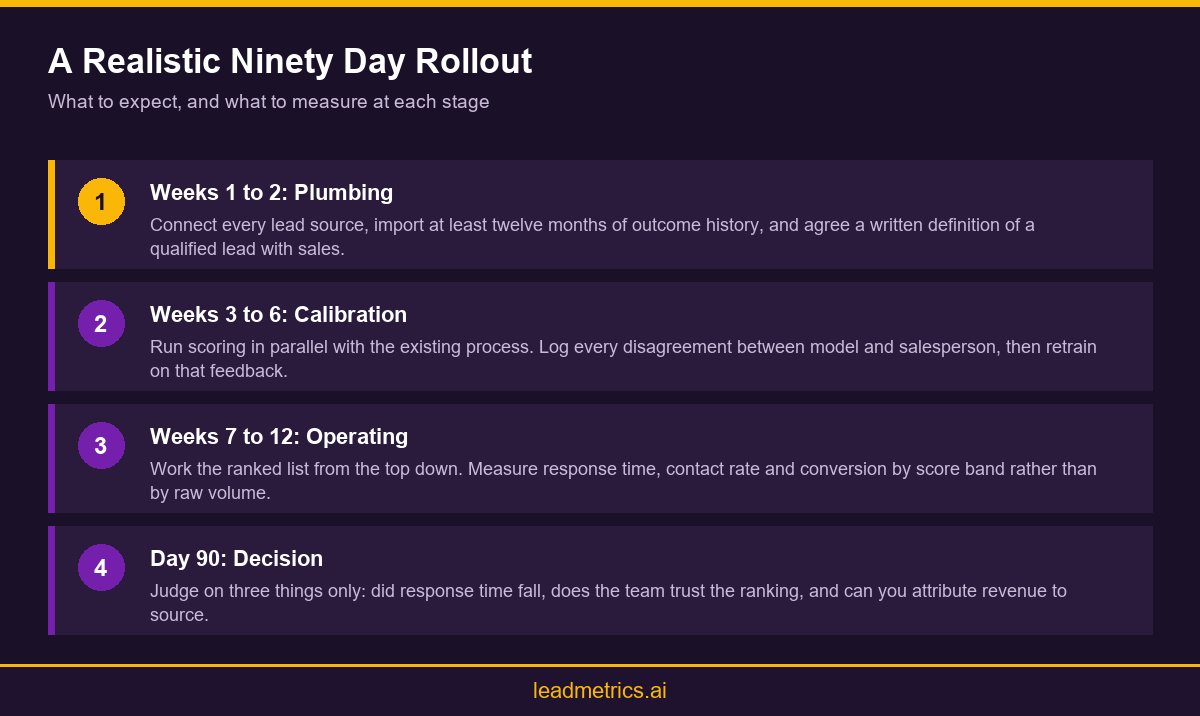
Realistic implementation runs in three stages. Weeks one and two are plumbing: connect every source, import historical outcomes, and agree a written definition of a qualified lead that sales actually accepts. Weeks three to six are calibration: the model produces scores, your team disagrees with some of them, and that disagreement is the training signal. Weeks seven to twelve are normal operation, producing the first defensible read on whether quality improved.
Set expectations accordingly with whoever approved the budget. Anyone promising transformation in week one is selling rather than implementing. The honest measure at ninety days is narrow: did response time fall, does the team trust the ranking enough to work it from the top down, and can you now attribute closed revenue to a specific source.
Sequencing carries half the workload and receives a fraction of the attention. Most leads are not unqualified, they are simply early, and the difference between a platform that recycles them and one that abandons them is substantial over a year. This guide to automated follow up that moves early leads forward covers that half in practical detail.
Resist the temptation to connect every source on day one. Teams that start with their two highest volume channels, get scoring working properly against those, then expand, reach a trustworthy model considerably faster than teams that connect nine sources simultaneously and spend six weeks debugging attribution. Narrow and working beats broad and uncertain, particularly in the first month when confidence in the system is still being established.
Assign a named owner before the first connection is made. Implementations that belong to everyone belong to nobody, and the calibration stage in particular requires someone willing to chase salespeople for feedback on scores they disagreed with. That feedback loop is what converts a generic model into one tuned to your business, and it does not happen on its own.
What Changes for India and UAE Buyers
Two markets, two different pressures. In India, the binding constraint is usually cost discipline combined with channel fragmentation. Buyers arrive from organic search, local listings and messaging apps in roughly equal measure, so breadth of capture matters more than depth in any single channel. Pricing sensitivity is real, and platforms billed in foreign currency without local invoicing create friction at every renewal.
In the UAE the pressure is different. Competitive cost per click is high, and a growing share of buyers begin research inside AI assistants rather than a traditional search box. That splits discovery from conversion as separate problems, which is why optimising for generative answer engines now sits alongside conventional search work rather than replacing it. Google's own guidance on creating helpful, reliable content remains the sane foundation underneath both.
Businesses operating in both markets should insist on reporting split by market rather than a blended figure. A blended cost per lead conceals which market is subsidising the other, and that concealment tends to persist until someone questions why growth in one region never converts into revenue.
Currency and invoicing deserve more attention than they usually receive in either market. A platform priced in dollars looks competitive at signing and considerably less so after an unfavourable year of exchange movement. Ask whether local invoicing is available, whether pricing is fixed at renewal, and what notice period applies. These are unglamorous questions that determine whether the relationship stays comfortable into year two and beyond.
One further regional difference is worth planning for. Sales cycles in the UAE frequently involve more stakeholders than equivalent deals in India, which means a lead that goes quiet is often still progressing internally rather than lost. Scoring models that penalise silence too aggressively will demote exactly the opportunities worth nurturing, so check how the system treats inactivity before trusting its rankings across both markets.
Conclusion
Choosing well comes down to three disciplines. Insist that capture, scoring, routing and nurture genuinely connect rather than merely sit beside one another. Weight your evaluation toward integration, attribution and exportability, because none of the three can be added later. Then judge the purchase at ninety days on response time, team trust and attributable revenue, rather than on dashboard activity. Get those three right and the software earns its place quickly. To see how this maps onto your current setup, book a walkthrough with the Leadmetrics team.
Share on Social Media
Frequently Asked Questions
What does this category of software actually automate?

How much historical data is needed before scoring is useful?
Will this replace my sales team?
How fast should lead routing happen?
What is the most common implementation mistake?
Can I export my data if I decide to leave?
Does it work for businesses that sell offline?
How is this different from a CRM?
What should I measure in the first quarter?
Does regional reporting really matter?