
Why Your Blogs Are Not Ranking: The Indexation Problem

Publishing consistently and ranking for nothing is one of the most demoralising positions in content marketing, and blog indexation issues are the usual explanation. If search engines are not indexing what you publish, adding more will not help. This article explains how to diagnose the problem properly, what actually causes it, and why fixing indexation almost always outperforms publishing another ten articles.
Key Takeaways
- Check indexation before questioning content quality. A page that is not indexed cannot rank regardless of how good it is.
- Thin, duplicated and near identical pages are the most common cause, and they damage the whole site rather than only themselves.
- Fixing indexation raises the return on everything already published, which is usually a better investment than publishing more.
Diagnose Before You Diagnose Content
The instinct when content underperforms is to question the content. That is occasionally correct and frequently premature, because a page that has not been indexed has never had the opportunity to rank. Judging its quality on a ranking it was never eligible for tells you nothing useful.
Start with the coverage report in Search Console and compare the number of pages you have published against the number actually indexed. If that ratio is well below eighty percent, indexation is your binding constraint and content quality is a secondary question. Twenty percent indexation means four in five articles are invisible regardless of how well they were written.
Check the reason given for exclusions as well, because the categories matter. Pages marked as discovered but not indexed suggest a crawl or quality signal problem. Pages marked as crawled but not indexed suggest the content was assessed and not considered worth including, which is a different and more uncomfortable diagnosis. Google's crawling and indexing documentation explains what each status means.
Run the check on a specific subset rather than the whole site where possible. Filtering the coverage report to blog URLs alone frequently reveals a considerably worse picture than the site wide figure, because product and service pages usually index reliably and mask the problem sitting in content.
Sample individually as well. Take ten recently published articles and inspect each URL directly. This takes fifteen minutes and gives a clearer sense of the pattern than an aggregate percentage, particularly whether the problem affects everything or only certain categories, templates or publication periods.
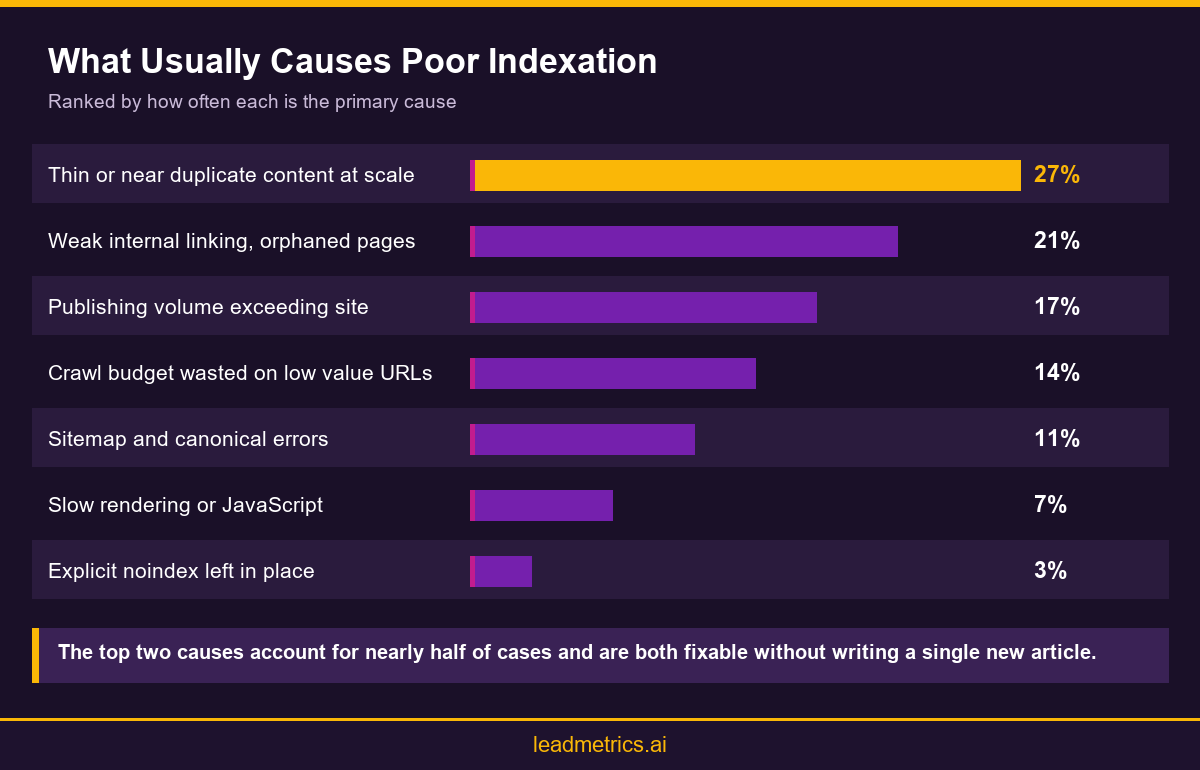
Why Near Duplicates Damage Everything
The most common underlying cause is publishing many articles that cover substantially the same ground. Six variations of the same guide do not compete with each other cleanly. They dilute the signal, and search engines respond by indexing one and disregarding the rest, or in worse cases by treating the overall site as low value.
That last consequence is what makes duplication expensive. The damage is not contained to the duplicated pages. A site carrying a large volume of thin or repetitive content can find its genuinely useful articles indexed more slowly and ranked less confidently, which means the weak content is actively taxing the strong content.
The fix is consolidation rather than deletion. Merge overlapping articles into one substantially better piece, redirect the others to it, and keep the internal links pointing somewhere useful. This usually reduces page count and increases traffic simultaneously, which is counterintuitive enough that teams resist it until they try it once.
Identifying duplication is easier than teams expect. Group published titles by their main topic and count how many address substantially the same question. Any group of three or more is a consolidation candidate, and most sites with an indexation problem contain several such groups that accumulated gradually without anyone deciding to create them.
Consolidation also improves what remains. Merging four thin articles produces one piece with more depth, more supporting detail and a stronger claim to the topic, which is exactly the shape of content that indexes and ranks reliably. The gain comes from concentration rather than from writing anything genuinely new.
Internal Linking and Orphaned Pages
Pages with no internal links pointing at them are difficult to discover and easy to disregard. Many blogs accumulate orphans steadily, because each new article links outward to older ones while nothing ever links back to the newest material. Over a year that produces a long tail of published pages nothing references.
Fixing this is mechanical rather than creative. Map which published pages receive no internal links, then add contextual links from related articles. Every page worth keeping should be reachable within three clicks of the homepage, and should have at least three internal links pointing to it from relevant content.
Publishing order matters here too. Pillar and hub pages should exist before the articles that link to them, so the structure forms as content is published rather than being retrofitted later. Retrofitting works, but it is considerably more effort than building it correctly from the start, and the broader approach to building organic visibility is covered in this guide to driving traffic organically.
Navigation and archive structure contribute more than most teams credit. Blogs that rely entirely on chronological pagination bury older articles many clicks deep, which signals low importance regardless of quality. Category and topic hubs solve this by giving every article a permanent, shallow route from the homepage.
Check where the internal links point as well as whether they exist. Links concentrated on a handful of popular pages while the rest receive nothing will reinforce the existing imbalance. Distributing links toward pages that currently receive none is what actually changes the picture.
Fix the Constraint Before Adding Volume
The temptation when traffic is flat is to publish more. Where indexation is the constraint, this makes the situation worse. Additional thin content deepens the quality signal problem, consumes crawl budget that better pages need, and produces more pages competing for the same queries.
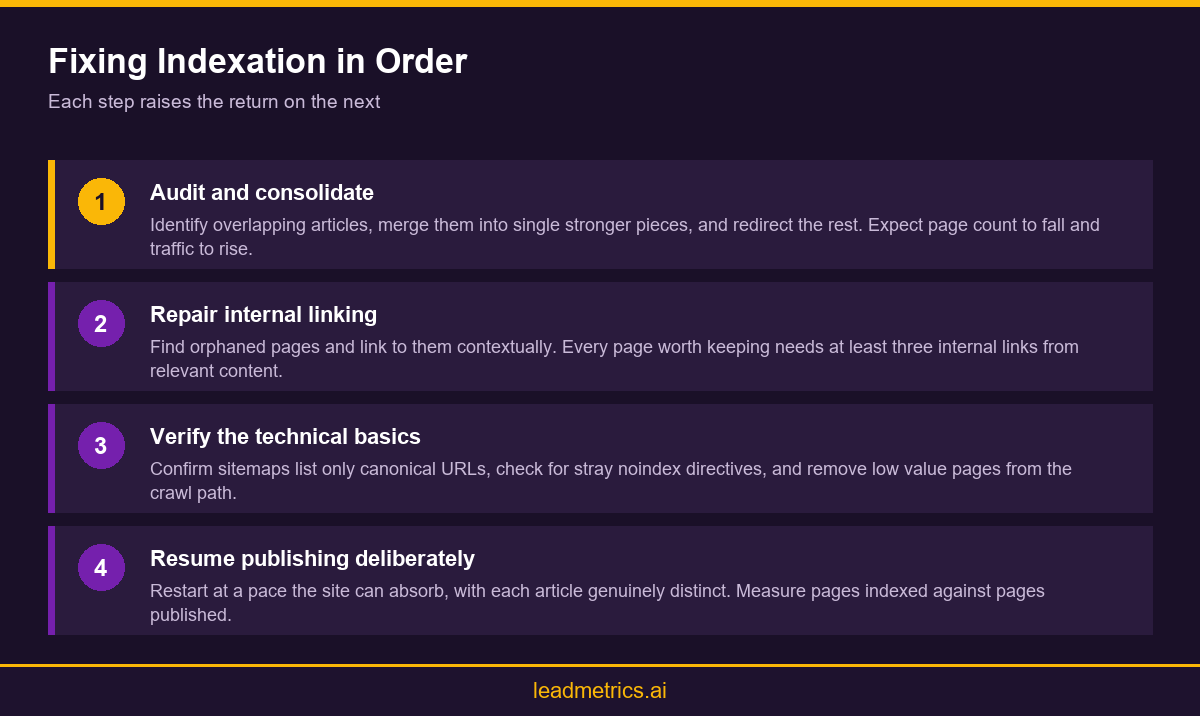
Sequence the work instead. Audit and consolidate what exists. Repair internal linking and remove orphans. Confirm sitemaps and canonicals are correct. Then resume publishing, at a rate the site can actually absorb, with each new article genuinely distinct from everything already published.
Measure the ratio rather than the count. Pages indexed against pages published is the number that tells you whether the underlying problem is improving, and it responds within weeks rather than quarters. Once that ratio is healthy, content quality becomes the right thing to question, and the answers you get will actually be about the content.
Set a realistic publishing rate once the cleanup is done. Sites frequently publish faster than their authority supports, which guarantees a growing backlog of unindexed pages. Fewer, stronger articles published consistently outperform a higher volume that search engines decline to include, and the difference compounds over a year.
Conclusion
If a large share of what you publish is not indexed, that is the problem worth solving and no amount of additional content will address it. Audit and consolidate overlapping articles, repair internal linking so nothing is orphaned, verify the technical basics, then resume publishing at a sustainable pace. Fixing indexation raises the return on everything already written, which is almost always a better investment than writing more. The Leadmetrics team can run the audit with you.
Share on Social Media
Frequently Asked Questions
How do I check whether my pages are indexed?

What does discovered but not indexed mean?
Will publishing more content help?
Is deleting old content advisable?
How many internal links should a page have?
How long does improvement take?
Can duplicate content harm the whole site?
Where does AI search visibility fit in?