
What AI Marketing Platforms Actually Cost in India

Working out AI marketing platform pricing in India is harder than it should be, because many vendors publish nothing and those who do publish rarely explain what triggers the next tier. This article covers the four pricing models you will encounter, where costs hide, and how the total compares against the two alternatives most Indian businesses are genuinely choosing between: an agency retainer or a part time hire.
Key Takeaways
- Compare total cost over twenty four months at several growth scenarios, not the monthly headline figure.
- Usage based pricing becomes expensive exactly when the platform starts working, which is worth modelling before signing.
- The honest comparison is against a retainer or a hire, including the tools those options still require.
The Four Pricing Models
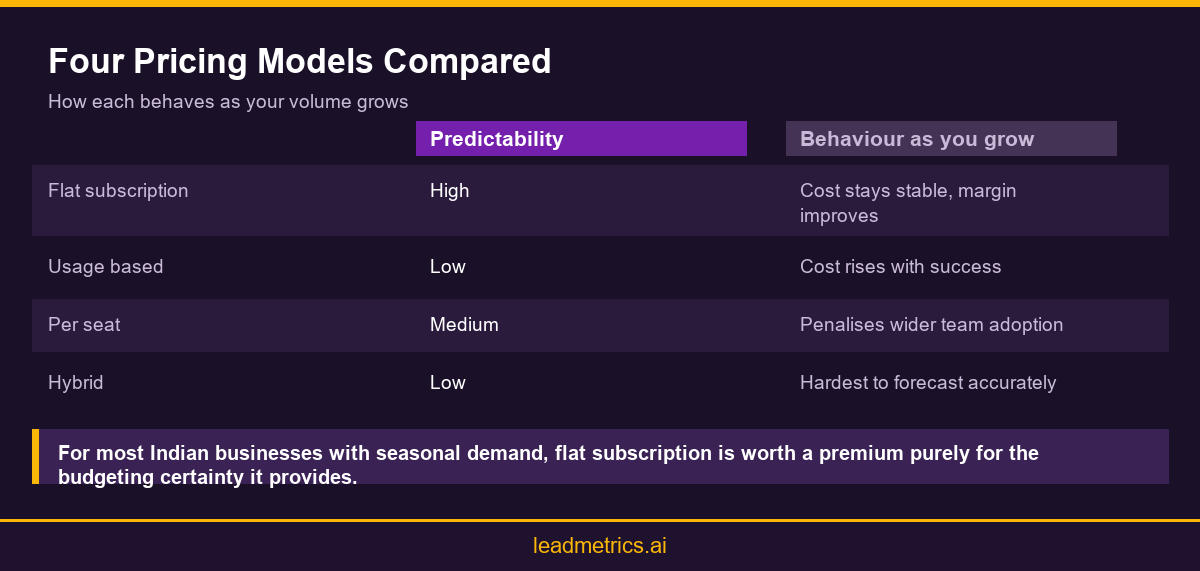
Flat subscription charges a fixed fee regardless of volume. It is the easiest to budget and usually the best choice for businesses with seasonal or unpredictable demand. Usage based pricing charges per contact, per lead or per action, and looks inexpensive at trial volume for exactly the reason it becomes expensive at scale.
Per seat pricing charges by user, which quietly penalises involving more of your team. That is the opposite of what healthy adoption looks like, and it frequently results in shared logins that undermine reporting. Hybrid models combine a base fee with usage components and are the hardest to forecast, which is occasionally the point.
One further variation deserves attention: pricing that changes by channel. Some platforms charge separately for each connected channel, which makes the headline figure attractive and the realistic figure considerably higher once you connect everything you actually use. Ask for a quote reflecting your full channel list rather than a starting configuration.
Annual versus monthly billing is the other lever vendors use. Annual commitments typically carry a meaningful discount, and for an established relationship that is reasonable value. For a first purchase the flexibility is usually worth more than the saving, because fit becomes clear within a quarter and being locked into a mismatch is expensive in more than money.
Whichever model you face, ask for the pricing in writing with the assumptions stated. Verbal quotes drift, and a written quote naming your channel count, contact volume and user numbers gives you something to hold at renewal. It also surfaces disagreements about scope while they are still cheap to resolve.
Broader industry context helps calibrate expectations here. Independent overviews of marketing technology and its cost structures are useful for understanding why pricing in this category varies so widely between products that appear superficially similar.
Where the Costs Hide
Four costs routinely sit outside the headline figure. Onboarding and implementation are frequently charged separately and can equal several months of subscription. Integrations are sometimes priced individually, particularly for anything outside the vendor's standard list. Data export is occasionally charged at exit, which is worth discovering before you sign rather than when you leave.
The fourth is renewal uplift. A platform priced attractively in year one can rise sharply in year two, and the negotiating position at renewal is considerably weaker than at purchase because your data already lives there. Ask directly what governs renewal pricing and get the answer in writing.
Support tiers are a fifth hidden cost worth checking. Products that appear competitively priced sometimes place reasonable response times behind a premium tier, which means the quoted figure buys you the software but not the ability to get help promptly when something breaks. Ask what response time the standard plan actually guarantees.
Data enrichment and third party lookups can also carry per record charges that sit outside the subscription entirely. These are easy to overlook because they are small individually and meaningful in aggregate. Ask which features call external services and how those calls are billed.
Contract auto renewal is the fifth cost that catches businesses out. Many agreements renew automatically unless cancelled within a notice window, and that window is often shorter than the time it takes to evaluate alternatives. Note the date in a calendar at signing rather than trusting that someone will remember eleven months later.
Currency and Billing in the Indian Market
Foreign denominated pricing carries a cost that does not appear in any comparison sheet. Exchange movement affects renewals unpredictably, foreign transaction charges apply on each payment, and reconciliation becomes an administrative task somebody has to own each month.
Local invoicing in rupees with appropriate tax documentation removes all three frictions. It is worth asking about early, because vendors who cannot invoice locally often cannot support locally either, and the two limitations tend to arrive together.
Payment method matters alongside currency. Vendors who only accept international cards create friction for businesses that prefer bank transfer or local payment rails, and that friction arrives every renewal cycle rather than once. It is a small question that saves a recurring administrative irritation.
Tax treatment is worth confirming with whoever handles your accounts before signing. International software subscriptions carry different obligations from domestic ones, and getting that wrong is an avoidable administrative problem rather than a large financial one. A vendor who can issue a compliant local invoice removes the question entirely.
Comparing Against the Real Alternative
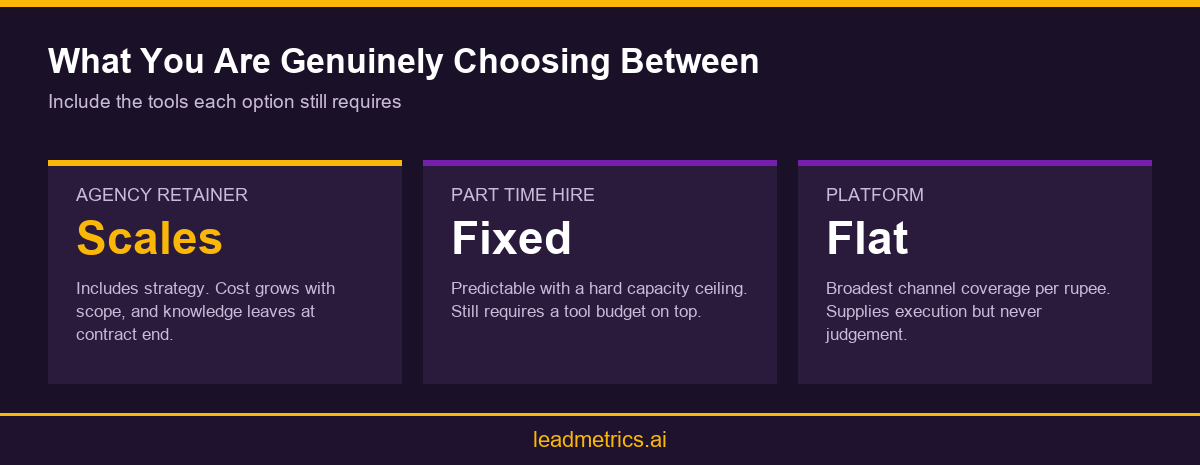
The comparison that matters is never software against zero. For most Indian businesses the genuine alternative is a small agency retainer or a part time marketing hire, and both of those still require tools on top. Build the comparison including those tools, or the retainer will look artificially cheap.
Then model twenty four months at three volume scenarios. Platforms that appear similar at current volume frequently diverge sharply under growth. The broader evaluation framework, including how to weight cost against the other eight criteria, is set out in this guide to choosing the right platform for lead generation, and the agency side of the argument is examined in this comparison of software against a retained team.
Build the comparison over twenty four months rather than twelve. Year one frequently includes onboarding costs and a promotional rate, which makes any platform look favourable against a retainer. Year two is where the real relationship shows, and modelling only the first year systematically flatters software against people.
Include one more figure that rarely appears: the cost of the status quo. Enquiries that go unanswered, follow ups that never happen and channels nobody has time to run all carry a price. It is harder to quantify than a subscription, and it is frequently the largest number in the comparison once somebody attempts it honestly.
Finally, be honest about the capacity you actually have. A platform that costs less than a hire only saves money if somebody operates it. Businesses that buy software to avoid hiring, then find nobody has time to run it, end up with the cost of the software and the gap they were trying to close. Budget the hours alongside the subscription, or the comparison is not a real one.
Conclusion
Pricing in this category rewards buyers who do the arithmetic properly and punishes those who compare monthly headline figures. Model twenty four months across several growth scenarios, ask directly what triggers the next tier and what governs renewal, insist on local invoicing, and compare against the retainer or hire you would otherwise fund. Do that and the numbers usually make the decision for you. The Leadmetrics team can run the comparison with your figures.
Share on Social Media
Frequently Asked Questions
Why do so few vendors publish pricing?

Which model is cheapest overall?
How much should onboarding cost?
Is annual billing worth the discount?
What triggers a pricing tier increase?
Should I expect price rises at renewal?
Does local invoicing really matter?
How do I justify the cost internally?