
Leadmetrics vs Mega: Comparing Two AI Marketing Platforms

Anyone researching Leadmetrics vs Mega is usually asking a narrower question than the marketing on either site answers: which one fits the way my business actually works. Both are AI marketing products aimed at small and medium businesses, and both automate work that used to need people. They differ in scope and in what happens after a lead arrives. This comparison sets out those differences plainly, including where Mega is the better choice.
Key Takeaways
- Mega concentrates on autonomous SEO and paid media execution. Leadmetrics covers a wider funnel including lead scoring, nurture and local listings.
- If your bottleneck is producing and optimising content and ads, scope you do not need is just cost.
- If leads arrive and then go cold, the difference in post capture handling is the deciding factor.
Where the Two Products Overlap
Both platforms automate search optimisation and content production, and both position themselves around AI agents that act rather than merely advise. Mega describes an SEO agent that continuously monitors a site, prioritises issues by impact and executes changes, alongside an ads agent handling cross platform paid campaigns. Leadmetrics covers similar ground across search, content and paid media.
At that level the products look alike, which is why comparison articles tend to be unhelpful. The meaningful divergence begins after a visitor becomes an enquiry, and that is where you should focus your evaluation rather than on whichever interface you preferred.
Both also share a structural characteristic worth understanding before comparing them. Each depends on the quality of the inputs you provide, particularly your existing content, your historical performance data and a clear definition of what a good customer looks like. Neither product compensates for vague positioning, and both will execute an unclear strategy faster than a human team would.
That shared dependency means the evaluation should include your own readiness, not only the products. A business with clean data, a defined audience and a working offer will get value from either. A business without those will struggle with both and conclude, incorrectly, that the software was at fault.
It is also worth noting what neither product claims to do. Neither sets your pricing, defines your positioning, or tells you which segment to pursue. Both execute against decisions you have already made. Businesses evaluating either while those decisions are still unsettled will find the software amplifies the uncertainty rather than resolving it.
Where They Diverge
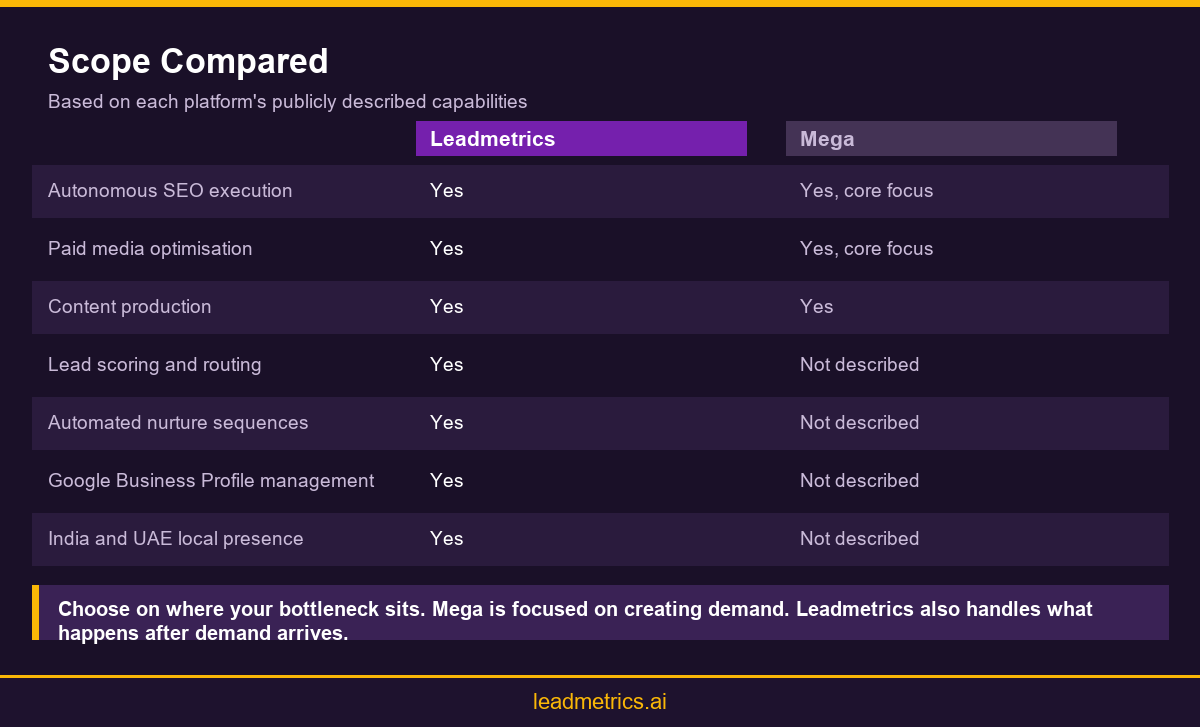
Mega's strength is depth in autonomous execution across SEO and advertising. For a business whose constraint is producing and optimising enough content and campaigns, that focus is an advantage rather than a limitation, and narrower products are frequently easier to adopt.
Leadmetrics extends further along the funnel, adding lead scoring, automated nurture, Google Business Profile management and consolidated reporting across organic, local, social and paid channels. That breadth matters if your problem is not generating interest but converting it. If leads arrive and then stall, additional content volume will not fix the actual bottleneck.
The practical consequence of the scope difference shows up in what you still have to buy elsewhere. A narrower product leaves lead handling, local listings and nurture to other tools or to manual work, which is entirely reasonable if you already have those covered. If you do not, the apparent saving disappears once you add the missing pieces back in.
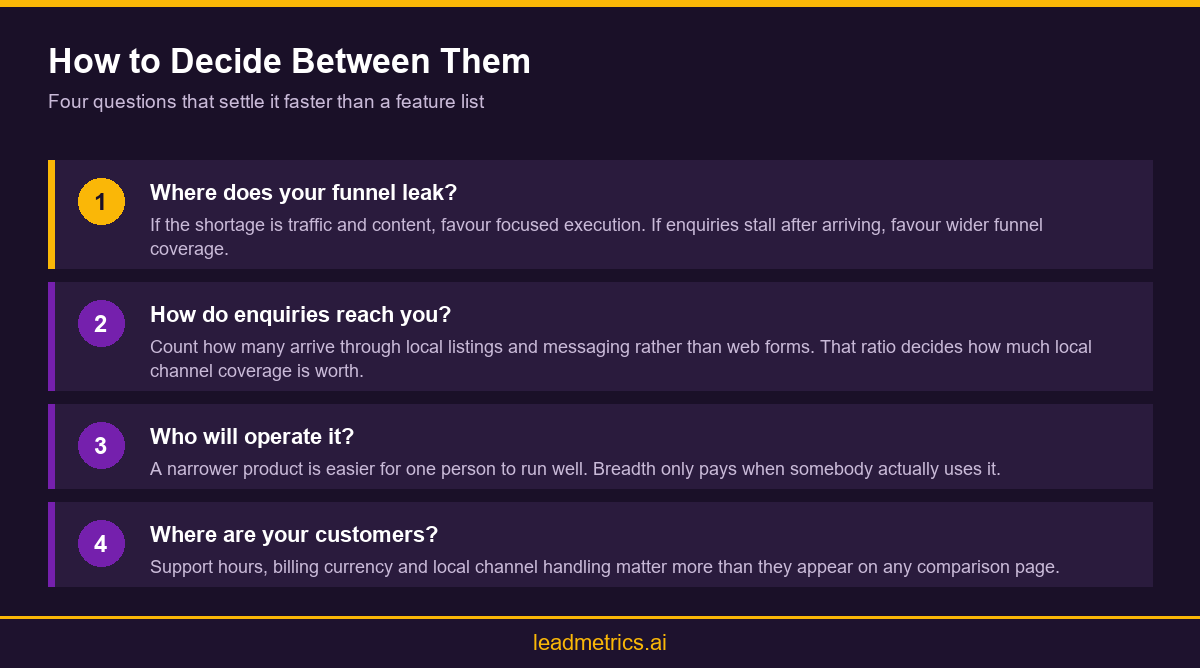
Work out which pieces you genuinely need before comparing. The exercise is simple: list the stages between a stranger discovering you and money arriving, then mark which stages currently work. Products should be compared on the stages that do not, rather than on the ones that already function well.
Autonomy levels are worth probing with both. There is a meaningful difference between a system that recommends changes for approval and one that implements them directly, and the right level depends on your risk tolerance and how much traffic is at stake. Ask each vendor what happens by default, and whether the approval gate can be adjusted as confidence grows.
Which One Suits Which Business
Mega suits businesses whose marketing problem is production capacity. If you know what you want to say, need far more of it published and optimised, and already handle enquiries well, a focused product will get you there with less configuration and less unused capability.
Leadmetrics suits businesses losing value after capture. If enquiries arrive and responses are slow, if nobody follows up more than once, or if you cannot say which channel produced revenue rather than clicks, the additional scope earns its cost. The evaluation criteria that apply to both are set out in this guide to choosing the right platform for lead generation.
There is a third category of business for whom neither is the right answer yet. If you are generating fewer than roughly twenty enquiries a month, automation of either kind is unlikely to be the constraint. The money is usually better spent creating demand first, then automating once there is enough volume for the automation to matter.
Equally, businesses with a complex sales process spanning several months and many stakeholders should test scoring carefully with either product. Models calibrated on shorter cycles tend to penalise the long quiet periods that are entirely normal in considered purchases, which is a solvable problem but one worth surfacing during a trial rather than afterwards.
Consider team composition as well. A business with a capable marketer in place can extract more from a focused product, because the surrounding judgement already exists. A business where marketing is one of five responsibilities held by the founder usually benefits more from breadth, since the alternative is those stages simply not happening at all.
Regional Fit and Support
For businesses operating in India or the Gulf, two practical factors often outweigh features. The first is billing and support hours, since a vendor operating on North American hours answers urgent questions overnight. The second is coverage of channels that matter locally, particularly Google Business Profile and messaging, which platforms designed around Western web funnels frequently under serve.
Leadmetrics operates entities and local profiles in both India and the UAE, which affects invoicing, support timing and how local channels are handled. Whether that matters depends entirely on where your customers are. For a business selling wholly into North America it is irrelevant. For one selling in Kochi or Dubai it frequently decides the outcome, as the regional differences in how search and answer optimisation now work illustrate.
A final practical note on evaluation. Comparison articles, including this one, are written by parties with an interest. The reliable test is running both against the same channel and the same outcome for six weeks and reading your own numbers. That costs a little time and settles the question far more convincingly than any published comparison, whoever wrote it.
Underlying both platforms, the same content fundamentals apply. Google's guidance on creating helpful and reliable content still governs what earns visibility, and any platform that encourages volume over usefulness will eventually work against you regardless of how autonomous it is. Automation changes the cost of producing content. It does not change what makes content worth finding.
Conclusion
Both products automate work that used to require people, and either can be the right answer. Mega is the stronger fit when your constraint is producing and optimising enough content and advertising. Leadmetrics is the stronger fit when enquiries already arrive and value is lost after that point, particularly for businesses selling in India or the Gulf. Identify which describes you before comparing interfaces. The Leadmetrics team can walk through your funnel and tell you honestly which applies.
Share on Social Media
Frequently Asked Questions
What is the core difference between them?

Is broader scope always better?
Which is easier to adopt?
How should I compare them fairly?
Does either handle Google Business Profile?
What about pricing?
Is this comparison biased?
Where should I start if unsure?