
Leadmetrics vs Kimmchi: Agent Workforce or Platform

Anyone weighing Leadmetrics vs Kimmchi is comparing two answers to the same question: how do you run marketing without hiring more people. Kimmchi answers with an AI workforce, autonomous agents that create, distribute and optimise across channels. Leadmetrics answers with a platform covering the funnel from discovery through to qualified lead. This article explains where those models differ in practice.
Key Takeaways
- Kimmchi is built around coordinated autonomous agents handling content, social and conversational lead qualification.
- Leadmetrics is built around a connected funnel, with local search and Google Business Profile management as first class components.
- The agent model suits content heavy teams. The platform model suits businesses whose discovery is local and whose leads need ranking.
Two Models for the Same Problem
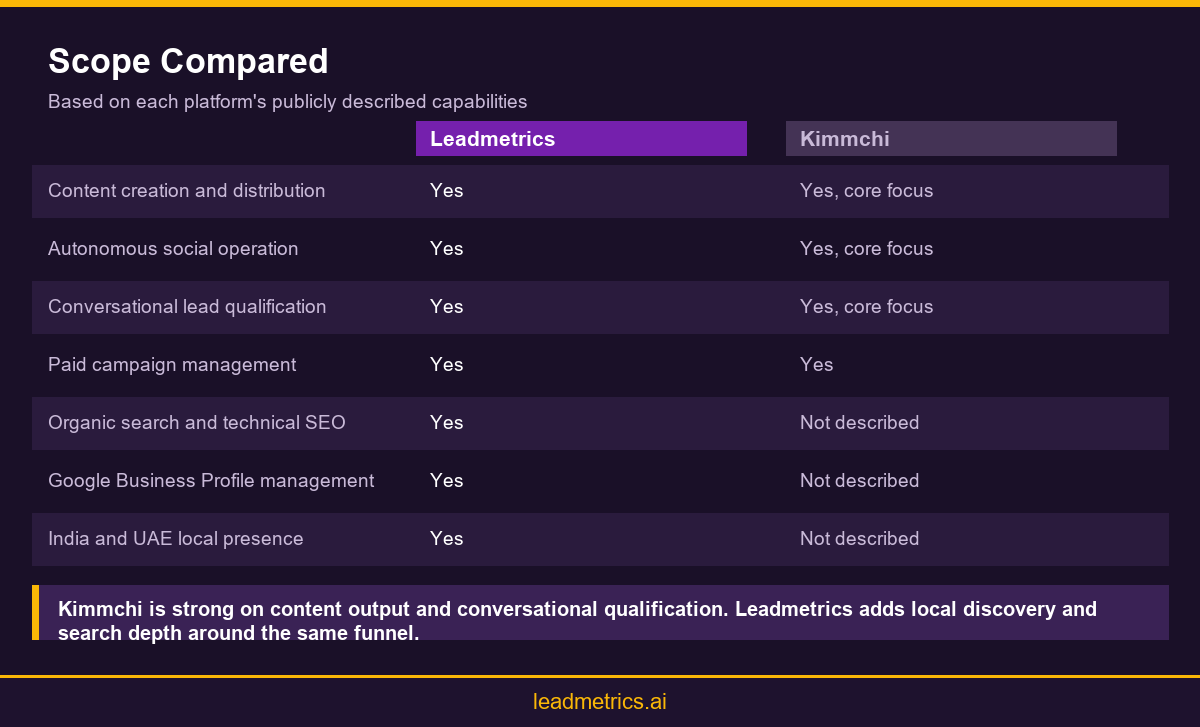
Kimmchi describes an AI workforce for marketing: autonomous agents that create, optimise and distribute content across channels, coordinate with one another by sharing insights, and improve through reinforcement learning across campaigns. Separate modules cover social media operation and conversational agents that engage visitors and qualify leads without human involvement.
That is a genuinely different architecture from a conventional platform. Rather than a set of tools a person operates, it presents as a set of workers that act. For teams whose constraint is output volume across many channels, that framing maps neatly onto the problem and reduces the coordination overhead a human team would otherwise carry.
Leadmetrics takes the connected funnel approach instead. Capture, scoring, routing and nurture are joined to content, search, local listings and paid media, with reporting spanning all of it. Automation is present throughout, but the organising idea is the funnel rather than the workforce. Both approaches remove manual work. They organise it differently, and that difference shows up in what each does well.
The distinction also affects how each product is bought and governed. A workforce framing invites comparison against headcount, which makes the business case straightforward and the oversight question harder. A platform framing invites comparison against other software, which makes oversight familiar and the cost case less dramatic. Neither framing is wrong, and being aware of which one you are responding to is useful during a sales process.
Where the Agent Model Wins
If your bottleneck is producing and distributing enough content across enough channels, an agent workforce addresses that directly. Coordination between agents matters here, because content produced for one channel and adapted for others without human intervention removes a substantial amount of repetitive work that teams rarely enjoy and frequently postpone.
Conversational qualification is the second strength worth naming. Engaging website visitors, asking qualifying questions and converting interest without a person is valuable for businesses receiving enquiries outside working hours or at volumes that outpace their team. For a business whose site attracts traffic but converts poorly, that capability may be the specific fix required.
Reinforcement learning across campaigns is a reasonable design choice, though it is worth asking how long the learning period is and what happens before enough data exists. Every learning system has a cold start, and the honest question is what the product does during it rather than whether one exists.
Volume economics favour the agent model clearly in certain situations. A business publishing across five or six channels with a small team faces a coordination problem that grows faster than the content problem itself. Agents that share context and adapt output between channels remove exactly that overhead, which is genuinely difficult to replicate with a human team of the same size.
After hours coverage is a related and underrated benefit. Enquiries arriving at ten in the evening are frequently lost by morning, particularly in consumer facing businesses. Conversational qualification that engages immediately, captures the requirement and books a follow up converts interest that would otherwise simply evaporate overnight.
Where Local Discovery Changes the Answer
The picture changes for businesses whose customers find them locally. In Indian cities and across the Gulf, a meaningful share of first contact happens through Google Business Profile, local directories and messaging apps rather than through content discovery. An agent workforce optimised for content and social will produce excellent output aimed at a channel mix you may not actually have.
Google Business Profile management is a specific example. Category selection, profile descriptions, post scheduling, review handling and question management all influence local ranking, and none of it is content marketing in the conventional sense. Businesses where local discovery drives enquiries should confirm coverage explicitly rather than assuming a broad platform includes it.
Technical search work sits in the same category. Indexation, crawl health and site structure determine whether content gets found at all, and publishing more onto a poorly indexed site compounds the problem rather than solving it. The relationship between local visibility and enquiry volume is set out in this guide to local search for small businesses.
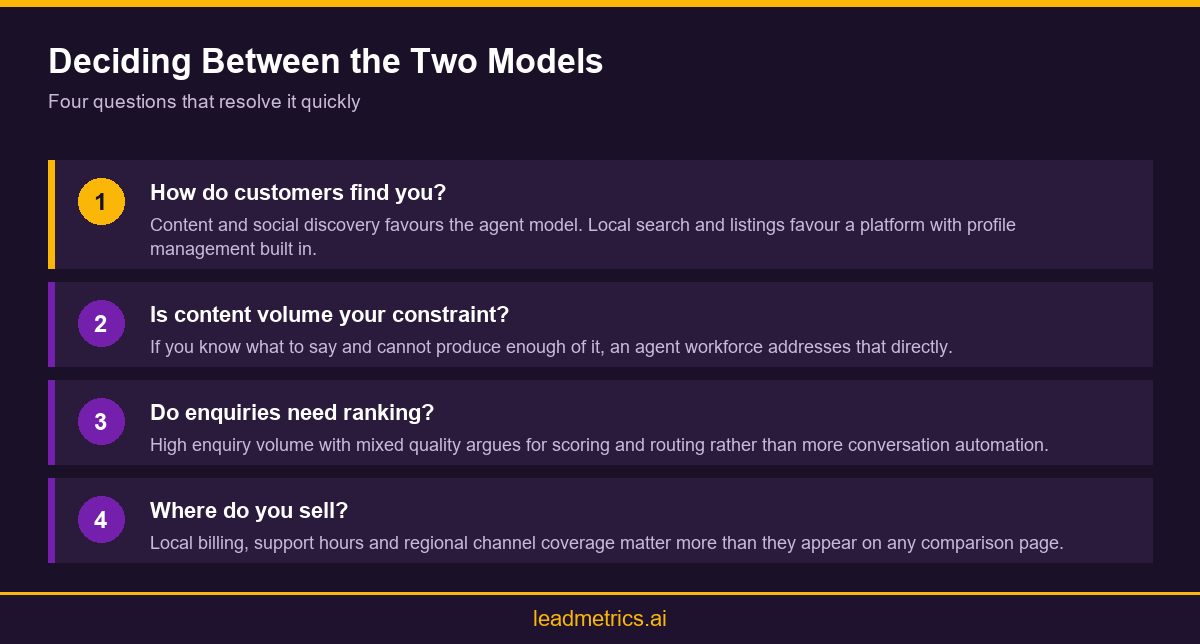
Channel audit is the practical first step for anyone weighing this. Take your last fifty enquiries and record where each genuinely originated. Owners routinely misremember their own mix, usually over weighting whichever channel they personally spend most time on. An hour spent on that exercise changes which product you shortlist more than any amount of vendor research.
Pay particular attention to how many arrived through a profile listing, a map result or a messaging app. Those three routes are systematically under served by platforms designed around content discovery, and they frequently represent a larger share of local business pipeline than the businesses themselves realise.
Practical Checks Before Deciding
Autonomy level deserves a direct question with either product. There is a real difference between agents that propose and agents that publish, and the appropriate setting depends on your brand risk and how much traffic is at stake. Ask what happens by default and whether an approval gate can be applied while confidence builds.
Brand control is the related concern. Autonomous content production at volume works well when brand voice is well defined and badly when it is not. Businesses with loose or evolving positioning tend to find that automation multiplies the inconsistency rather than resolving it, which is a strategy problem wearing a software costume.
You can review Kimmchi's stated capabilities directly at the Kimmchi website, and reading both vendors' own material alongside comparisons like this one is sensible. Then run a short parallel trial on a single channel, because six weeks of your own numbers outweighs any published analysis, including this one.
Ask about oversight tooling as well. Autonomous systems producing at volume need review mechanisms that scale with them, which usually means sampling rather than approving everything. A product offering no practical way to audit what was published on your behalf is asking for trust it has not yet earned, and that is a reasonable thing to say out loud during a sales conversation.
Conclusion
These are two reasonable answers to the same constraint. Kimmchi suits teams whose problem is producing and distributing enough content and conversation across channels, and its agent coordination is a genuine strength. Leadmetrics suits businesses whose discovery is local, whose enquiries need ranking before anyone calls them, and who want search, listings and paid media reporting in one place. Identify which describes you before comparing interfaces. Speak to the Leadmetrics team for an honest read.
Share on Social Media
Frequently Asked Questions
What is the fundamental difference?

Which handles content better?
Which is better for local businesses?
Do autonomous agents need supervision?
What happens during the learning period?
Is brand voice a risk with automation?
Can conversational agents replace a sales team?
How should I trial them?