
How to Get More Google Reviews: A Repeatable System

Most local businesses know reviews matter and still collect them by accident. Working out how to get more Google reviews is less about persuasion and more about building a request into the moment a customer is happiest, then removing every step between that moment and a published review. This article sets out a system that runs without anyone remembering to do it, and explains which tactics the platform rules actually permit.
Key Takeaways
- Timing beats wording. A request sent within hours of a good experience outperforms a better written one sent a week later.
- Every step between intent and published review loses people. Cut the journey to a single tap wherever possible.
- Never gate requests by predicted sentiment. It breaches Google's policies and the risk considerably outweighs the benefit.
Why Review Volume Compounds
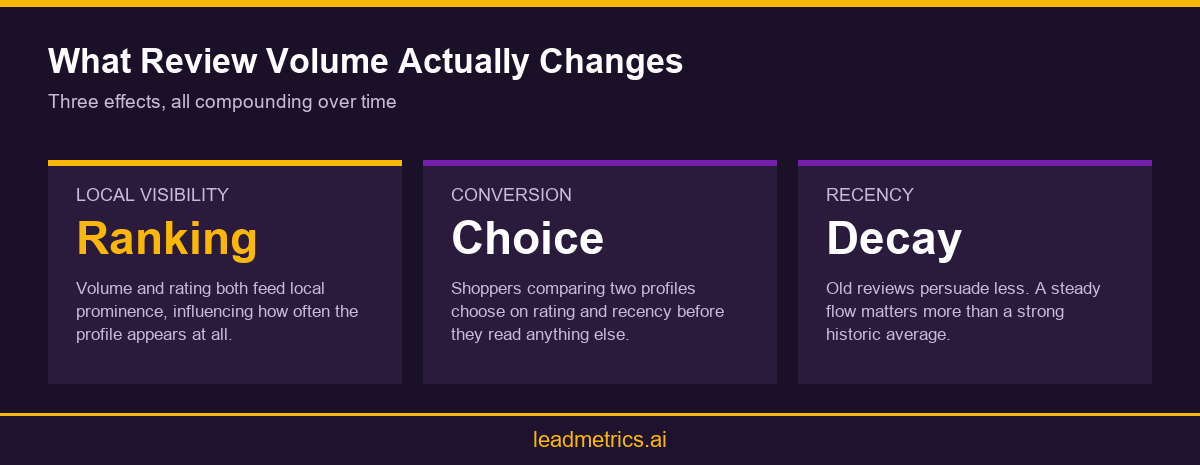
Reviews influence two things at once, which is why they repay attention more than most local marketing activity. They affect how prominently a profile appears in local results, and they affect whether someone who sees it chooses you. Very few activities move both discovery and conversion simultaneously.
Recency matters alongside volume. A business holding a strong average from reviews written three years ago is gradually becoming less persuasive than a competitor with a slightly lower average and a steady flow of recent feedback. Customers read dates, and a profile where the newest review is eighteen months old reads as a business that may no longer be operating well.
This is why a system beats a campaign. A burst of thirty reviews in one month looks unnatural and then stops working as those reviews age. Two or three each week, sustained, produces a profile that stays persuasive indefinitely and never triggers the pattern detection that sudden spikes can. The wider profile fundamentals are covered in this guide to profile optimisation.
Distribution across locations matters as much as the total for businesses operating in several places. A portfolio averaging four and a half stars can contain two branches sitting below four, and those are the ones customers searching that specific area will see. Portfolio averages conceal exactly the locations that need attention, which is why per location review tracking belongs in any multi site reporting.
There is also a floor effect worth knowing. Profiles with very few reviews convert poorly almost regardless of rating, because a perfect score from three people reads as unproven rather than excellent. Getting past roughly twenty reviews changes how a profile is read, and for businesses starting near zero that first threshold is the most valuable one to cross.
Ask at the Right Moment
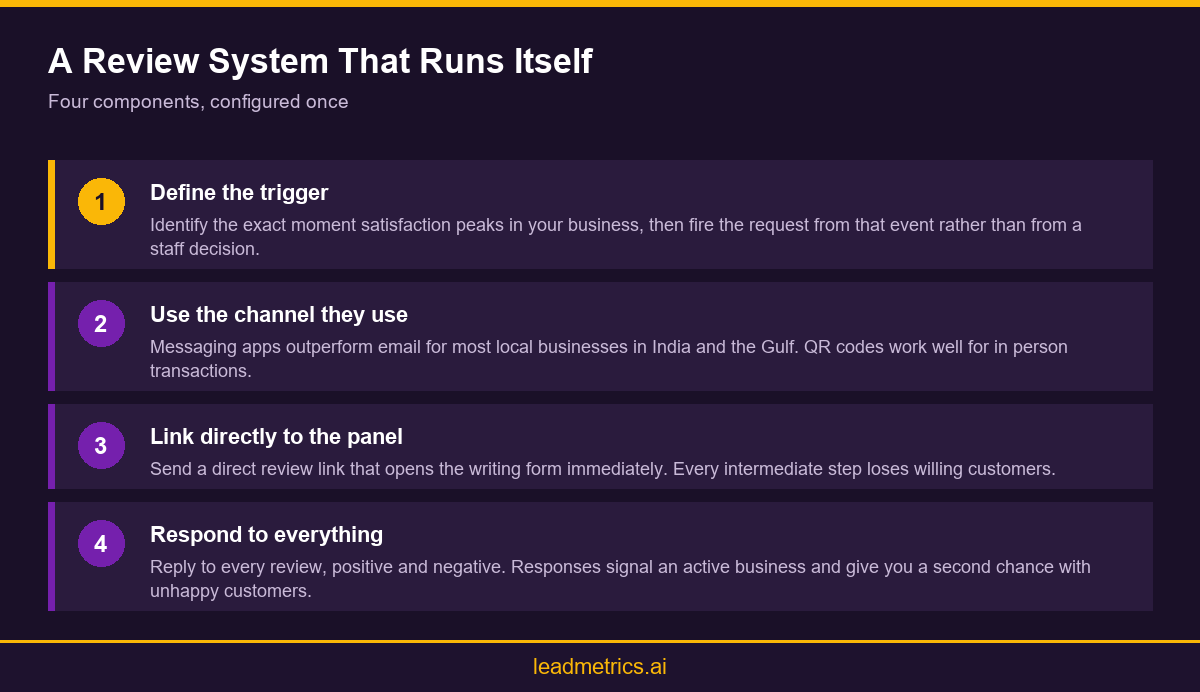
The single largest determinant of response rate is timing. A request reaching someone within a few hours of a good experience converts several times better than the same request sent a week later, because the feeling that would motivate writing has faded and the task now competes with everything else in their day.
Identify the specific moment satisfaction peaks in your business. For a restaurant it is shortly after the meal, not the next morning. For a clinic it is after a successful follow up, not immediately post treatment when the outcome is still uncertain. For a service business it is on completion, while the technician is still present and the result is visible.
Then trigger automatically from that moment rather than relying on staff to remember. Manual review requests fail predictably, not because people are careless but because asking feels awkward and the busiest moments are exactly when requests should be going out. A system that fires without anyone deciding to fire it removes both problems at once.
Frequency of asking is the other lever. Businesses that request reviews only from new customers overlook their most enthusiastic audience, which is usually people who have returned several times. A returning customer on their third visit is both more likely to write something and more likely to write something specific and credible.
Train staff on the framing rather than the mechanics. Asking whether someone would mind sharing their experience is considerably more effective than asking for a five star review, and it stays within the rules. The second phrasing pressures people, produces thinner feedback, and occasionally prompts exactly the defensive reaction you were hoping to avoid.
Remove Every Step in the Journey
Each step between intent and a published review costs you people. Someone willing to write one who must search for your business, scroll to find the review button and then sign in will frequently abandon halfway, and none of that reflects any change in how they feel about you.
Use a direct review link that opens the writing panel immediately. Deliver it through whichever channel that customer already uses, which for most Indian and Gulf businesses means a messaging app rather than email. A QR code at the counter or on an invoice works well for in person transactions, since the phone is usually already in hand.
Keep the message short and specific. A request naming what the customer bought or which staff member served them performs better than a generic one, because it reads as a person asking rather than a system, and it gives them something concrete to write about. The most common reason people decline is not unwillingness but not knowing what to say.
Watch where the link actually lands on mobile, since that is where nearly all of these requests are opened. A link that opens a browser, prompts a sign in and then loses the destination will lose most of the people who clicked it. Test the full journey on a phone that is not already signed in, because your own device will hide the problem entirely.
Staying Within the Rules
Two practices are worth avoiding firmly. The first is incentivising reviews with discounts or gifts, which breaches Google's policies and produces feedback that reads as bought. The second is review gating, where you survey customers first and only send review links to those who respond positively. It is explicitly prohibited, and the consequences range from review removal to profile action.
The legitimate version is to ask everyone and handle negative feedback properly when it arrives. That is uncomfortable and it is also more durable, because a profile with a handful of critical reviews answered well is more credible than one showing nothing but five star ratings. Buyers are practised at spotting the second pattern.
Check the current policy directly rather than relying on advice that may be out of date. Google's Business Profile help documentation is the authoritative source on what is permitted, and it changes periodically. For businesses managing profiles across several locations, consistency of approach matters as much as the approach itself, as covered in this playbook for local search.
Handle negative reviews with a consistent process rather than improvisation. Acknowledge the specific complaint, avoid defensiveness, and move the detail to a private channel. Future readers are the real audience for that reply, and they are judging how you behave under criticism rather than whether the original complaint was fair.
Resist the urge to dispute reviews except where they genuinely breach policy, such as obvious spam or reviews for the wrong business. Removal requests are slow, frequently unsuccessful, and the effort is usually better spent generating enough recent positive feedback that one poor review stops being prominent.
Conclusion
Review generation works when it stops depending on anyone remembering. Fire the request from the moment satisfaction peaks, send it through the channel that customer already uses, link straight to the writing panel, and respond to everything that arrives. Ask every customer rather than filtering by predicted sentiment, because gating is both prohibited and less convincing. Two or three reviews a week, sustained, will outperform any campaign. Speak to the Leadmetrics team about automating the whole sequence.
Share on Social Media
Frequently Asked Questions
How many reviews should a local business aim for?

Can I offer a discount for leaving a review?
Is it acceptable to only ask happy customers?
What is the best channel for review requests?
Should I respond to negative reviews?
How quickly should requests be sent?
Do review responses affect ranking?
How does this fit with wider local visibility work?