
How to Choose an AI Digital Marketing Platform

Every AI digital marketing platform claims to consolidate your stack, cut your costs and improve your results. Most demonstrations are convincing. The difficulty is that the differences between products only become visible after you have committed, by which point switching is expensive. This guide gives you a framework for finding those differences during evaluation instead, with nine criteria, a pricing model breakdown and the specific questions that separate a genuine platform from an assembled bundle.
Key Takeaways
- Decide what you want consolidated before you look at products. Buying scope you will not use is the most common and most expensive mistake in this category.
- Pricing models matter more than headline price. Usage based pricing punishes exactly the growth you are buying the platform to achieve.
- Run a structured scoring exercise with sales and marketing together, rather than reacting to whichever demonstration was most polished.
What the Category Actually Covers
An AI digital marketing platform sits between your channels and your customer records, handling planning, production, publishing, capture and reporting in one place. In practice, scope varies enormously between vendors who all use the same description. Some cover search and paid media only. Others add content production, social scheduling and local listings. A smaller number reach into lead scoring and nurture.
This matters because scope determines what you can decommission. If a platform covers four of your seven tools, you still pay for three tools plus the platform, and consolidation has not happened. Before evaluating anything, list every marketing tool you currently pay for, with its annual cost. That list is your specification, and it will tell you more than any feature comparison.
Be clear about what the category does not include. These platforms execute marketing, they do not decide strategy. They will not tell you which market to enter, how to price, or why your positioning is not landing. Teams that expect judgement from software are consistently disappointed, and the disappointment is usually blamed on the product rather than on the expectation.
A useful way to test scope honestly is to ask each vendor which of your existing tools you could cancel on the day you go live. Not eventually, not after a roadmap item ships. On day one. The answer is usually shorter than the sales conversation implied, and the gap between those two numbers is the real cost of the purchase.
Watch also for scope described in the future tense. Roadmap items presented alongside shipped features are easy to miss in a fast demonstration, and a platform bought for something that does not exist yet is a common and avoidable mistake. Ask directly which capabilities are live today for customers on your intended plan.
Scope creep during evaluation is worth guarding against explicitly. Vendors are skilled at surfacing capabilities you had not considered, and some of those genuinely are valuable. The discipline is to add them to a separate list rather than to the requirement, then review that list once at the end. Requirements that grow during a sales process almost always grow toward whichever product is being demonstrated at the time.
Nine Criteria Worth Scoring
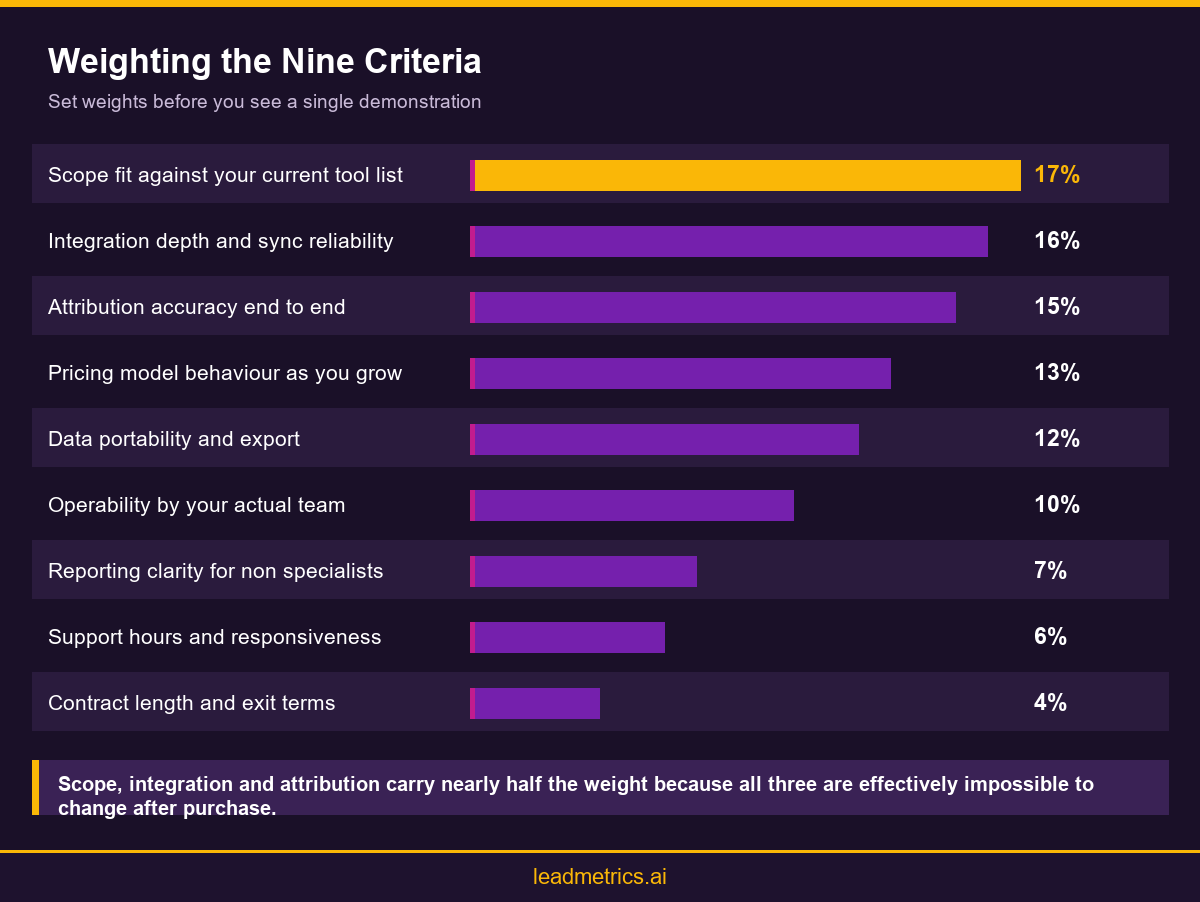
Structured scoring beats impressions. Build a simple sheet, weight each criterion before you see any demonstration, then score each vendor consistently. Deciding the weights in advance is the important part, because weights chosen afterwards tend to be reverse engineered to justify a preference already formed.
The nine that matter are scope fit against your tool list, integration depth, attribution accuracy, data portability, pricing model behaviour as you grow, operability by your actual team, reporting clarity, support responsiveness in your time zone, and contract flexibility. Notice how few of these appear in a typical product demonstration.
Include your sales lead in the exercise, not only marketing. The two functions weight speed, qualification and reporting very differently, and a platform chosen purely on marketing criteria frequently produces excellent dashboards alongside a sales team that quietly reverts to its own list. That outcome is the most expensive failure in this category because it is rarely noticed for months.
Score each vendor immediately after their demonstration rather than at the end of the process. Recall degrades quickly and blends between products, and the vendor you saw most recently benefits disproportionately from that blurring. Scoring while the detail is fresh produces a far more honest comparison.
Add one criterion that does not appear on any vendor's material: how straightforward was it to get clear answers. Vendors who answer awkward questions directly during a sales process generally behave the same way during an incident. Those who deflect will deflect later, when the stakes are considerably higher and you have less leverage.
Keep the scoring sheet after the decision. When the platform is reviewed in a year, the original weights tell you whether the disappointment is with the product or with the requirement, and those are very different problems with very different solutions. Most teams discard the sheet and then relitigate the original decision from memory, which rarely goes well.
If two vendors score within a few points of each other, the scoring has done its job by telling you the choice is close. At that point decide on the qualitative factors instead: who answered awkward questions more directly, whose support hours match yours, and whose contract terms are more reasonable. Those are legitimate tiebreakers rather than an admission the framework failed.
Pricing Models and Where Costs Hide
Headline price tells you very little. What matters is how the price behaves as you grow, because you are buying the platform precisely in order to grow. Four models dominate, and each rewards a different customer.
Flat subscription is predictable and usually best for planning. Usage based pricing looks cheap at trial volume and becomes expensive exactly when the platform starts working, which is a perverse incentive worth naming out loud. Per seat pricing penalises involving more of your team, which is the opposite of what good adoption looks like. Hybrid models combine a base fee with usage components and are the hardest to forecast.
Onboarding cost deserves particular scrutiny because it is frequently quoted separately and occasionally waived under pressure. Ask what it covers, who performs it, and what happens if the implementation runs long. A fixed scope statement is worth more than a discount here, since overruns are where implementation budgets usually fail.
Consider the cost of not consolidating as well. Several subscriptions, several logins and several reporting formats carry an administrative cost that nobody invoices for but somebody pays in time each month. That figure belongs in the comparison, and including it often changes which option looks expensive.
Currency exposure belongs in the cost model for any business billed in a foreign currency. A platform priced in dollars and paid in rupees or dirhams carries an exchange risk that compounds across a multi year relationship, and it is rarely mentioned in any comparison. Model the cost at a range of exchange rates rather than today's, particularly if you are signing a longer commitment.
The Questions That Surface Hidden Cost
Ask four things directly. What triggers the next pricing tier. What happens to price at renewal. Is onboarding charged separately. Are integrations included or priced individually. Vendors answer these clearly when the answer is favourable and vaguely when it is not, so the quality of the answer is itself useful information.
Modelling Twenty Four Months
Build the cost over two years at three volume scenarios: flat, double and quadruple. Platforms that look similar at current volume frequently diverge sharply under growth, and the divergence is invisible if you only compare today's invoice. This single exercise changes more purchase decisions than any feature comparison.
Platform, Agency or In House
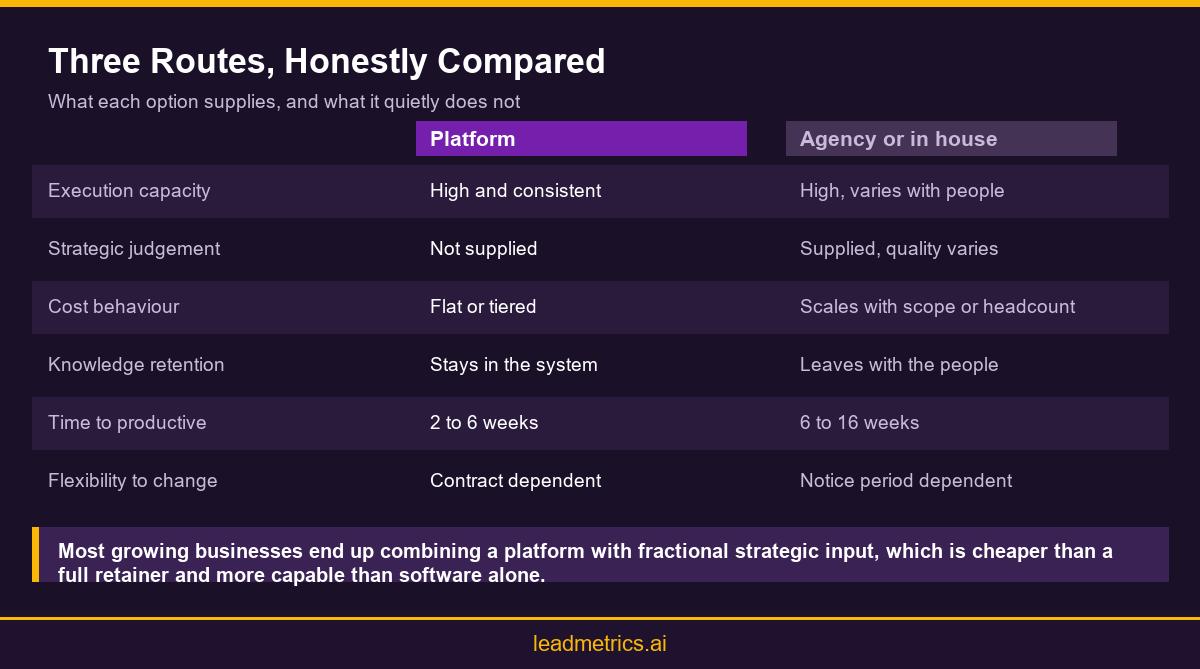
The comparison is rarely as clean as vendors present it. A platform replaces execution capacity, not strategic direction. An agency supplies both but at a cost that scales with scope, and the institutional knowledge departs with the contract. An in house team supplies both and retains knowledge, but carries fixed cost and takes months to assemble.
For most businesses the honest answer is a combination, and the useful question is which combination. Many growing companies land on a platform plus a fractional strategist, which costs considerably less than a full retainer while preserving the judgement a platform cannot supply. The trade offs are set out in more detail in this comparison of software against a retained marketing team and from the internal hiring angle in what changes when you automate rather than recruit.
Whichever route you pick, write down the assumption you are testing and the date you will review it. Arrangements in this category tend to persist by inertia rather than by decision, and a scheduled review is the cheapest protection against paying for something that stopped working a year ago.
There is a common intermediate state worth naming, because many businesses end up in it without choosing it: running a platform while still paying an agency to operate that platform. This can make sense during a genuine transition, but it frequently persists long after the transition should have concluded, leaving you carrying both cost structures indefinitely. If you choose it, set a handover date and hold to it.
Consider the succession question too. If the person who owns the platform relationship leaves, how much of the configuration and reasoning goes with them. Agencies and in house teams both carry this risk visibly. Platforms carry it quietly, through undocumented configuration and workflows that only one person understands. A short written runbook costs an afternoon and protects against a genuinely disruptive gap.
Migration Risk and How to Pilot Safely
The largest risk in this category is not choosing a weak product. It is committing everything at once and discovering the mismatch three months later with your data half migrated. Pilot design matters more than most buyers assume, and a good pilot is deliberately narrow.
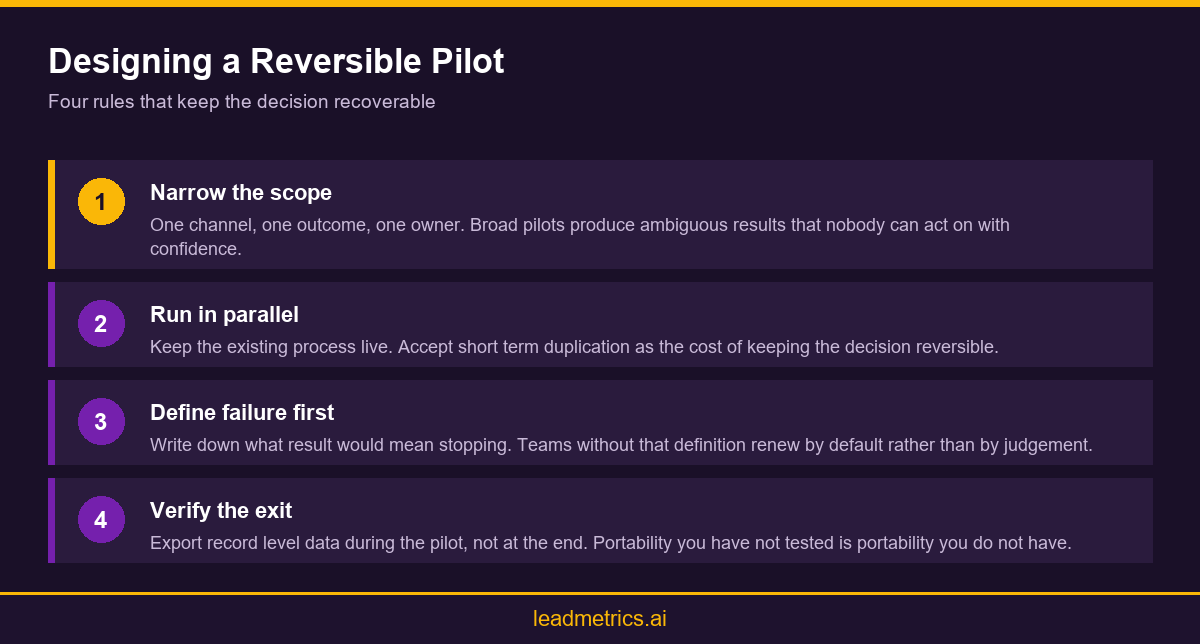
Choose one channel and one measurable outcome. Run the platform alongside your existing process rather than replacing it, accepting the short term duplication as the price of a reversible decision. Set a decision date before you start and define in advance what would constitute failure, because teams that have not defined failure rarely recognise it.
Protect your exit throughout. Confirm during the pilot that you can export record level data, not formatted reports, and that historical performance data leaves with you. Portability verified early costs nothing. Portability discovered late costs the entire switching decision.
Decide in advance who owns the pilot and protect their time. Pilots fail far more often from neglect than from product weakness, because the person responsible is usually doing it alongside a full workload. Two hours a week formally committed is worth more than enthusiastic intentions that evaporate in the second week.
Keep a written log of what surprised you during the pilot. Those notes are the most valuable artefact the exercise produces, more useful than the performance numbers, because they tell you what living with the product is actually like. They also make the eventual decision easy to explain to whoever signs the contract.
Define what success looks like numerically before the pilot begins, and write it somewhere others can see. A pilot judged on impressions afterwards will always be judged favourably by whoever championed it and unfavourably by whoever did not. A pilot with a written threshold produces a decision instead of an argument, which is worth considerably more than the pilot itself.
Reporting You Can Actually Defend
Reporting is where platforms diverge most sharply and where buyers inspect least carefully, because every dashboard looks impressive in a demonstration. The test is not whether reporting is attractive. It is whether you could take a figure from it into a budget conversation and defend how it was calculated.
Ask the vendor to show revenue by source rather than leads by source. Many products report volume confidently and revenue vaguely, and volume is the number that misleads. A channel producing many cheap leads that never close will look like your best performer in almost every default dashboard in this category.
Also check whether reporting survives the handoff into sales. If attribution stops at the form submission and your CRM cannot tell you which source produced closed revenue, you have measurement of marketing activity rather than measurement of marketing outcome. The difference matters most in exactly the conversations where budgets get decided.
One further reporting test is worth running. Ask the vendor to reproduce a number you already know from another system, such as last month's conversions from a single channel. Platforms with sound measurement will land close and explain any variance. Those that cannot will change the subject, which is itself the answer you needed.
Check who can read the reporting too. If interpreting the dashboard requires the person who configured it, reporting has become a dependency rather than a capability. Good reporting is legible to someone who was not involved in setting it up, which is precisely the person who usually needs it during a budget discussion.
Consider who else will read the reporting. If results go to a board, an investor or a parent company, the reporting needs to withstand questions from people unfamiliar with your channel mix. Export quality matters here as much as dashboard quality, since those audiences generally receive a document rather than a login. Test the export, not only the screen.
Regional Considerations for India and the UAE
Buyers operating across both markets face a reporting problem before they face a product problem. Blended figures conceal which market subsidises the other, and that concealment usually persists until somebody asks why growth in one region never turns into revenue. Insist on per market breakdowns as a hard requirement rather than a preference.
Practical differences follow from there. Indian buyers should weight local invoicing, rupee pricing and channel breadth across listings and messaging. UAE buyers should weight data residency, bilingual handling and attribution accuracy, given considerably higher acquisition costs. Discovery behaviour differs too, which is why optimising for generative answer engines now matters alongside conventional search work.
Underneath both markets, the fundamentals have not changed. Google's guidance on creating helpful and reliable content remains the sane foundation, and a platform that encourages volume over usefulness will eventually work against you regardless of which market you sell into.
Finally, plan for the possibility that one market outperforms the other substantially. Many businesses running both India and the Gulf discover that one region carries the economics while the other consumes attention. A platform that reports them separately lets you act on that early. One that blends them lets the imbalance persist quietly for a year, which is the more expensive outcome by some distance.
Time zone coverage is the other regional factor that looks minor until it is not. A vendor whose support operates on North American hours will answer your urgent question overnight, which is tolerable occasionally and genuinely disruptive during onboarding or an outage. Confirm the working hours of the team who will actually respond, rather than the headquarters location printed on the website, since the two frequently differ and only one of them affects you.
Local channel behaviour differs enough between the two markets to be worth testing rather than assuming. Google Business Profile carries substantially more weight for discovery in Indian cities than most Western designed platforms expect, while UAE buyers increasingly begin research inside AI assistants. A platform that treats both as secondary to web forms will under record a meaningful share of where your demand actually originates.
Language handling deserves a specific check for anyone operating in the Gulf. Arabic support that works in the interface frequently degrades in automated emails, exports and reporting, and each of those is customer facing in some circumstance. Test the rendered output rather than the preview, because the two are usually produced by different parts of the system and fail independently.
Conclusion
Choosing well in this category is mostly a matter of doing unglamorous work early. List the tools you want to retire, weight your criteria before you see a demonstration, model cost across two years at several volumes, and design a pilot you could reverse. Do that and the decision becomes straightforward, because the differences that actually matter will have surfaced while you could still act on them. Speak to the Leadmetrics team to work through the framework against your current stack.
Share on Social Media
Frequently Asked Questions
What should I decide before looking at any product?

Which pricing model is safest?
How long should a pilot run?
Who should be involved in the evaluation?
Is more scope always better?
What is the most overlooked criterion?
How do I compare reporting quality fairly?
Should I choose a specialist or a full funnel product?
Does contract length really matter?
How does lead handling fit into this?