
AI Marketing Platforms for Agencies: Scaling Without Hiring

For most agencies the growth ceiling is arithmetic. Every new client needs hours, hours need people, and people erode margin. An AI marketing platform for agencies changes that ratio by absorbing the repeatable execution work, which is most of it. This article covers where the leverage genuinely comes from, what breaks when you scale accounts faster than process, and how to protect delivery quality while raising clients per head.
Key Takeaways
- Leverage comes from standardising repeatable execution, not from removing judgement. The judgement is what clients actually pay for.
- Multi account architecture matters more than features. Platforms built for one business become unmanageable across twenty clients.
- Reporting that clients can read without you is the difference between retention and a monthly explanation call.
Where the Leverage Actually Comes From
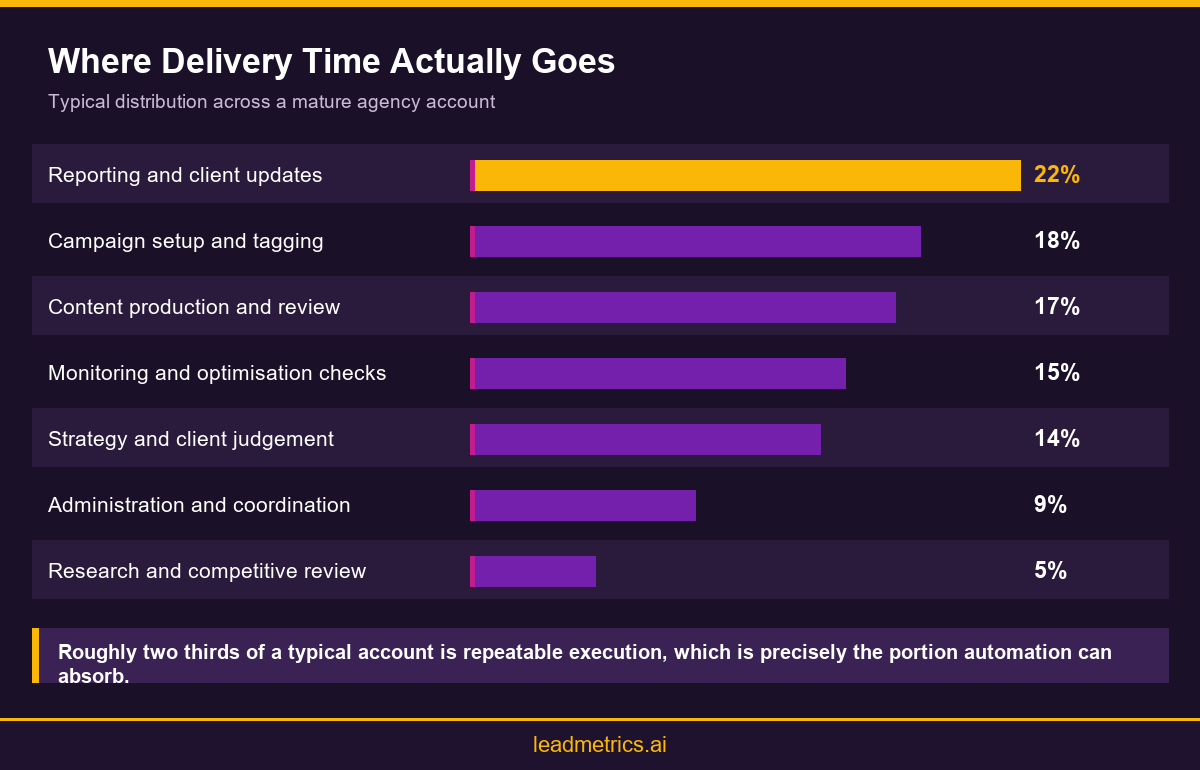
Agency work divides into three categories. There is judgement, which is positioning, strategy and the difficult client conversation. There is craft, which is writing, design and campaign construction. There is repetition, which is reporting, scheduling, monitoring, tagging and the hundred small tasks nobody bills for honestly.
Automation takes the third category almost entirely, assists meaningfully with the second, and does nothing for the first. That distribution is the whole economic case. If repetition consumes forty percent of delivery time across your accounts, removing most of it changes your clients per head ratio without touching the work clients value, which is the only version of scaling that does not degrade the product.
Be realistic about which category your team actually spends time in. Agencies consistently overestimate how much of their week is judgement and underestimate repetition. A two week time audit before buying anything will tell you whether the leverage is there, and occasionally it reveals that the real problem is scope creep rather than tooling.
Run the audit properly rather than estimating. Ask the team to log time in three buckets for two weeks, then look at the total. The result is usually uncomfortable, because senior people discover how much of their week sits in the repetition column and how little in the judgement column they were hired for. That discomfort is the business case.
One caveat worth stating. If your accounts are unprofitable because the scope was priced wrongly, automation will make them slightly less unprofitable and nothing more. Tooling amplifies whatever economics already exist. Fix the pricing first, then automate, or you will scale a loss more efficiently than before.
Note which category your most experienced people occupy. If senior staff are absorbed in repetition, the cost is not only their time but the strategic work that never happens because nobody had capacity for it. That opportunity cost rarely appears in any calculation and is frequently the largest number in it.
Multi Account Architecture Is the Real Requirement
Most marketing platforms are designed for a business managing its own marketing. Agencies have a fundamentally different shape: many clients, separate data, shared team, different permissions per account, and consolidated reporting across all of it. A platform that handles one business elegantly can become unmanageable across twenty.
Test specifically for account switching speed, permission granularity, template reuse across clients, and whether billing supports a single agency invoice rather than twenty separate relationships. These are unglamorous requirements that rarely feature in a demonstration and determine almost entirely whether the platform survives your tenth client.
Client data separation deserves specific attention during evaluation. Agencies carry an obligation that single business platforms are not designed around: one client's data must never be visible in another client's account, including in aggregate reporting and in any model trained across accounts. Ask directly how the platform isolates data and whether anything is shared across tenants.
Onboarding speed per account is the other multi account requirement that only reveals itself at scale. A platform requiring four hours of configuration per client is entirely tolerable at three clients and a serious drag at thirty. Time the setup of your second account during evaluation, since the first always takes longer and tells you less.
Ask how the platform handles client offboarding as well. When a client leaves, their data should be exportable and removable cleanly, and that process should not require a support ticket. Agencies change clients more often than most businesses change platforms, so this is a routine operation rather than an edge case.
What Breaks When You Scale Accounts
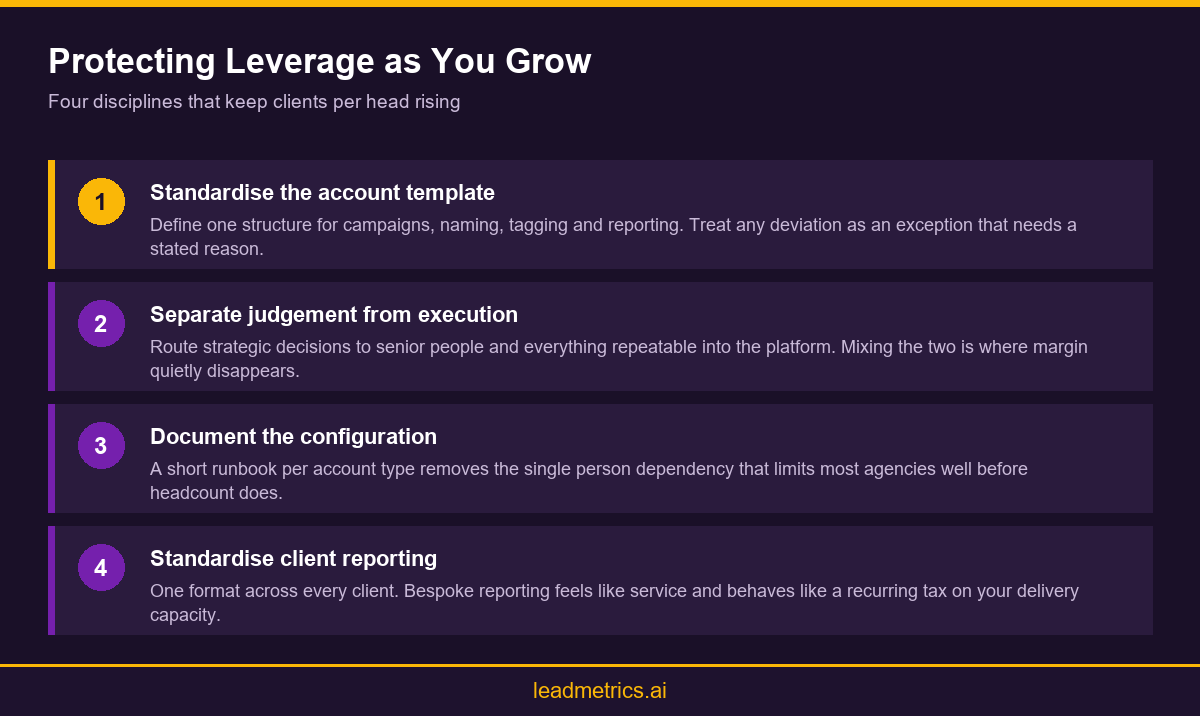
Three failures recur. The first is template drift, where each account gradually acquires bespoke configuration until nothing is standard and the leverage disappears. The second is reporting divergence, where clients receive different formats depending on who built the account. The third is knowledge concentration, where one person understands the setup and becomes a bottleneck and a risk simultaneously.
All three are process problems rather than product problems, which means buying a better platform will not solve them. Standardise the account structure before scaling, document it, and treat deviation as an exception requiring a reason. Agencies that skip this step scale to roughly fifteen accounts comfortably and then stall, usually without understanding why.
There is a fourth failure worth naming because it is the least visible. As automation absorbs execution, junior staff lose the repetitive work through which they used to learn the craft. Agencies that do not replace that learning path deliberately find their bench weakens over two or three years, long after the cause has been forgotten. Build review and shadowing into the process to compensate.
Guard against the assumption that more accounts per person is always the goal. Beyond a point, account managers lose familiarity with each client's business, and the service becomes technically competent and commercially generic. The right ratio is the one where your people still understand what each client is trying to achieve, which is usually lower than the theoretical maximum the tooling permits.
Reporting That Protects Retention
Client churn in agencies is frequently a reporting failure rather than a performance failure. Clients leave when they cannot see what they are paying for, even when results are acceptable. A platform that produces reporting a client can read without a call removes a substantial cause of friction and a recurring drain on senior time.
Insist on revenue attribution rather than activity summaries. Reporting that shows impressions and clicks invites the question of what they produced. Reporting that shows which channel generated closed business answers it in advance. The measurement principles involved are set out in this guide to choosing the right platform for lead generation, and the broader industry context is covered in general references on marketing automation practice.
One further point on transparency. Agencies occasionally resist giving clients direct platform access, fearing it makes the agency look replaceable. In practice the opposite tends to hold. Clients who can see the work value it more accurately, and the ones who conclude they could do it themselves were usually going to reach that conclusion anyway.
Reporting cadence is worth standardising alongside format. Clients who receive a report monthly and hear nothing between tend to interpret silence as inactivity. A brief automated weekly summary alongside the monthly review costs almost nothing once configured and substantially reduces the number of calls that begin with a question about what has been happening.
Finally, use reporting to manage scope rather than only to demonstrate results. When a client requests work outside the agreement, a report showing what the current scope is producing makes that conversation straightforward. Without it, scope creep is negotiated on goodwill, which favours whoever is more persistent rather than whoever is correct.
Reporting also has a defensive function that is easy to overlook until it is needed. When a client questions value after a weak quarter, a consistent record of what was executed and what it produced turns a difficult conversation into a factual one. Agencies without that record end up arguing from memory against a client arguing from frustration.
Conclusion
Agencies scale by removing repetition, not by removing judgement. Audit where delivery time genuinely goes, standardise your account structure before you grow into it, choose a platform built for many clients rather than one business, and report on revenue rather than activity. Those four disciplines raise clients per head without the quality drop that usually accompanies growth. Speak to the Leadmetrics team about how the platform handles multi account delivery.
Share on Social Media
Frequently Asked Questions
How many clients can one person realistically manage?

Does automation reduce the value clients see?
What is the biggest scaling mistake?
Should clients get direct platform access?
How should agency pricing change?
What about white labelling?
Does this work for specialist agencies?
How do I start without disrupting delivery?