
AI Lead Generation for B2B Companies in India

AI Lead Generation for B2B Companies in India
India's B2B market is vast, and decision making rarely rests with one person. Finance, operations, and senior leadership all weigh in before a deal closes, often stretching the sales cycle to several months. AI lead generation helps B2B companies stay visible and relevant throughout that long cycle, instead of losing momentum between touchpoints. This guide covers how AI driven lead generation works for B2B sales in India, what platform features matter most, and how to measure whether your pipeline is actually improving.
Key Takeaways
AI lead generation scores B2B prospects on firmographic fit and stakeholder engagement, helping sales teams prioritise accounts that match their ideal customer profile.
Pairing AI driven SEO with paid search captures both inbound research and active buyer intent across India's long decision cycles.
Platforms that connect scoring, nurturing, and CRM data in one dashboard shorten the gap between first contact and a closed deal.
Why B2B Lead Generation in India Needs AI
India's B2B buyers research extensively before ever speaking to a sales rep. A single deal can involve a finance lead reviewing pricing, an operations manager comparing implementation timelines, and a senior executive weighing strategic fit, all at different points across weeks or months. Generic outreach that treats every contact the same way misses the nuance each stakeholder needs.
AI lead generation tracks each stakeholder's behaviour separately, building a fuller picture of where a deal actually stands. Agencies and in-house teams that review client results consistently find that AI scoring surfaces stalled deals earlier than manual pipeline reviews, since it flags when engagement from a key stakeholder drops off rather than waiting for a quarterly forecast meeting to reveal the gap.
The cost of getting this wrong is significant. A sales team chasing unqualified leads spends weeks on conversations that were never going to close, while genuinely interested accounts go quiet from lack of timely follow-up. Tailored campaign strategies built around real account behaviour reduce this waste substantially, since budget and rep time both concentrate on accounts the data shows are actually progressing toward a decision.
Market scale compounds the challenge. India's B2B sector spans thousands of companies across manufacturing, IT services, finance, and logistics, each with different buying committees and procurement processes. Social media engagement tracking helps identify which industry segments are responding to specific messaging, so campaigns can be refined before budget is spent broadly across a market too large to target manually.
Regional variation adds further complexity. A manufacturing buyer in Pune researches differently from a fintech procurement lead in Bangalore, and a one size fits all campaign rarely performs well across both. AI driven paid campaigns adjust targeting and messaging by region automatically, learning from conversion patterns in each city rather than applying a single national template that underperforms everywhere it is deployed.
How AI Scores and Qualifies B2B Leads
Scoring starts with firmographic data: industry, company size, revenue band, and geographic location, matched against your ideal customer profile. This filters out contacts that will never convert regardless of how engaged they appear, focusing the model on accounts genuinely capable of buying.
Behavioural signals add the second layer. Paid campaigns capture buyers actively searching for a solution, while organic content reaches researchers earlier, often before a formal evaluation has even started. The model tracks which whitepapers were downloaded, how many pricing pages were viewed, and which stakeholders within an account are engaging, building a composite score that reflects the account as a whole rather than any single contact.
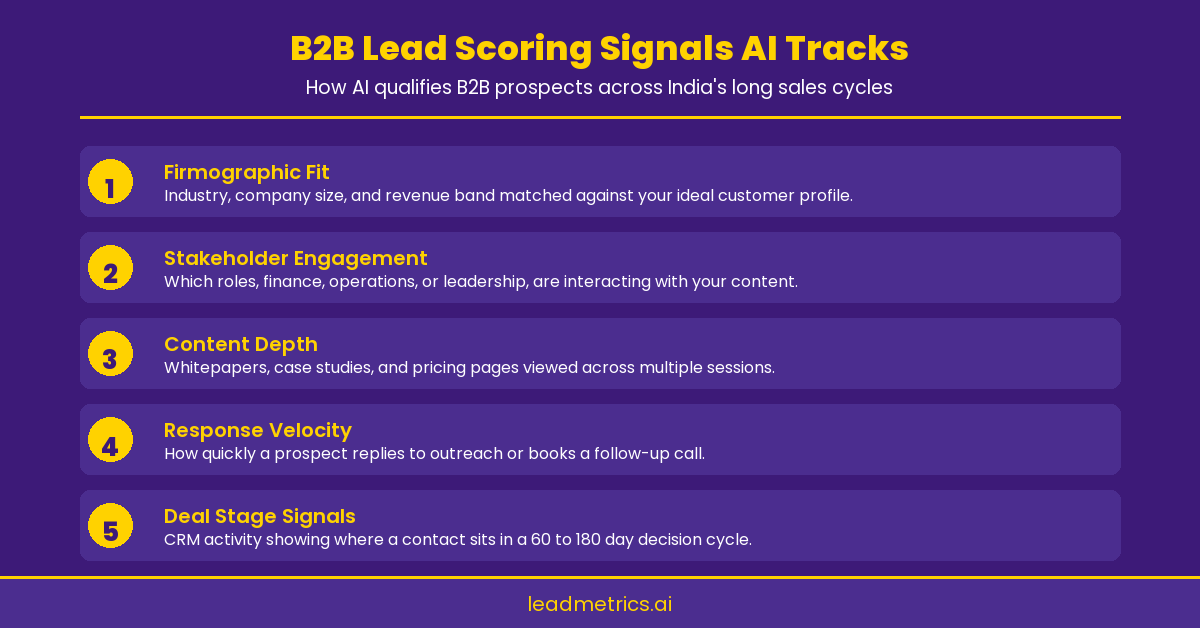
This account level view matters in India's B2B context because individual contacts often change roles or leave a deal mid cycle. When scoring tracks the account rather than a single person, a sudden change in personnel does not erase months of accumulated context about where the deal actually stands.
Nurturing sequences benefit from the same account level logic. Rather than sending identical follow-up emails to every contact at a company, AI tailors content to each stakeholder's role and engagement history. A finance lead receives ROI focused content, while a technical evaluator sees implementation detail, all triggered automatically as engagement signals shift across the buying committee throughout the cycle.
What to Look for in an AI Lead Generation Platform for B2B
A platform built for B2B India needs to handle multi-stakeholder accounts, long nurturing windows, and integration with the CRM your sales team already relies on. Point solutions that handle only paid ads or only email rarely give a complete picture of account engagement.
Look for a centralized dashboard that unifies paid search, SEO, and social engagement data into a single account view. Transparent attribution is just as important: if the platform cannot show which content, campaign, or stakeholder interaction moved a deal forward, your team cannot refine targeting with any confidence. Compare Leadmetrics plans against the combined cost of running separate point solutions for ads, SEO, and email to see where consolidation saves both budget and reporting time.
Nurturing flexibility matters too. A platform should let you build different sequences for different stakeholder roles within the same account, since the content a finance lead needs differs entirely from what convinces a technical evaluator or a senior decision maker.
Reporting cadence is worth checking before you commit to any platform. Sales leadership in B2B organisations typically needs a weekly view of account level movement, not a monthly export buried in a spreadsheet. If a vendor cannot demonstrate this in a demo, get in touch with the Leadmetrics team to see how a connected dashboard handles multi-stakeholder reporting in practice.
Measuring ROI for B2B Lead Generation Campaigns
Lead volume is a poor proxy for B2B success, since a single qualified account is worth far more than a hundred unqualified form fills. Cost per qualified account, measured against your ideal customer profile, gives a much clearer picture of campaign efficiency.
Lead to opportunity rate shows how many scored accounts actually progress to a genuine sales conversation. Sales cycle length reveals whether nurturing is successfully compressing the typical 60 to 180 day decision window common in Indian B2B procurement. Stakeholder coverage is a less common metric but equally valuable: tracking how many distinct roles within a target account have engaged with your content shows whether a deal has genuine organisational buy-in, or whether it remains dependent on a single champion who could leave or change priorities at any point. Channel attribution closes the loop, connecting paid campaigns and AI driven search visibility directly to closed revenue rather than top of funnel traffic alone.
Review these metrics monthly alongside your sales team, not in isolation. The most useful adjustments often come from combining what the AI model surfaces with frontline feedback from reps who are speaking to these accounts directly every week.
Benchmarking against comparable companies helps set realistic expectations. Reviewing client results from other B2B businesses operating in similar sectors gives sales leadership a grounded basis for forecasting, rather than relying on vendor projections that rarely account for India's specific procurement timelines and stakeholder dynamics.
Conclusion
B2B sales in India reward companies that can stay relevant across a long, multi-stakeholder decision cycle. AI lead generation makes that possible by scoring every account on real engagement, surfacing stalled deals early, and connecting paid, organic, and social channels into a single view. Whether your buying committees span manufacturing plants in Pune, fintech offices in Bangalore, or enterprise procurement teams in Delhi, the same principle holds: score the account, not just the contact, and let AI keep every stakeholder engaged until the deal is ready to close. Compare Leadmetrics pricing plans against your current marketing spend, or get in touch to build a lead generation strategy suited to your sales cycle.
Share on Social Media
Frequently Asked Questions
How does AI lead generation help B2B companies in India?

AI lead generation scores accounts on firmographic fit and stakeholder engagement, helping sales teams focus on prospects most likely to convert across India's typically long, multi-stakeholder B2B decision cycles.
Why do B2B deals in India take so long to close?
Most B2B purchases involve multiple stakeholders, including finance, operations, and senior leadership, each evaluating the decision from a different angle. This naturally extends the sales cycle to 60 to 180 days or more.
Can AI lead generation track multiple stakeholders within one account?
Yes. AI platforms build an account level view, tracking engagement from each contact separately while combining the signals into a single score that reflects overall organisational interest, not just one person's activity.
What channels work best for B2B lead generation in India?
Paid search captures active buyers, organic SEO reaches researchers earlier in their journey, and social media keeps your brand visible to stakeholders across a long evaluation period spanning several months.
How much does AI lead generation cost for a B2B company?
Pricing depends on account volume, channels used, and CRM integration needs. Compare Leadmetrics pricing plans to see how a unified platform compares with running separate tools for ads, SEO, and email.
Does AI lead generation work across different regions of India?
Yes. AI driven campaigns adjust targeting and messaging by region automatically, learning from local conversion patterns rather than applying one national template across markets that behave very differently.
How is AI lead scoring different from manual CRM qualification?
Manual qualification depends on a rep's notes after a call. AI scoring updates automatically in real time based on actual engagement, surfacing stalled or accelerating deals before a quarterly review would catch them.
What KPIs should B2B companies track for lead generation ROI?
Cost per qualified account, lead to opportunity rate, sales cycle length, and stakeholder coverage all matter more than raw lead volume when measuring B2B lead generation performance in India.
Can small and mid-sized B2B companies in India use AI lead generation?
Yes. AI lead generation scales to company size, and SMBs often see the biggest relative gain since automated scoring lets a small sales team manage a pipeline that would otherwise need significantly more headcount.
How do I start using AI lead generation for my B2B sales team?
Review your current sales cycle length and stakeholder patterns, then get in touch with the Leadmetrics team to discuss a scoring and nurturing strategy built around your specific buying committees.